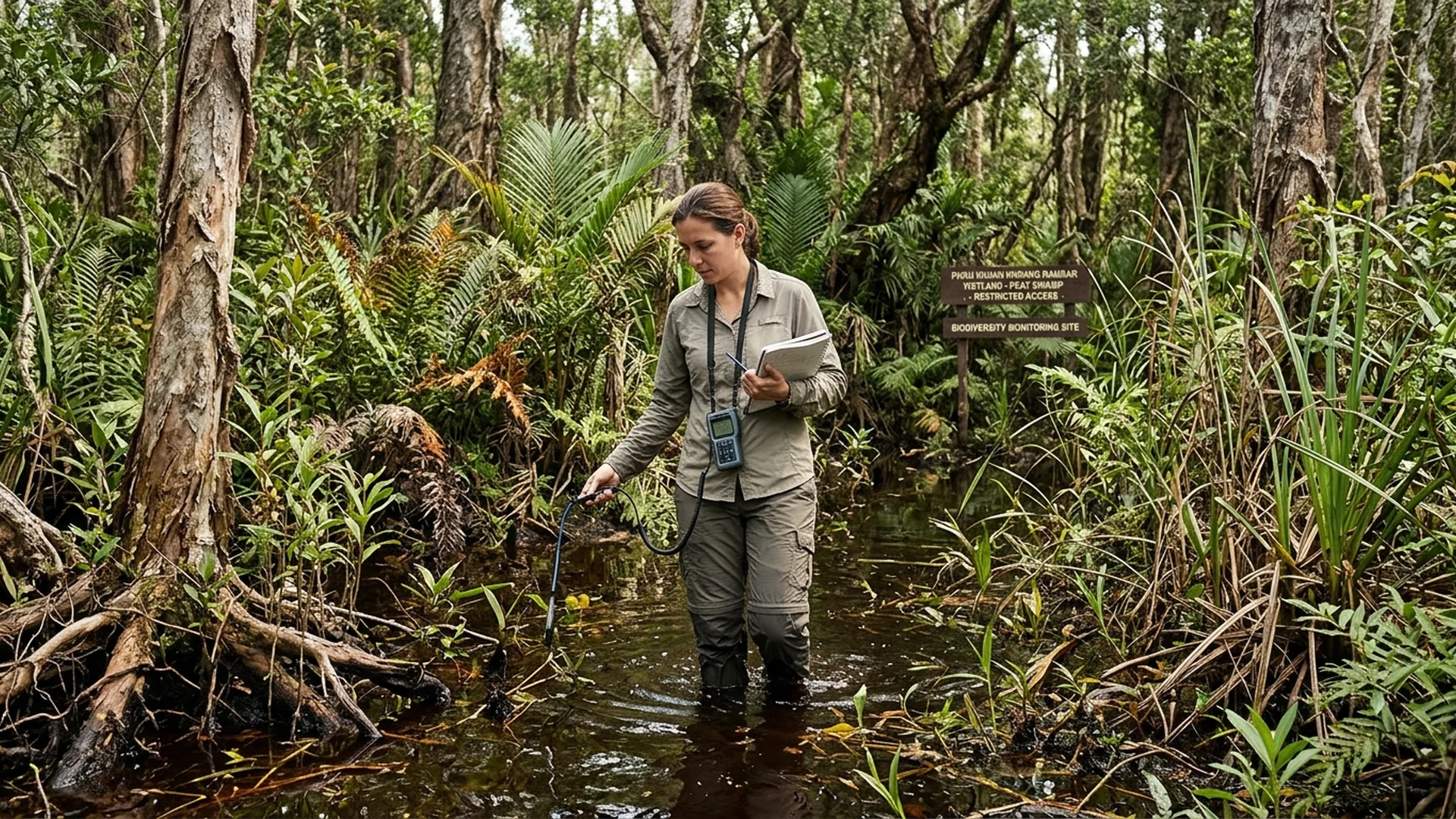
Deep within tea-colored waters reflecting a dense canopy of ancient flora lies a realm where time appears to slow its pace. Peat swamps and wetlands are far more than mere flooded timberlands; they operate as colossal green sponges and primeval air-purification sanctuaries that labor in silent magnificence. Amid morning mists and the earthy fragrance of decomposing organic matter accumulated over millennia, international wetlands—known as Ramsar Sites—act as ecological shields against global climate change while cradling delicate, breathtaking biodiversity.
Venturing into this primeval realm transcends standard ecotourism. It is a pilgrimage back to understanding the profound interconnection between water, earth, and the breath of our planet. Within this wall-less natural classroom, evolutionary marvels are quietly preserved, from breathing roots breaking the water’s surface to lush evergreen rainforests rooted in some of Southeast Asia’s densest peat deposits.
Respiration Beneath the Peat: The Carbon Sink Mechanism
Beneath the tranquil canopy of the peat swamp lies a dense accumulation of organic matter transformed over ages into peat. Unlike conventional terrestrial forests, peatlands sequester carbon through a uniquely slow pathway. Plant and animal debris falling into oxygen-depleted, highly acidic waters decomposes at a remarkably sluggish pace. Consequently, carbon is locked deeply within subterranean strata rather than escaping into the atmosphere. To ecologists, these wetlands act as nature’s ultimate vault, securely sequestering greenhouse gases. Preserving these waterlogged expanses is therefore every bit as critical as safeguarding ancient rainforests, preventing dormant carbon from returning to the skies.
Toa Daeng and Thale Noi: Living Museums of Ramsar Wetlands
Among Thailand’s wetland sanctuaries, the Toa Daeng Peat Swamp Forest in Narathiwat stands as the country’s last remaining pristine lowland peat expanse. It serves as a sanctuary for rare botanical species, featuring stilt roots and pneumatophores that thrust upward like natural sculptures. Meanwhile, in Phatthalung, Thale Noi—recognized as Thailand’s inaugural Ramsar Site—demonstrates the intricate interplay between freshwater lakes, vast lotus expanses, and the traditions of local water buffalo herding. These landscapes function as natural flood moderators, biological filters, and vital nurseries for countless aquatic species dependent on seasonal tidal and monsoon rhythms.
The Fragility of Equilibrium: When Wetlands Face Transformation
The wonder of the peat swamp ecosystem is matched only by its profound fragility. Whenever these wetlands face disturbance through drainage for agricultural conversion or prolonged droughts that lower the subterranean water table, dried peat transforms into volatile tinder. This can ignite stubborn subterranean fires that are extraordinarily difficult to extinguish, releasing colossal quantities of carbon into the atmosphere overnight. Comprehending these intricate ecosystems and supporting sustainable wetland management is not merely an academic pursuit; it is an indispensable key to preserving regional and global hydrological security.