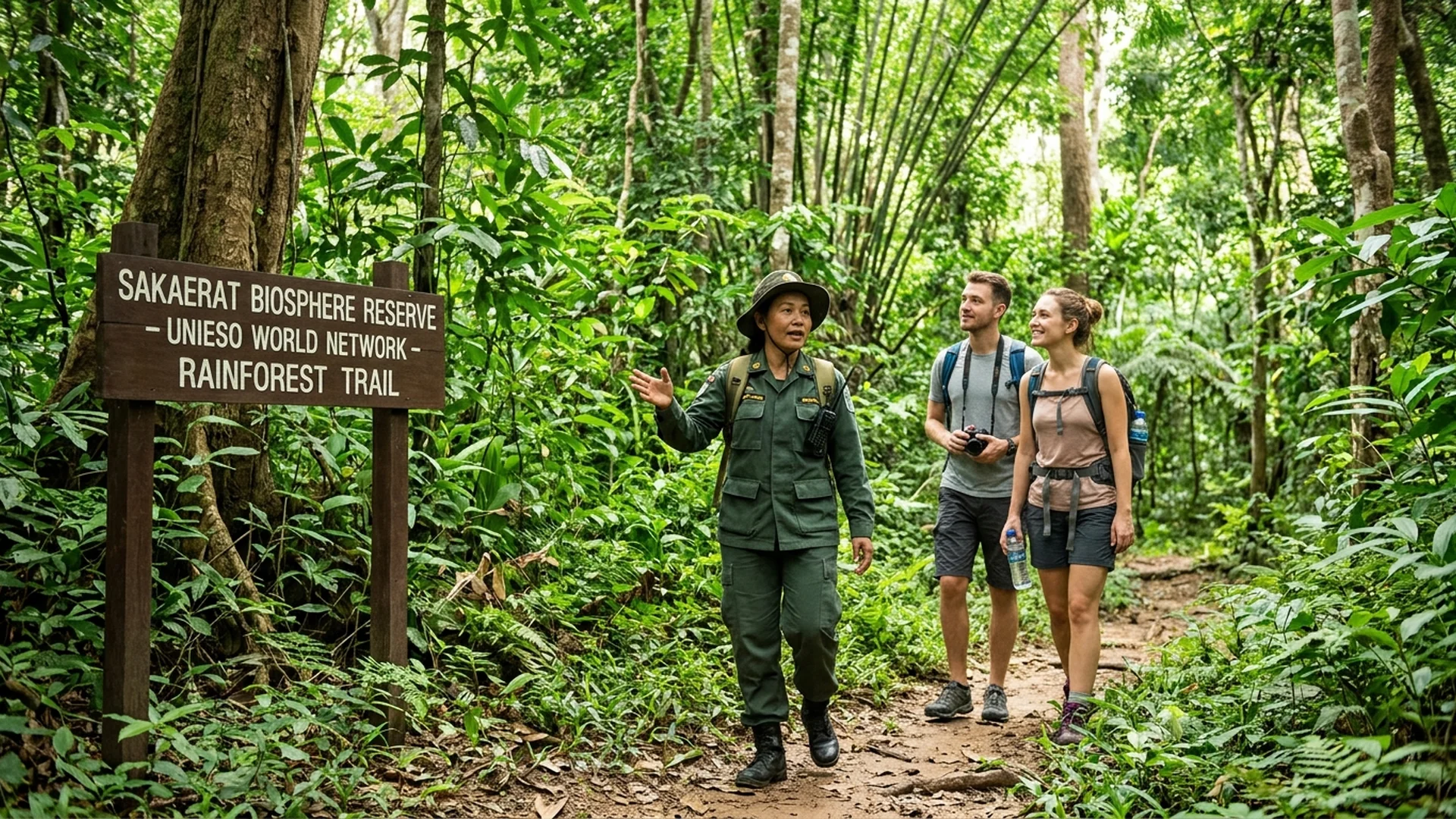
Amidst the relentless tide of modern tourism crashing against ancient forests and highland peaks, a select group of international ecological sanctuaries in Thailand serves a much deeper purpose than mere picturesque escapes. They function as sprawling living laboratories under the stewardship of UNESCO, safeguarding the fundamental ecological machinery of our planet.
Biosphere Reserves are far from sealed enclosures exclusionary to humankind. Instead, they represent a fascinating model weaving biodiversity conservation together with the livelihoods of indigenous communities through systematic zoning. From deeply guarded central cores to outer transition zones where humans learn to coexist without devastation, journeys into these realms transcend conventional nature travel. They are intellectual pilgrimages designed to help us truly understand the breathing rhythm of our living world.
Decoding the Three-Tiered Structure: The Heart of Biosphere Management
A genuine understanding of Biosphere Reserves under UNESCO’s Man and the Biosphere (MAB) Programme requires visualizing a three-tiered overlapping structure engineered to balance humanity and nature. The innermost tier is the Core Zone, characterized by strict protection as undisturbed wilderness where natural processes unfold autonomously, serving as an irreplaceable genetic reservoir for flora and fauna. Surrounding the core is the Buffer Zone, designated for scientific research, ecotourism, and non-destructive activities. The outermost layer, the Transition Zone, accommodates local human settlements, sustainable agriculture, and everyday community life under guided stewardship. This sophisticated administrative framework proves that humanity can act as the finest guardian of the forests when equipped with an understanding of natural boundaries.
Sanctuaries of Life: Exploring Biodiversity from Sakaerat to Doi Chiang Dao
Thailand takes immense pride in its globally recognized biosphere reserves, each possessing distinct ecological characteristics. Beginning at the Sakaerat Environmental Research Station in Nakhon Ratchasima, we encounter the epitome of lush dry evergreen and deciduous dipterocarp forests, serving as critical habitats for rare flora like the giant banyan and hornbills. Moving southward, the Ranong Mangrove Forest forms a massive coastal ecosystem vital as a marine nursery and a significant carbon sink. Further adding to this ecological crown is Doi Chiang Dao in Chiang Mai province, a towering limestone massif harboring rare semi-alpine plants left over from the ice age, establishing it as one of Southeast Asia’s most invaluable botanical classrooms.
The Threshold of Coexistence: How Local Wisdom Shields Three Forests
The defining characteristic elevating Thailand’s biosphere reserves is the seamless integration of indigenous wisdom with conservation mandates. In locales like Huai Tak, Mae Sa, and the surrounding forests of Sakaerat, local communities do not view the forest as a restrictive barrier, but rather as an expansive ancestral home demanding careful stewardship. Traditional foraging practices, agroecology, and ancient wildfire management techniques serve as critical cogs maintaining the surrounding ecosystem’s robust health. Consequently, traveling to these sanctuaries invites modern visitors to relearn the long-forgotten ‘science of reliance’ upon the natural world.