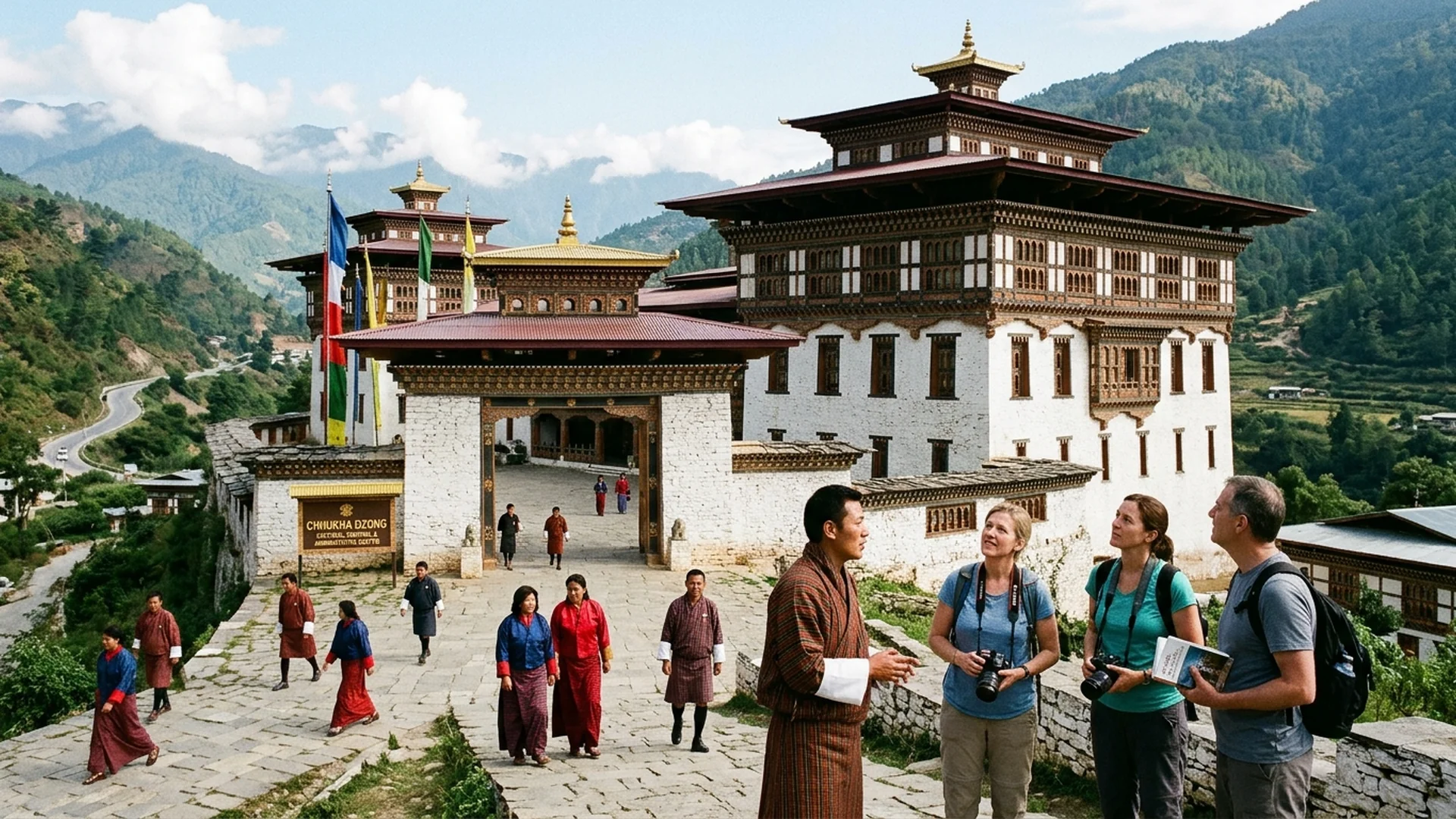
Along the strategic mountain artery that winds upward from the southern border town of Phuentsholing toward the sacred heart of the Thunder Dragon Kingdom in Thimphu, the unfolding drama of plunging gorges and the rushing Wang Chhu river commands the traveler’s gaze. Yet amidst the tranquil, sub-tropical forests of Tsimasham, a brilliant whitewashed fortress rises with commanding grace. Chhukha Dzong, formally consecrated as Ngoedrup-Tse Dzong, stands as a magnificent sentinel that exquisitely mirrors Bhutan’s transcendent journey from ancient legacy into the 21st century.
While the vast majority of Bhutan’s storied dzongs trace their origins back to the 17th century under the visionary hand of Zhabdrung Ngawang Namgyel, Chhukha Dzong holds a distinct place of honor as a premier modern dzong. Completed and consecrated with supreme state honors in 2012 in the presence of Her Majesty Queen Jetsun Pema and the Je Khenpo, the nation’s Chief Abbot, this sanctuary shatters the notion that traditional Bhutanese master-craftsmanship is confined to antiquity. Instead, it proves that the breathing, sacred arts of the kingdom continue to thrive with undiminished vitality in the modern era.
Visiting Chhukha Dzong transcends a mere roadside pause; it serves as a portal into an unseen dimension of Bhutan. Here, travelers encounter a profound harmony between fortified structural resilience, exquisite woodcarving and murals executed under the strict canons of Zorig Chusum (the thirteen traditional arts), and a profound serenity far removed from the thrum of mass tourism—offering a deeply contemplative, intellectual aesthetic for the discerning global wanderer.
Architecture of the 21st Century: The Living Breath of Zorig Chusum in a New Paradigm
The commissioning and construction of a dzong in Bhutan is at once an architectural feat and a deeply spiritual undertaking. Groundbreaking and site preparation for Chhukha Dzong began in the early 2000s to establish a modern administrative and monastic hub that could better serve the growing region. Spanning an expansive 9.8 acres, the complex was meticulously designed to honor ancient canonical architecture. Its primary edifices feature striking battered walls—stone masonry tapering gracefully upward toward thick white plaster—engineered to provide exceptional structural equilibrium and seismic resilience in the volatile Himalayan terrain.
What continuously captivates architecture aficionados is the unwavering dedication to Zorig Chusum, the thirteen traditional arts of Bhutan, employed throughout its creation. Intricate wooden beam structures and traditional window frameworks, known as rabsel, are masterfully joined using ancient interlocking mortise-and-tenon techniques without a single metal nail. Crowning the exterior walls are deep crimson bands of khemar, signifying sacred ground, while the central utse tower is capped by a radiant serthog pinnacle that catches the alpine sunlight. Chhukha Dzong thus stands as a contemporary testament that Bhutanese architectural heritage is not a static museum piece, but a living, evolving art form.
The Strategic Waters of Wang Chhu: A Bridge Between Southern Culture and the Royal Valleys
Chhukha District represents one of the nation’s most vital economic and strategic corridors, housing immense hydroelectric infrastructure that powers the country while carrying the primary arterial highway linking Phuentsholing at the Indian border to Thimphu and Paro. Chhukha Dzong occupies a commanding vantage point on a verdant ridge within Tsimasham, gazing down into the roaring emerald torrents of the Wang Chhu river as it snakes through towering forested canyons.
This dramatic geography offers more than just sweeping, contemplative panoramas; it acts as a subtle cultural threshold. Travelers journeying overland experience a distinct geographical metamorphosis—ascending from the humid, semi-tropical lowlands of the south into the crisp, crystalline air of the high inner Himalayas. Chhukha Dzong serves as the quintessential first milestone welcoming visitors with the quiet majesty and profound spiritual gravity characteristic of the high mountain realm.
Sanctuary of Governance and Spirit: Experiencing Local Rhythms and the Chhukha Tshechu
In true Bhutanese fashion, Chhukha Dzong operates upon the ancient dual system of governance, dividing its spatial architecture neatly between secular administration—housing the offices of the Dzongda (District Governor)—and the monastic quarters, where resident monks pursue their spiritual disciplines. Within its spacious central courtyard, known as the dochey, an atmosphere of profound stillness prevails, punctuated only by the soft murmur of low-register chants and the delicate drift of burning juniper incense.
For cultural connoisseurs timing their journey for the autumn months, the dzong plays host to the annual Chhukha Tshechu, a sacred mask dance festival performed in reverence to Guru Rinpoche. Villagers from across the surrounding valleys gather in their finest handwoven ghos and kiras to witness mesmerizing cham dances, such as the Shinje Pho Mo Cham and Nyilima Cham, alongside the rare unfurling of a monumental thongdrel religious tapestry at first light. Untouched by the commercialization found in busier destinations, the festival offers an unvarnished window into the pure faith and vibrant communal heart of rural Bhutan.