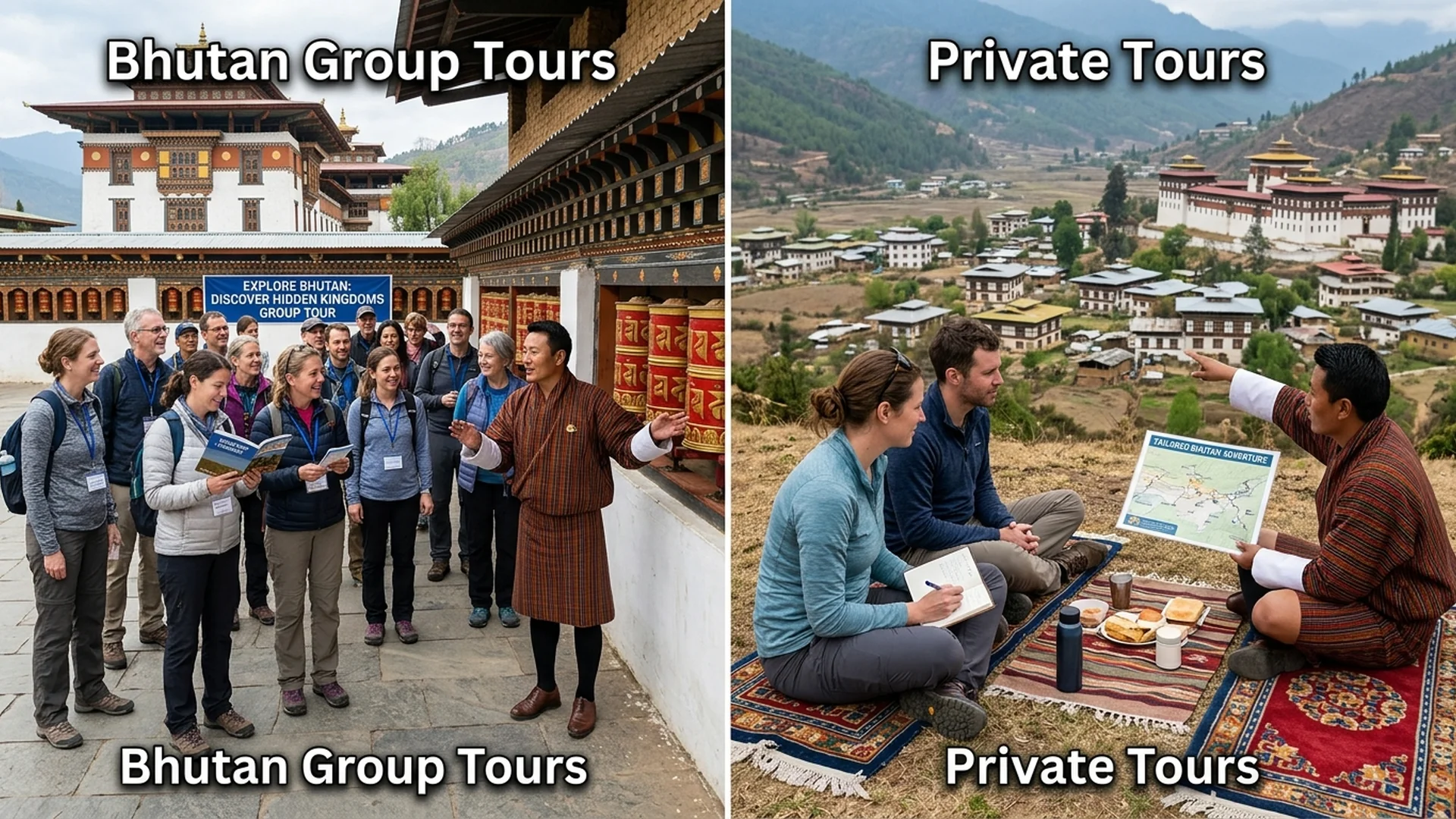
As the morning mist lifts across the verdant terraces of the Punakha valley, discerning travelers realize that every step through this sovereign realm of Gross National Happiness (GNH) is anchored in a profound philosophy of high-value, low-impact tourism. Entering the Kingdom of Bhutan today transcends conventional vacation planning; it represents an intellectual and sensory investment governed by the Sustainable Development Fee (SDF) of USD 100 per night.
With this foundational cost standardized across the board, the strategic question for luxury travelers and families is no longer merely budgetary. Rather, it centers on choosing between a group tour and a private tour—discerning which architectural framework will extract the absolute highest value from your pilgrimage to Paro Taktsang (Tiger’s Nest) while honoring your personal rhythm of contemplation and discovery.
Decoding the Financial Architecture: SDF and Ground Costs
The cornerstone of traveling through Bhutan lies in distinguishing between mandatory government levies and commercial ground services, which encompass private guides, chartered vehicles, and accommodations. Because the SDF remains fixed at USD 100 per person per night through August 2027, this foundational financial commitment remains constant regardless of your chosen itinerary style.
Consequently, the variance rests entirely within ground logistics. Opting for a join-in group tour effectively divides the daily expenses of expert guides, private drivers, and luxury multi-purpose vehicles among fellow travelers, substantially lowering overall expenditures. This approach suits those who appreciate streamlined organization and collegiate camaraderie. Conversely, a private tour incurs higher per-person overheads for dedicated transport and exclusive guiding, yet yields absolute sovereignty over your itinerary—a true measure of personalized value.
Footsteps and Breath: Pacing Flexibility at Tiger’s Nest and Beyond
The iconic silhouette of Paro Taktsang, clinging precipitously to a granite cliff face 900 meters above the valley floor, serves as a profound physical and spiritual touchstone for every pilgrim. Here, the distinction between group and private travel crystallizes around the concept of pacing flexibility.
Within a structured group tour, experiences are inherently tethered to a collective schedule. The cohort moves in unison, adhering to a shared timeline designed to accommodate the majority. Should you experience altitude fatigue or wish to linger in golden morning light to capture the ethereal architecture, rigid group timetables can introduce subtle pressure. A private journey, however, allows your dedicated guide to intuitively calibrate each walking interval to your physical stamina. Whether you wish to pause indefinitely at a panoramic overlook or pivot on a whim from monastic architecture to an unhurried forest trail, the day bends entirely to your desires.
Dimensions of Exclusivity: From Ultra-Luxury Sanctuaries to Private Blessings
For discerning travelers seeking the pinnacle of refinement, Bhutan offers much more than pristine Himalayan topography. It serves as the custodian of legendary hospitality houses such as Amankora and Six Senses, whose properties span disparate, enchanting valleys. Staying within these havens invites bespoke lifestyle curation, from traditional stone bath therapies (dotsho) to starlit dinners framed by the stone ruins of 17th-century fortresses.
Private touring facilitates intricate coordination with these sanctuaries and local communities. It opens doors to intimate spiritual audiences, such as arranging a private prayer ceremony with high-ranking lamas—sanctuaries of contemplation that larger tour cohorts cannot easily navigate due to logistical constraints and formal protocols.