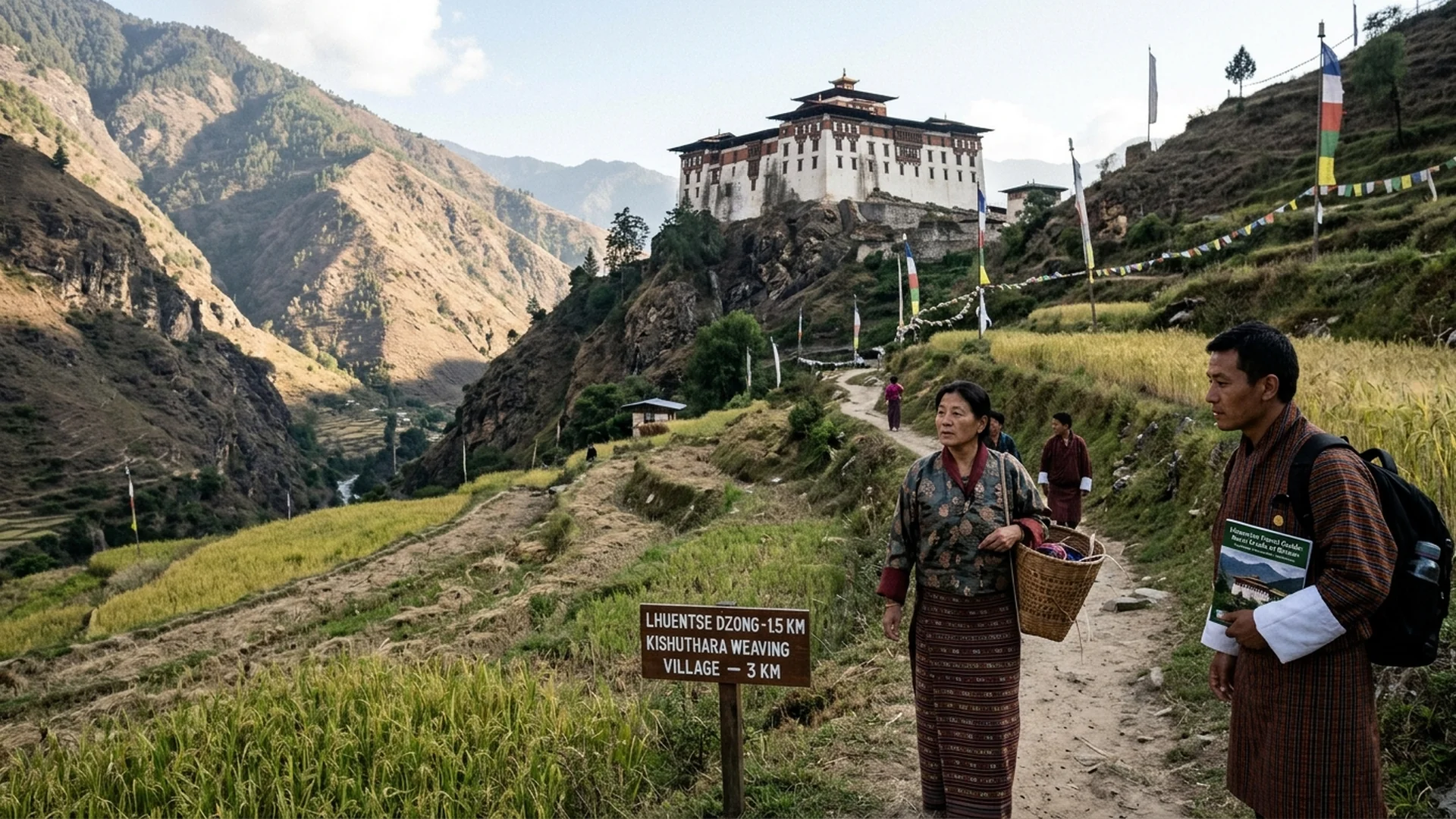
As time flows unhurriedly through the intricate, mist-veiled valleys of eastern Bhutan, the rhythmic clack of wooden looms from remote hillside dwellings still resonates like an ancient hymn. Lhuentse remains a hidden gem untouched by the swift currents of modernity. This sovereign sanctuary is far more than a mere destination; it is the spiritual cradle and venerable historical current intricately bound to the origins of the Wangchuck dynasty, the enlightened monarchs of the Kingdom of Gross National Happiness.
Traversing into the embrace of Lhuentse leads travelers along winding mountain paths, dense virgin forests, sheer precipices, and the crystalline currents of the Kuri Chhu. The enveloping atmosphere is steeped in a profound tranquility rarely found in western valleys like Paro or Thimphu. Here, Vajrayana Buddhism and sublime craftsmanship merge into a singular creative expression, weaving timeless narratives through intricately patterned silk and ancient sanctuaries that proudly defy the centuries.
Lhuentse Dzong: The Cliffside Fortress and Sacred Royal Cradle
Lhuentse Dzong stands with quiet majesty upon a narrow mountain spur cascading down to the valley floor, embraced by the rushing torrents of the Kuri Chhu. Originally established in the 17th century by Kunga Wangpo—son of Pajo Drugom Zhigpo, who introduced the Drukpa Kagyu lineage to Bhutan—the fortress was later restored and renamed by Desi Tenzin Rabgye.
The supreme significance of Lhuentse Dzong extends far beyond its quintessential Bhutanese architectural mastery. This sacred enclave is the ancestral home of the Wangchuck dynasty; the forebears of Bhutan’s first king maintained deep, enduring ties and governance over these rugged highlands for generations. The serene ambiance within the dzong’s courtyards, the gentle chanting of resident monks, and ancient murals evoke a living current of devotion entirely free from the bustle of mass tourism, casting a tranquil, spellbound hush over every visitor.
Khoma Village and the Art of Kishuthara: Royal Court Weaving
Venturing deeper into Lhuentse’s secluded valleys reveals Khoma Village, an intimate agrarian community universally revered as the epicentre of Kishuthara, the most complex and breathtaking brocade silk weaving in the kingdom. Weaving here transcends mere vocation; it is an unbroken generational inheritance, with young girls mastering the backstrap loom as early as age eight.
Creating a single Kishuthara textile demands extraordinary patience. The intricate Thrima technique—involving discontinuous supplementary weft patterning—creates three-dimensional geometric and floral motifs that resemble fine embroidery. Silk threads are painstakingly dyed with natural pigments and interwoven strand by strand into stunning Kira garments reserved for premier national festivals and state ceremonies. Visiting Khoma Village and engaging with master artisans in their native homesteads offers a cultural intimacy and aesthetic depth that cannot be replicated anywhere else.
Takila Guru Statue: Monumental Sacred Art in the Tangmachu Valley
Crowns of the Tangmachu ridge in Lhuentse cradle the Takila Guru Statue, universally known as the Guru Nangsi Zilnon—a colossal 154-foot effigy of Guru Rinpoche that ranks among the largest statues of the Second Buddha in the world. This monumental sanctuary was constructed in accordance with ancient prophecies to radiate boundless peace, protective grace, and prosperity across the Himalayan realms.
The golden statue shimmers brilliantly against azure skies and rolling mountain vistas, surrounded symmetrically by eight grand stupas and one hundred and eight minor chortens aligned with cosmic geometry. Standing upon this elevated courtyard amid crisp alpine air and drifting mist invites a moment of quiet introspection and an overwhelming encounter with living faith.