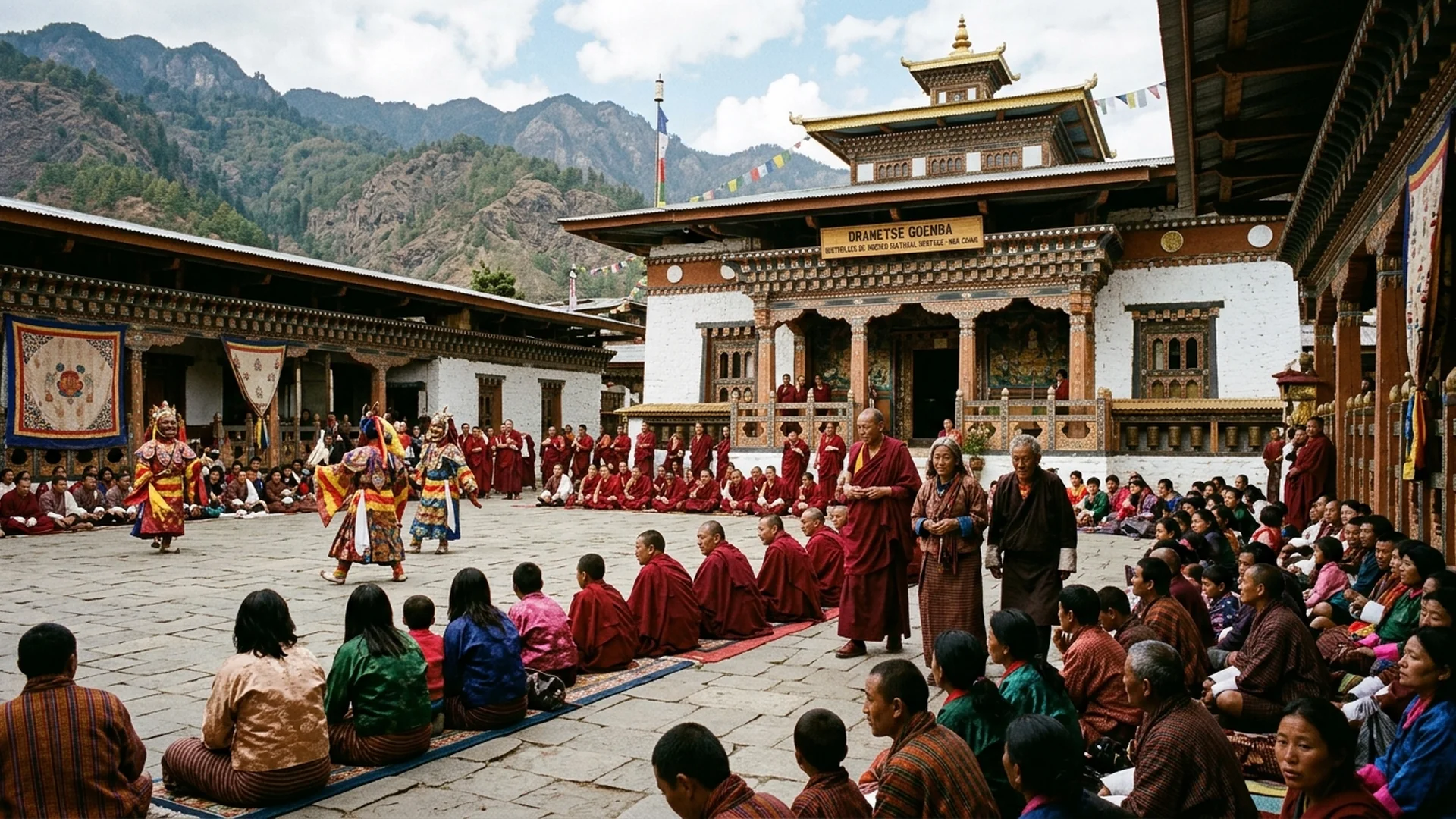
As one navigates the labyrinthine mountain passes of eastern Bhutan, dense veils of mist gradually part to reveal a striking vision: an ancient monastery standing resolute upon an isolated ridge, appearing almost suspended in the azure expanse. This is Drametse, a sacred toponym whose poetic Dzongkha translation translates to ‘the peak of the enemy-free heights.’ Far beyond a mere historical monument, this revered sanctuary serves as the pulsating spiritual core of the eastern valleys, where time slows its relentless march, inviting discerning travelers to commune with pristine tantric Buddhism and roots untouched by the frenetic cadence of modernity.
Journeying to Drametse Goemba within the Mongar district represents a pinnacle pilgrimage for cultural connoisseurs yearning to access the authentic essence of Bhutan’s eastern highlands. Here, profound silence articulates grand narratives, and every footstep resonates with an unbroken lineage of devotion spanning over half a millennium.
Lineage of Faith: The Visionary Creator of the Enemy-Free Peak
Drametse Goemba was established in 1511 under the devout patronage of Ani Chhoeten Zangmo, an accomplished spiritual master and direct blood descendant of Pema Lingpa, one of Tibetan Buddhism’s most revered treasure revealers. According to local lore, she selected this commanding summit for its absolute tranquility, rendering it ideal for profound meditation. The moniker ‘Drametse’ was bestowed to signify a realm liberated from inner turmoil, hostility, and all adversarial forces.
The monastery’s vernacular architecture mirrors classical Bhutanese design harmonizing seamlessly with its dramatic topography. Hand-carved timber elements, thick compacted-earth walls, and wind-tossed prayer flags act as ethereal bridges between the earthly realm and celestial spheres. Crossing the threshold into the sanctum, the rich aroma of burning yak butter mingles with the resonant, subterranean chanting of resident monks, forging an atmosphere of immense spiritual gravity.
Drametse Ngacham: The Sacred Drumbeat Reverberating Globally
On an international scale, Drametse holds profound renown as the cradle of the Drametse Ngacham, or the Dance of the Drums of Drametse, recognized by UNESCO in 2005. Far more than mere folklore, this performance is a sacred ritual embodying the celestial pure land of Guru Rinpoche.
During auspicious monastic festivals, or Tshechus, monks don terrifying yet majestic masks representing protective deities and fierce animals while bearing large wooden drums. Their powerful, synchronized movements symbolize the subjugation of negative forces and ego. The echoing cadence of these drums across the Drametse gorge serves as a resonant alarm, awakening dormant human consciousness from the illusions of samsara.
Sanctuary of Silence: Sacred Artistry Within the Inner Sanctum
Within the primary sanctum, Drametse safeguards irreplaceable antiquities seldom witnessed in western Bhutan. Gilt-bronze images of Pema Lingpa and various deities rest upon sacred altars, meticulously preserved across generations by the monastic community. Ancient murals illustrating jataka tales and wrathful protectors retain their mineral brilliance, casting a warm luminescence when afternoon light pierces through narrow clerestory windows.
To stand quietly before these sacred stpas and shrines yields an unhurried, meditative stillness unattainable within commercialized itineraries. It remains an exquisite opportunity for global travelers to introspect amidst the vast, unaltered grandeur of the eastern mountains.