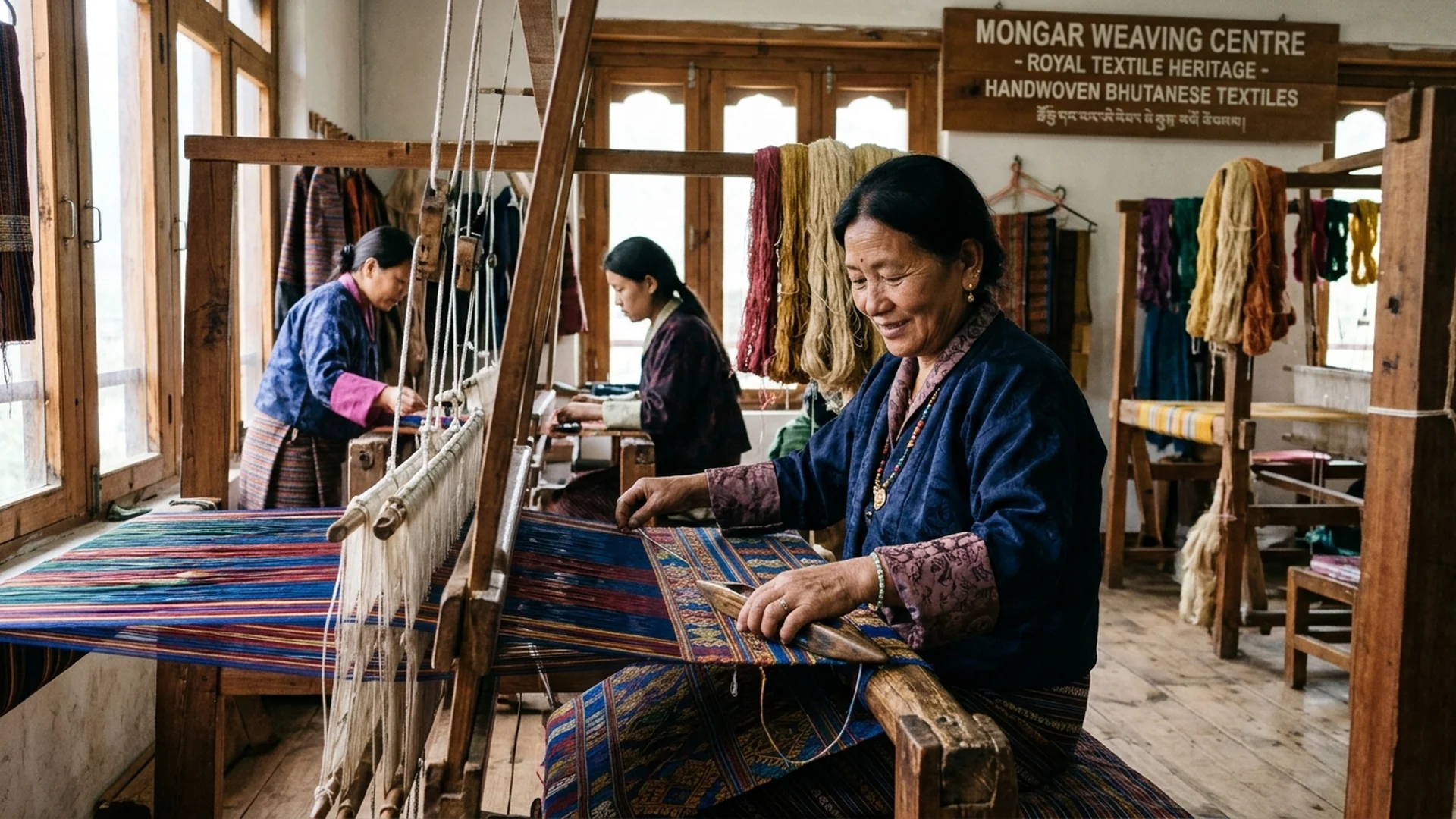
As the morning mist slowly dissipates over the undulating ranges of eastern Bhutan, the gentle, rhythmic clatter of ancient wooden looms begins to articulate a song of enduring time. Within the warm embrace of vernacular architecture, the Mongar Weaving Centre stands as a sanctuary where time appears to decelerate, allowing the soulful mastery of female artisans to radiate timeless beauty through natural fibers.
Crossing the threshold from the familiar sanctuaries of the western valleys into the remote expanses of the east is akin to turning the pages of an unwritten manuscript. For discerning global travelers captivated by deep cultural immersion, this is far more than a mere destination; it is a living museum reflecting the zenith of artisanal mastery, where ancestral beliefs, sacred motifs, and daily rhythms are meticulously rendered onto handwoven textiles with peerless devotion.
The Aesthetics of the Backstrap Loom and the Breath of Botanical Dyes
Behind every textile curated and brought to life within the Mongar Weaving Centre lies a meticulous genesis, beginning with the careful selection of raw natural fibers and botanical dyes harvested from indigenous flora, barks, and heartwoods. The ancestral wisdom of indigo dyeing, rich yellows derived from wood cores, and earthen reds imbues Mongar textiles with an organic vibrancy—hues that possess extraordinary depth and shift dynamically under natural alpine light. Female master weavers continue to honor the ancient discipline of the backstrap loom, a heritage requiring supreme physical stamina, precise balance, and absolute meditative focus. Each passage of the shuttle and tightening of the warp is not merely production, but a moving meditation reflecting the harmonious covenant between humanity, nature, and the sacred.
Kishuthara and Trima: The Pinnacle of Haute Silk Artistry
To speak of the crown jewels of Bhutanese textiles is to invoke the breathtaking splendor of Kishuthara silk and the intricate supplementary-weft pickup technique known as Trima. These represent rare forms of haute handcrafts rarely witnessed in contemporary global luxury. Within this sanctuary, master artisans dedicate months—and occasionally upwards of a year—to delicately hand-select individual silk threads, weaving complex geometric and auspicious motifs with astonishing intricacy. The tactile, raised dimensionality of these motifs against dense silk foundations reflects advanced techniques historically preserved exclusively within royal artisan lineages and traditional eastern Bhutanese communities.
Passing the Thread of Wisdom Across Generations
Mongar serves not merely as an eastern frontier outpost, but as a beating heart of robust textile culture. Inside the weaving center, visitors are welcomed by the proud smiles of practitioners spanning generations: from venerable elder craftswomen possessing encyclopedic knowledge of archaic patterns to perceptive youth absorbing intellectual property destined to outlive modernity. A pilgrimage here invites travelers into intimate dialogues with the very custodians of these traditions, revealing the theological symbolism and Buddhist cosmological narratives woven silently into the fabric—insights no literary volume could ever fully capture.