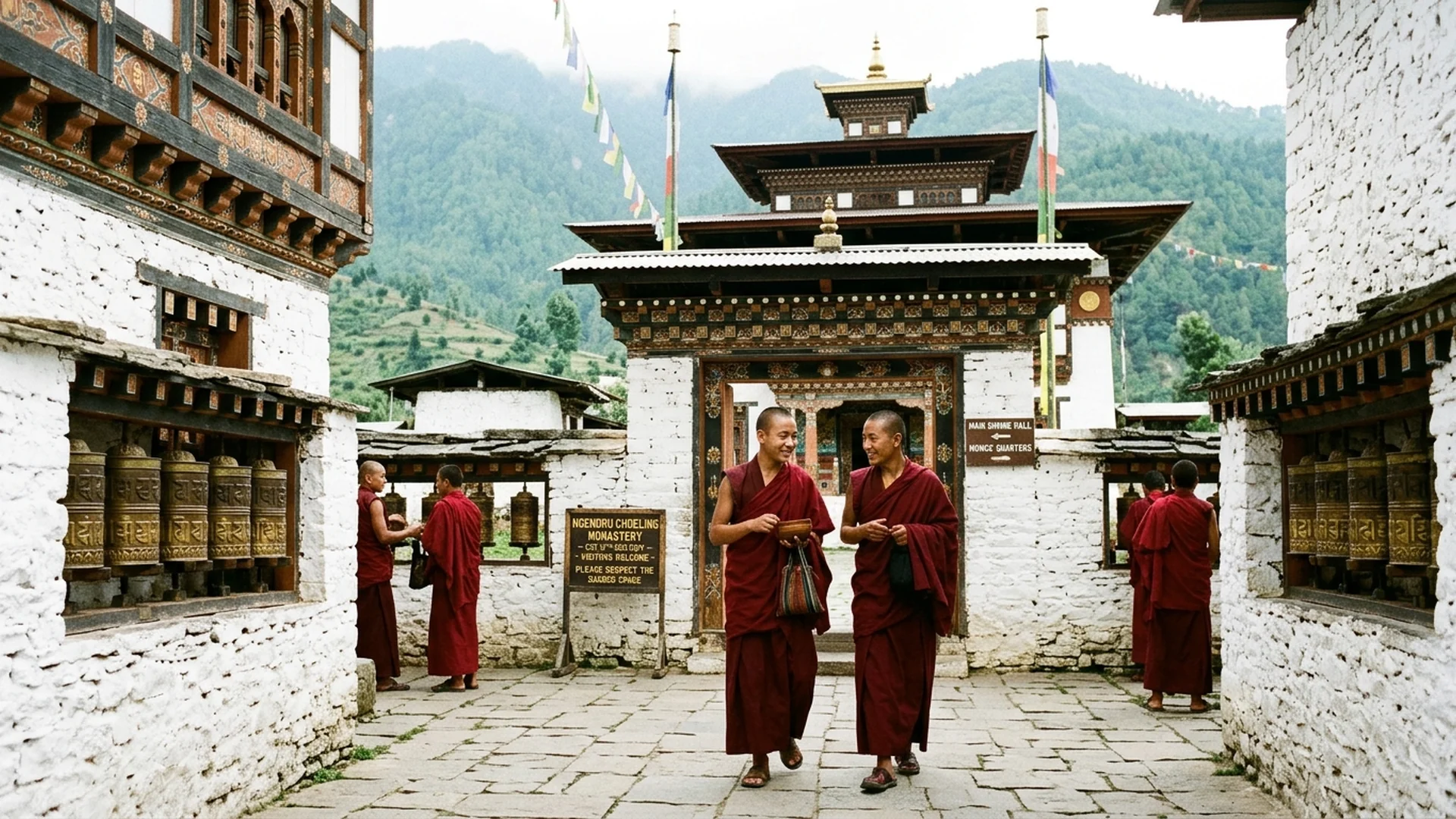
Step far beyond the familiar itineraries of western Bhutan and venture into the remote embrace of Ngendru Choeling Monastery, a sanctuary where ancient Vajrayana faith and timeless stillness converge. Here, amid the undulating contours of the eastern valleys, the clamor of the modern world dissolves entirely, replaced by the rhythmic chanting of monks and the rustle of mountain winds through venerable timber.
As morning mist slowly lifts from the high-altitude ravines, the monastery emerges like a vision preserved from another era. This is a landscape where time unspools at a gentler, more contemplative pace, inviting the discerning traveler to forge a profound, unhurried connection with nature and sacred tradition.
To journey to Ngendru Choeling is not merely a physical displacement across Himalayan passes; it is an inward pilgrimage. It offers an encounter with the living architecture of devotion and the radiant, compassionate gaze of communities whose daily existence remains harmoniously attuned to the dharma and the mountain peaks.
Vajrayana Architecture and Living Heritage: A Sanctuary Carved in Faith
The structural composition of Ngendru Choeling Monastery reflects centuries of traditional Bhutanese craftsmanship, seamlessly uniting intricate woodcarvings, sacred Buddhist iconography, and robust stonework engineered to withstand the shifting mountain elements. Within the main prayer hall, the air is thick with the soothing scent of clarified yak butter and indigenous herbal incense. Soft candlelight flickers against gilded statues and ancient thangkas—traditional scroll paintings that visually articulate the cosmological narratives and paths to enlightenment cherished by the Drukpa Kagyu lineage, the spiritual bedrock of the kingdom.
An Unhurried Life Among Eastern Valleys: The True Pulse of Serenity
The defining characteristic of eastern Bhutan is its raw, unadorned topography and a rhythm of life untouched by hyper-modernity. Around the grounds of Ngendru Choeling, travelers witness the daily routines of monks and young novices dedicated to the quiet study of Buddhist scriptures. Existing within the profound quiet of this valley offers visitors a transformative perspective: that enduring fulfillment is born not from material accumulation, but from self-awareness and absolute presence in the unfolding moment.