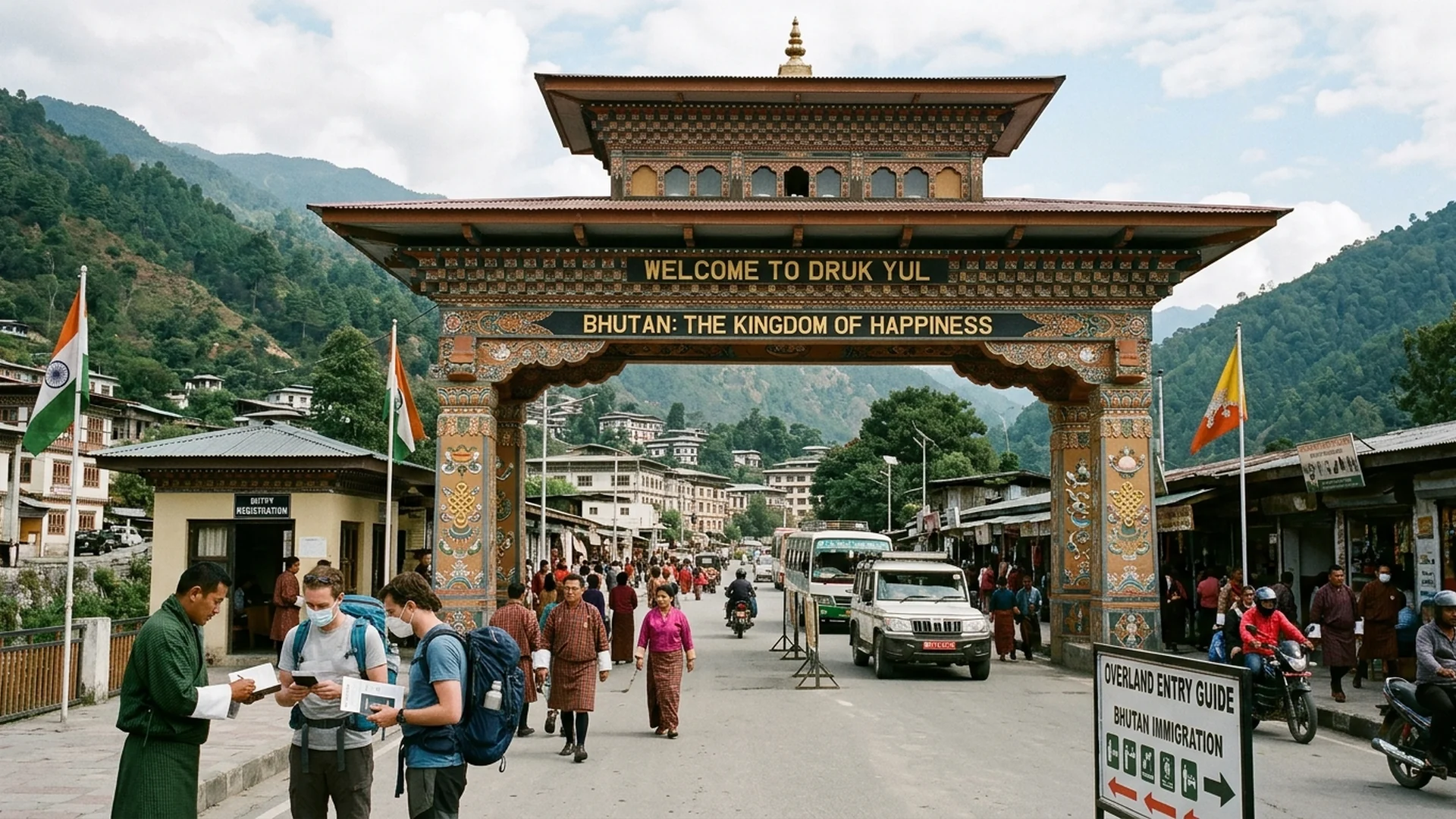
Few territorial thresholds on Earth possess the power to shift time, sound, and consciousness with a single footstep. The Phuentsholing Gate, often revered as the Dragon Gateway, stands as a mesmerizing seam between the vibrant spice-scented chaos of Jaigaon in India and the tranquil, meticulously ordered, and architecturally sublime Kingdom of Bhutan.
Standing before the pristine white archway, adorned with intricate traditional woodwork and ancient Buddhist iconography, the clamor of the streets behind dissolves behind a veil of spiritual stillness. This is far more than a standard overland immigration checkpoint; it is the opening movement of an unhurried symphony, inviting the traveler to draw a deep, grounding breath and attune their rhythm to a nation governed by Gross National Happiness (GNH).
Architecture of Faith: Deciphering the Symbolism of the Phuentsholing Arch
The Phuentsholing Gate was never conceived merely as a territorial boundary marker. Instead, it stands as a masterwork of traditional craftsmanship that mirrors Vajrayana Buddhist cosmology. Built with a robust concrete core clad in exquisite timber carvings echoing the grand style of a Dzong (fortified monastery-fortress), the arch is illuminated by sacred pigments and auspicious motifs. Citing mythical dragons, rolling cloudscapes, and blooming lotuses, the intricate carvings speak eloquently of divine protection and inner purity. To contemplate these delicate details under the soft morning light is to initiate a silent dialogue with the enduring spirit of Bhutan.
The Seam of Two Worlds: From Cacophony to Quietude
The most arresting aspect of entering Bhutan overland through the Phuentsholing Gate is the sharp, undeniable cultural transition. The moment you cross the painted line, the dust and urgency of the Indian border town yield gracefully to immaculate cleanliness. Urban architecture here is strictly governed by national zoning laws to preserve indigenous aesthetics, and citizens walk in traditional attire—the knee-length ‘Gho’ for men and the ankle-length ‘Kira’ for women. The profound quiet that settles over the surroundings reflects a deep-seated social discipline and reverence for the environment, forming the bedrock that makes Bhutan a cherished dream for discerning global travelers.
Cultural Heartbeats Near the Portal: First Impressions of Phuentsholing
Though Phuentsholing functions primarily as a frontier town, it is imbued with sacred spaces that reward the mindful traveler seeking to acclimatize body and spirit. Begin at the Zangto Pelri Lhakhang (temple), a serene urban sanctuary and park that symbolically mirrors the celestial paradise of Guru Rinpoche, adorned with invaluable murals. A short ascent along winding mountain roads leads to the Kharbandi Monastery (goempa), which houses sacred statues and commands breathtaking panoramas of the Bengal plains and lush forests below. These contemplative sites act as a sublime overture before ascending into the dramatic, high-altitude valleys of the interior.