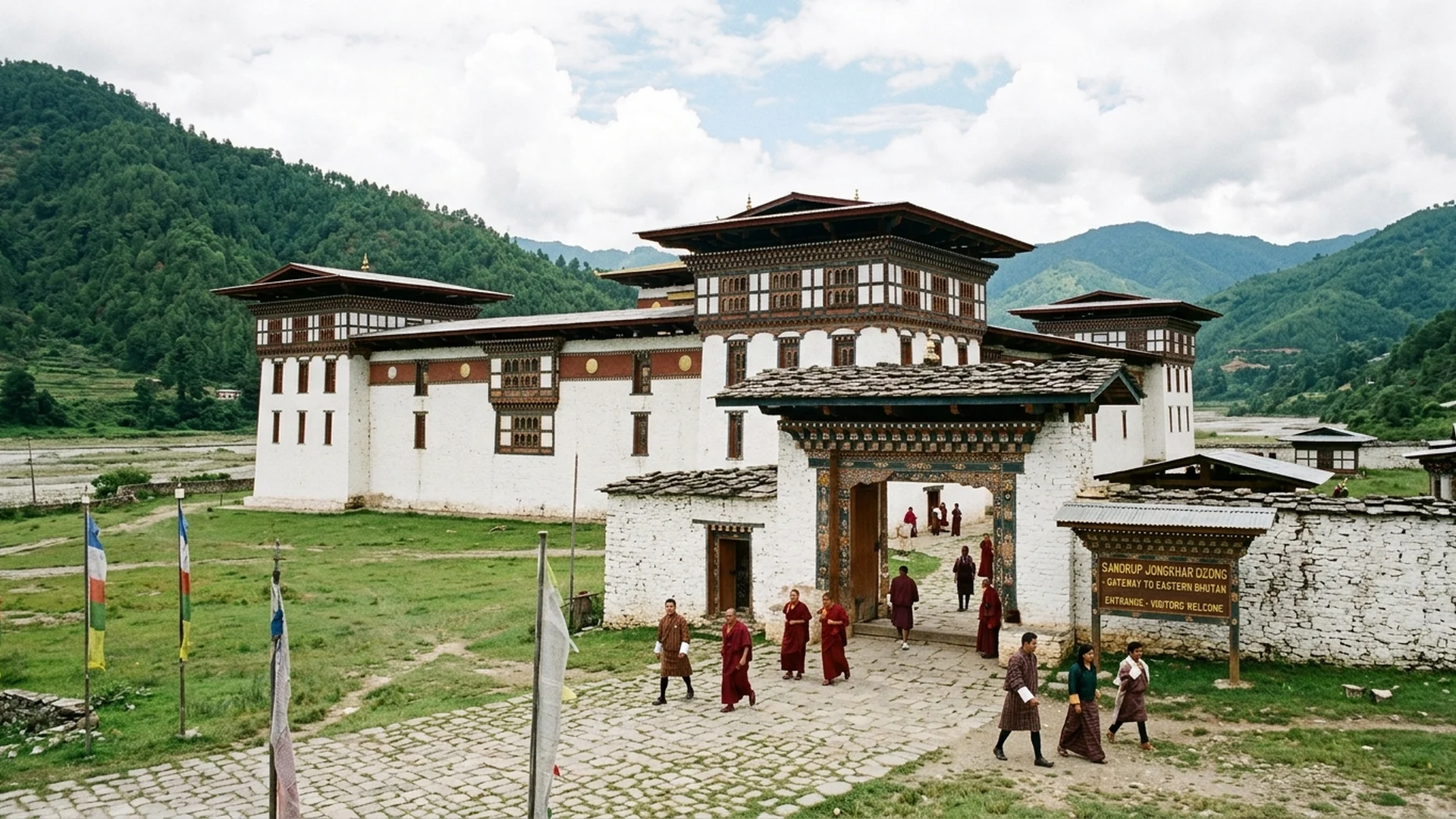
When conjuring Bhutan, the mind naturally drifts to mist-shrouded valleys, precipitous mountain ridges, and ancient fortresses clinging to sheer cliffs. Yet, for the discerning traveler willing to venture beyond conventional itineraries into the pristine eastern realms, the Kingdom unveils a startlingly different visage. Samdrup Jongkhar occupies a unique frontier geography, acting as a serene threshold where the majestic solitude of the high Himalayas meets the vibrant pulse of the Indian plains.
At the heart of this border town stands Samdrup Jongkhar Dzong, a magnificent fortress-monastery that defies traditional architecture. Rather than crowning a strategic mountain spur or river confluence, this dzong deliberately roots itself upon an expansive plain. It serves as a modern emblem of hospitality, embodying an open-hearted welcome for international travelers seeking to explore the deeply spiritual and rarely charted territories of eastern Bhutan.
Architectural Departure: When a Fortress Chooses the Plain Over the Peak
Traditionally, a dzong in Bhutan was conceived for dual purposes: defense against external incursions and administration of spiritual law. This imperative historically dictated sites atop steep valley ridges or where fierce mountain rivers converge. Samdrup Jongkhar Dzong gently subverts these ancient norms by occupying a tranquil flatland. This geographic departure does not diminish its gravitas; rather, it speaks to an evolving epoch where fortresses transition from bastions of defense into open administrative and spiritual centers. The architectural blueprint prioritizes sweeping symmetry, soaring interior courtyards, and the generous admission of natural light, which dances brilliantly across whitewashed walls framed by meticulously carved timber woodwork.
The Border Heritage Gate: A Living Pulse of Culture and Exchange
Sharing an immediate proximity with the Indian state of Assam imbues Samdrup Jongkhar with an ambiance distinct from western Bhutan’s serene capitals. Here, two rich cultures gently intermingle, carrying echoes of historical cross-border trade. Samdrup Jongkhar Dzong stands as a guardian of peace and continuity, greeting international guests with quiet dignity. Within its sacred perimeter, the air is thick with the scent of traditional incense, punctuated by the soft murmur of monastic prayers and an unwavering devotion to Mahayana Buddhism, offering profound tranquility amid a fast-changing world.
The Genesis of an Eastern Himalayan Odyssey
For the traveler seeking profound engagement and escape from the well-trodden path, visiting Samdrup Jongkhar Dzong is much more than an aesthetic appreciation of architecture; it is a ritual of passage. Crossing this threshold sets the stage for deeper explorations into remote eastern valleys such as Mongar, Trashigang, or Lhuentse—regions defined by folded topography, pristine forests, and indigenous communities preserving ancient ways of life. Commencing one’s journey here is akin to turning the first page of an epic narrative, where every ensuing mile reveals uncharted layers of Bhutanese heritage.