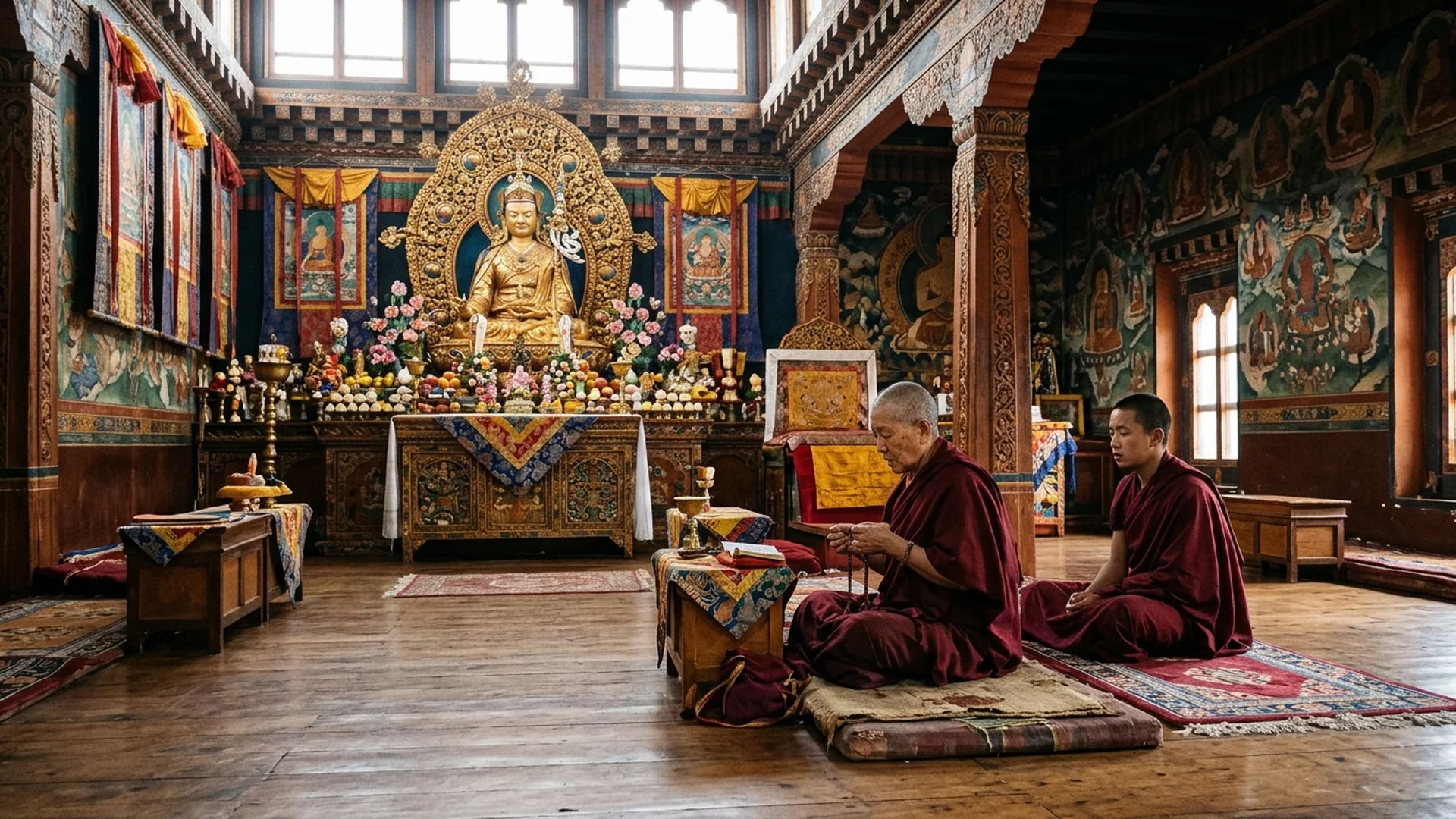
As travelers cross the border into the realm of Gross National Happiness, the southeastern border town of Samdrup Jongkhar is frequently overlooked as merely a point of transit. Yet, behind its tranquil exterior lies a profound masterpiece of sacred Buddhist architecture that brings the celestial realms down to earth: Zangto Pelri Lhakhang. This revered sanctuary serves as the majestic gateway to the cultural richness of eastern Bhutan, radiating a timeless aura of devotion.
Visiting this sacred lhakhang (temple) transcends a typical sightseeing excursion; it is a passage into the intricate cosmology of Vajrayana Buddhism. Here, a magnificent three-tiered structure decodes the vision of Zangto Pelri—the glorious copper-colored mountain paradise of Guru Rinpoche (Padmasambhava). Crafted by master artisans of the royal workshops, the temple envelops visitors in the soothing fragrance of indigenous incense and the low, resonant hum of monastic chants that effortlessly stills the wandering mind.
Decoding the Cosmos: The Three-Tiered Architecture of Zangto Pelri
Zangto Pelri Lhakhang is meticulously engineered according to ancient texts to manifest the pure land of Guru Rinpoche on Earth. The sanctuary is distinctly divided into three tiers, each housing a specific spiritual dimension. The ground floor represents the earthly realm and the underworld, consecrated with the primary Buddha statue and narrative murals of the Buddha’s life. The middle tier embodies the celestial realm of the Four Great Kings and heavenly abodes, embellished with delicate wood carvings of celestial beings and mythical snow lions. At the summit rests the innermost sanctuary, a sublime representation of the pure paradise housing various manifestations of Guru Rinpoche, illuminated by exquisitely carved wooden lattice windows that filter natural light across the sacred altars.
Sacred Artistry: The Royal Craft Heritage of Eastern Bhutan
The interior of the lhakhang functions as a living art gallery, preserving the immaculate mastery of Bhutanese artisans. Every wall glows with vibrant, natural-pigment thangka-style murals executed with astonishing precision. Guardian deities, intricate mandalas, and Jataka tales are portrayed following the strict canonical proportions of sacred geometry. Supporting pine pillars are meticulously hand-carved with floral motifs and the Tashi Tagye (Eight Auspicious Symbols). Every architectural detail serves not merely as decoration, but as a visual language communicating profound philosophical teachings to all who enter.
Living Devotion and the Sacred Kora
The true heartbeat of Zangto Pelri Lhakhang is revealed through the daily spiritual rhythms of the local community. During the early morning and late afternoon hours, devotees dressed in traditional gho and kira gather to spin the brass prayer wheels encircling the base of the temple. Accompanied by quiet recitation, they perform clockwise circumambulation (Kora). The gentle chiming of brass bells blending with mountain breezes creates an enveloping atmosphere of supreme sanctity, offering discerning travelers an intimate glimpse into the gentle, devout soul of eastern Bhutan.