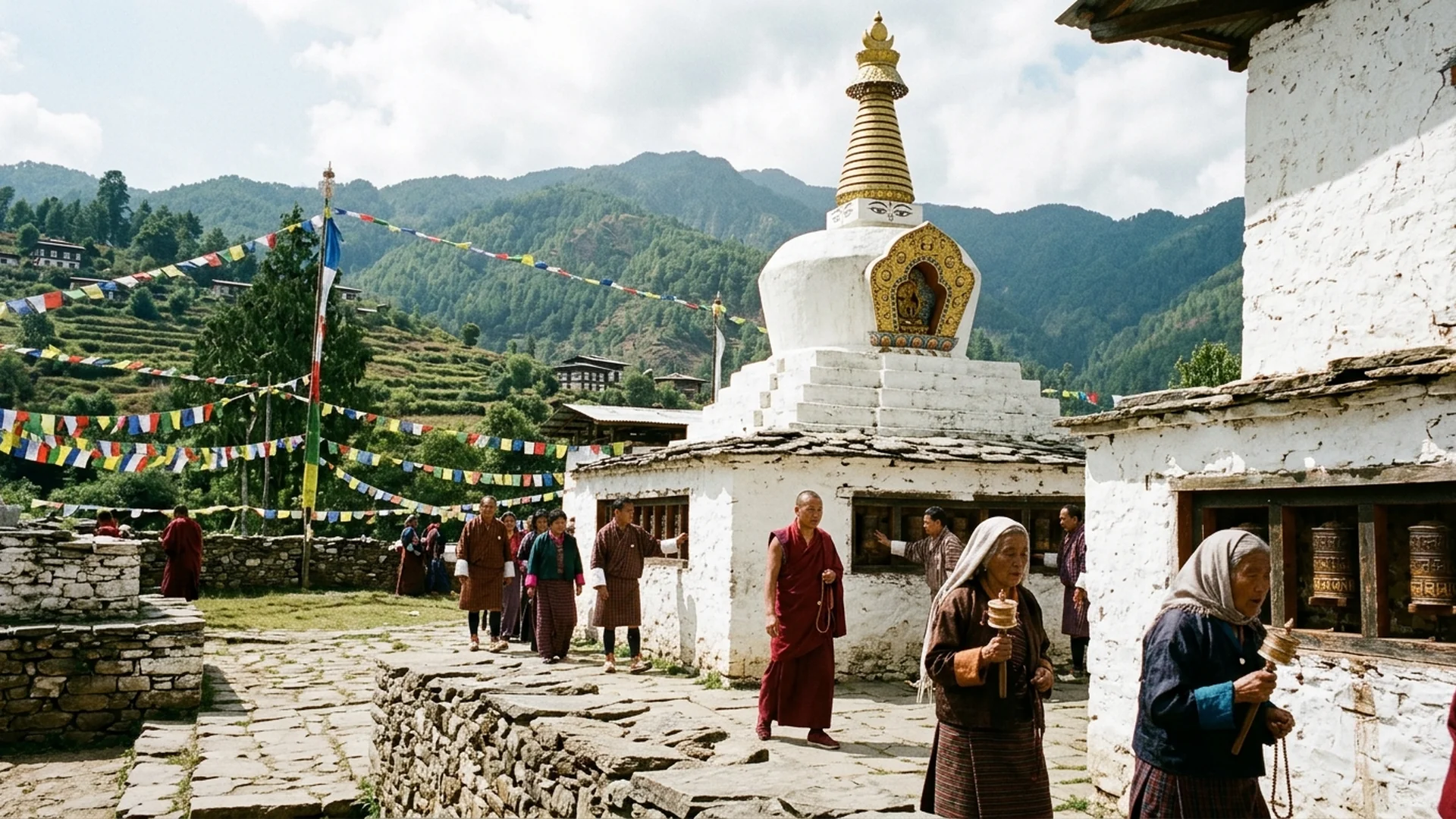
Amidst the emerald canopies and gentle morning mists of the Trashiyangtse valley in Eastern Bhutan—where time itself seems to slow its cadence—stands a brilliant, snow-white monument of striking architectural grace. Chorten Kora is far more than an 18th-century sanctuary defying the erosion of years; it is a profound spiritual anchor and a living bridge uniting the faith of communities across the borders of Bhutan and India.
When the dawn’s first light strikes the bell-shaped dome—modeled after the revered Boudhanath Stupa in Nepal—soft incantations and the lingering aroma of sacred juniper drift upon the mountain breeze. For the discerning traveler drawn to Vajrayana Buddhism and uncompromised indigenous culture, this remote sanctuary offers an unforgettable encounter with living history, mystic folklore, and an enduring pulse of devotion.
Historical Roots and Nepalese Architectural Inspiration
Erected between 1740 and 1745 under the visionary guidance of Lama Ngawang Loday, Chorten Kora was conceived to generate profound spiritual merit and pacify malignant spirits haunting the river valley. According to historical chronicles, its architectural blueprint draws direct inspiration from the great Boudhanath Stupa of Kathmandu—a profound anomaly in Bhutan, where sacred monuments typically adhere to traditional Tibetan architectural idioms.
The brilliant white structure rises from tiered plinths, offering a serene circumambulation path for devotees. Crowned by the painted Wisdom Eyes facing the four directions, the stupa symbolizes the omniscient awareness and universal compassion of the Buddha. These architectural nuances not only reflect master craftsmanship of the era but also celebrate an extraordinary cross-cultural and cross-border spiritual kinship across formidable Himalayan passes.
Legends of the Dakini and the Spirit of Trashiyangtse
Beneath the immaculate whitewashed exterior lies a rich tapestry of local folklore. Legend recounts that a malevolent force once terrorized the valley settlement, prompting the founding lama to employ compassionate spiritual intervention. Oral histories tell of a princess—or divine Dakini—who willingly consecrated her presence within the monument to seal away malevolent energies and restore harmony to the region.
Consequently, generations of villagers have believed that circumambulating Chorten Kora accumulates vast spiritual merit while honoring the guardian spirits of the landscape. In the twilight hours, when amber light bathes the white stupa against a backdrop of undulating ridges, the atmosphere acquires an unmistakable stillness and sacred gravity.
The Drukpa Kora and Dakpa Kora: A Bridge Across Frontiers
With the turn of the first month in the Bhutanese lunar calendar—typically spanning February and March—Chorten Kora awakens during the grand celebrations of the Drukpa Kora and Dakpa Kora festivals, standing as the preeminent spiritual gatherings of Eastern Bhutan.
What distinguishes these festivities is the remarkable pilgrimage of believers from across the Indian border, particularly the Monpa tribal communities of adjacent Arunachal Pradesh. Journeying across mountain trails for days, they converge to perform circumambulation alongside Bhutanese locals. The sight of pilgrims in vibrant national attire circling the stupa under a canopy of candlelight offers a powerful testament to peace, shared faith, and borderless camaraderie increasingly rare in the modern world.