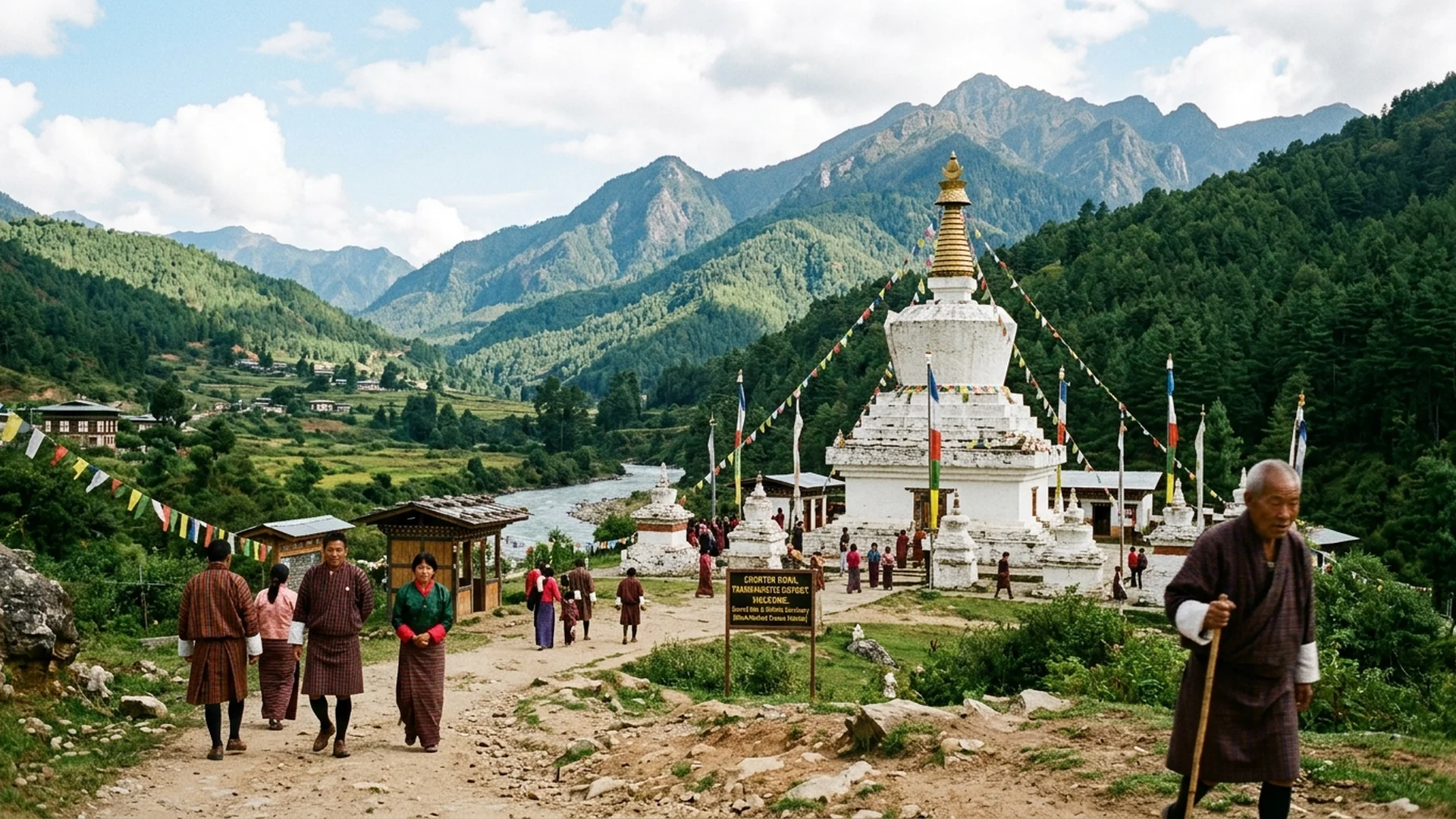
As the morning mist slowly dissolves from the valleys below, the soft murmur of low-toned chants from ancient monasteries drifts through the dense, primeval forests of Eastern Bhutan. Here lies Trashiyangtse, a timeless realm where the relentless pace of the modern world surrenders to the enduring rhythms of the Himalayas. For the discerning traveler seeking sanctuary, this remote frontier offers an authentic encounter with a sacred geography virtually untouched by mass tourism.
Crossing high mountain passes into the nation’s eastern reaches feels akin to turning the pages of an illuminated manuscript. Trashiyangtse is far more than a mere coordinate on a map; it is a profound cultural repository where esoteric Vajrayana Buddhism, master craftsmanship, and wild, untamed ecosystems converge in quiet harmony.
Chorten Kora: A Monument of Faith and Timeless Architecture
Perched gracefully along the banks of the Kholong Chhu river, the great stupa of Chorten Kora stands as an architectural masterpiece and a deeply revered spiritual anchor. Modelled after the iconic Boudhanath Stupa in Kathmandu, it commands attention with its brilliant whitewashed dome and the all-seeing Wisdom Eyes painted upon its neck, gazing out across the four cardinal directions. Erected in the mid-18th century by Lama Ngawang Loday to subdue local malevolent spirits and safeguard the valley, the stupa remains a powerful focal point for pilgrims.
Every year in February, the grounds awaken during a vibrant festival where devout Buddhists from across Bhutan and border communities in India gather to celebrate compassion and universal peace. The heavy scent of burning juniper incense mingles with the ceaseless, rhythmic spinning of copper prayer wheels, creating an atmosphere charged with sacred resonance.
Legacy of the Artisans: The Art of Dappa Woodcraft
Trashiyangtse is widely celebrated as the preeminent capital of woodworking and fine craftsmanship in Bhutan. The intricate art of turning and carving wooden vessels known as ‘Dappa’ has been meticulously handed down through generations of master artisans. Selected timbers undergo a rigorous process of boiling and curing to ensure durability before being meticulously hand-lathed to create lightweight vessels with impossibly smooth contours and rich, natural grain patterns.
Beyond the creation of Dappa, the town serves as the proud home of the Zorig Chusum Institute, a dedicated academy where the thirteen traditional arts and crafts of Bhutan are preserved. Here, the younger generation is carefully tutored in painting, sculpture, and classical woodcarving, ensuring that these ancestral techniques endure for centuries to come.
Bumdeling Wildlife Sanctuary: A Pristine Refuge for Rare Fauna
Journeying deeper into the rugged northern expanse brings travelers to the Bumdeling Wildlife Sanctuary, a protected realm encompassing diverse ecological zones ranging from subtropical broadleaf forests to high-alpine meadows. This vital wetland ecosystem transforms each winter into a sanctuary for the endangered black-necked cranes, which complete an arduous migration from the windswept Tibetan plateau.
To witness these majestic birds stepping gracefully through the morning frost is to experience a rare, silent communion between humanity and the natural world. Beyond avian wonders, Bumdeling is a noted paradise for lepidopterists, sheltering rare swallowtail butterflies and an astonishing array of indigenous Himalayan flora.