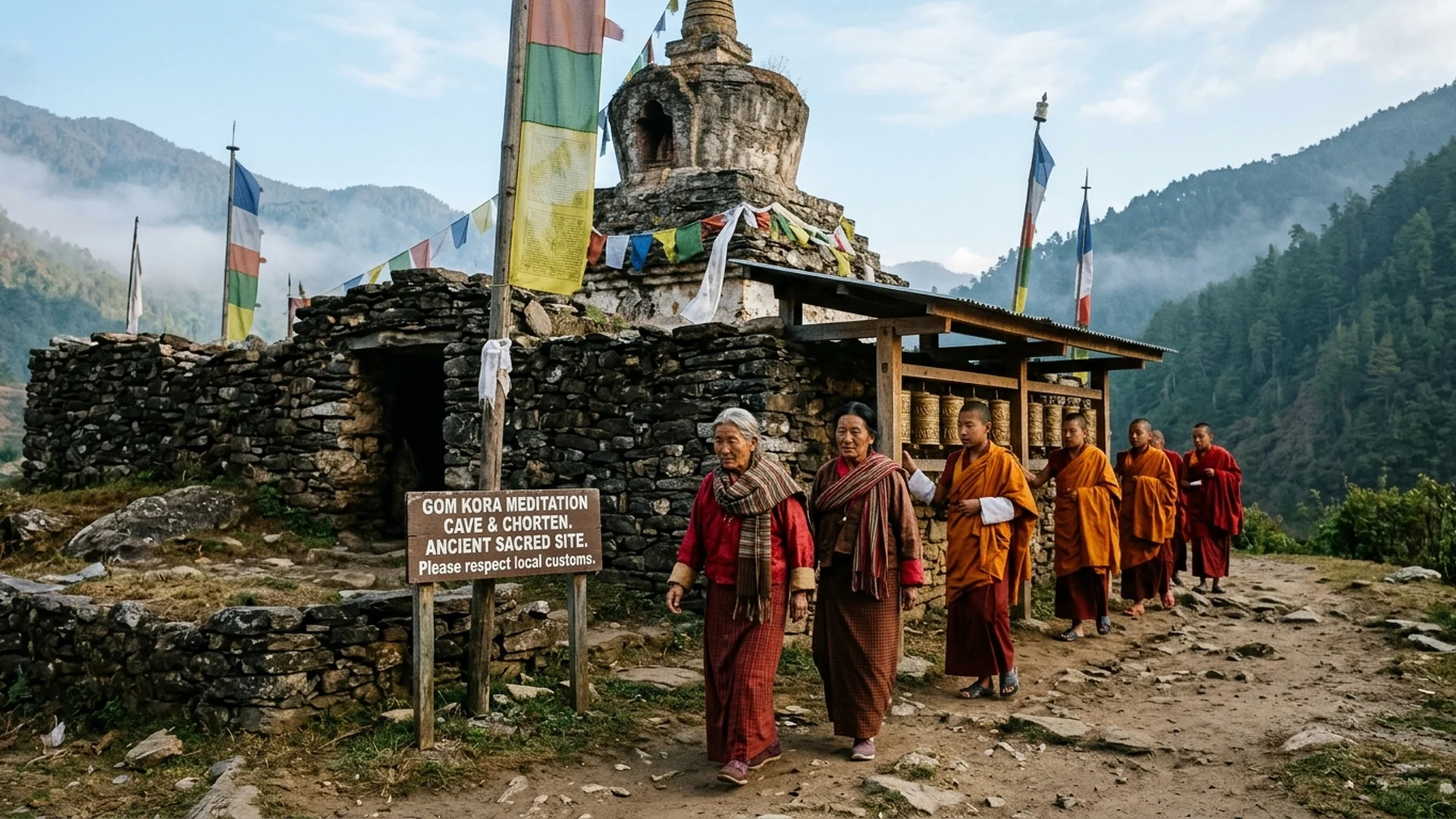
Step beyond the well-trodden western valleys and journey into the spiritual heart of eastern Bhutan at Gom Kora—a sacred landscape where natural majesty converges with the demon-taming legacy of Guru Rinpoche. Here, ancient nomadic traditions and cross-border pilgrims meet in timeless devotion. As morning mist gently lingers over the rushing waters of the Dangme Chhu, the stark white sanctuary resting against a colossal cliffside resembles a portal to another era, where unwavering faith has breathed life into the rugged terrain for centuries.
Venturing into the eastern reaches of Trashigang and Trashi Yangtse offers a profound departure from the conventional tourist circuit. In this remote sanctuary, silence is never emptiness; rather, it is resonant with the echoes of realized masters. Gom Kora (or Gomphu Kora) stands as an essential pilgrimage for the discerning cultural traveler, offering a raw, unvarnished encounter with Mahayana Buddhist lore and the relentless wheel of time.
The Legend of the Demon-Subduing Cave and Guru Rinpoche’s Footprints
The chronicle of Gom Kora traces back to the 8th century when Guru Rinpoche—revered across Bhutan as the Second Buddha—traversed these untamed lands to vanquish a malevolent spirit terrorizing the populace. According to local lore, the fugitive demon sought refuge within a dark, rocky alcove beside the roaring river. Through transcendent compassion and unshakeable meditative power, Guru Rinpoche entered deep samadhi and subdued the entity once and for all. The physical imprints of this spiritual battle remain indelibly etched upon the massive dark boulder to this day. Visitors standing before the sacred rock wall can easily discern natural impressions of the master’s body, foot, and divine implements. A striking white temple was erected over this meditation cave in later centuries to enshrine these miraculous vestiges and provide a sanctuary for monks chanting sacred liturgy.
Architecture and a Journey Back to the 17th Century
Gom Kora’s architectural profile is defined by traditional Bhutanese design, featuring pristine whitewashed tiered roofs contrasted against brightly painted woodwork along the eaves. Inside, the sanctum is heavy with the meditative scent of burning incense and consecrated butter lamps. The interior murals, dating back to the 17th-century royal artistic tradition, depict episodes from the Buddha’s life, various manifestations of Guru Rinpoche, and fierce Mahayana protectors. These pigments, derived from natural minerals and ancient resins, retain an extraordinary earthen vibrancy. The surrounding valley unfolds in sweeping terraced rice fields and dense green ridgelines running parallel to the swift river current, creating a profoundly still atmosphere perfectly suited for contemplation and introspection amidst pristine wilderness.
The Gomphu Kora Tshechu: A Tapestry of Eastern Bhutanese Faith
Each spring, typically in March or April, Gom Kora transforms from a place of secluded meditation into a vibrant hub of religious pageantry during the Gomphu Kora Tshechu. This ancient festival is among the most culturally significant in eastern Bhutan. What distinguishes this gathering is the unbroken, 24-hour ritual of circumambulation (Kora) performed by throngs of devotees circling the sacred boulder through the dark, guided only by candlelight and torches. The festival also serves as a vital rendezvous for the semi-nomadic Brokpa highlanders from Merak and Sakteng, who journey across high mountain passes wearing distinctive woolen garments and felt hats, mingling seamlessly with faithful pilgrims who cross the southern border from India in an extraordinary display of shared Himalayan devotion.