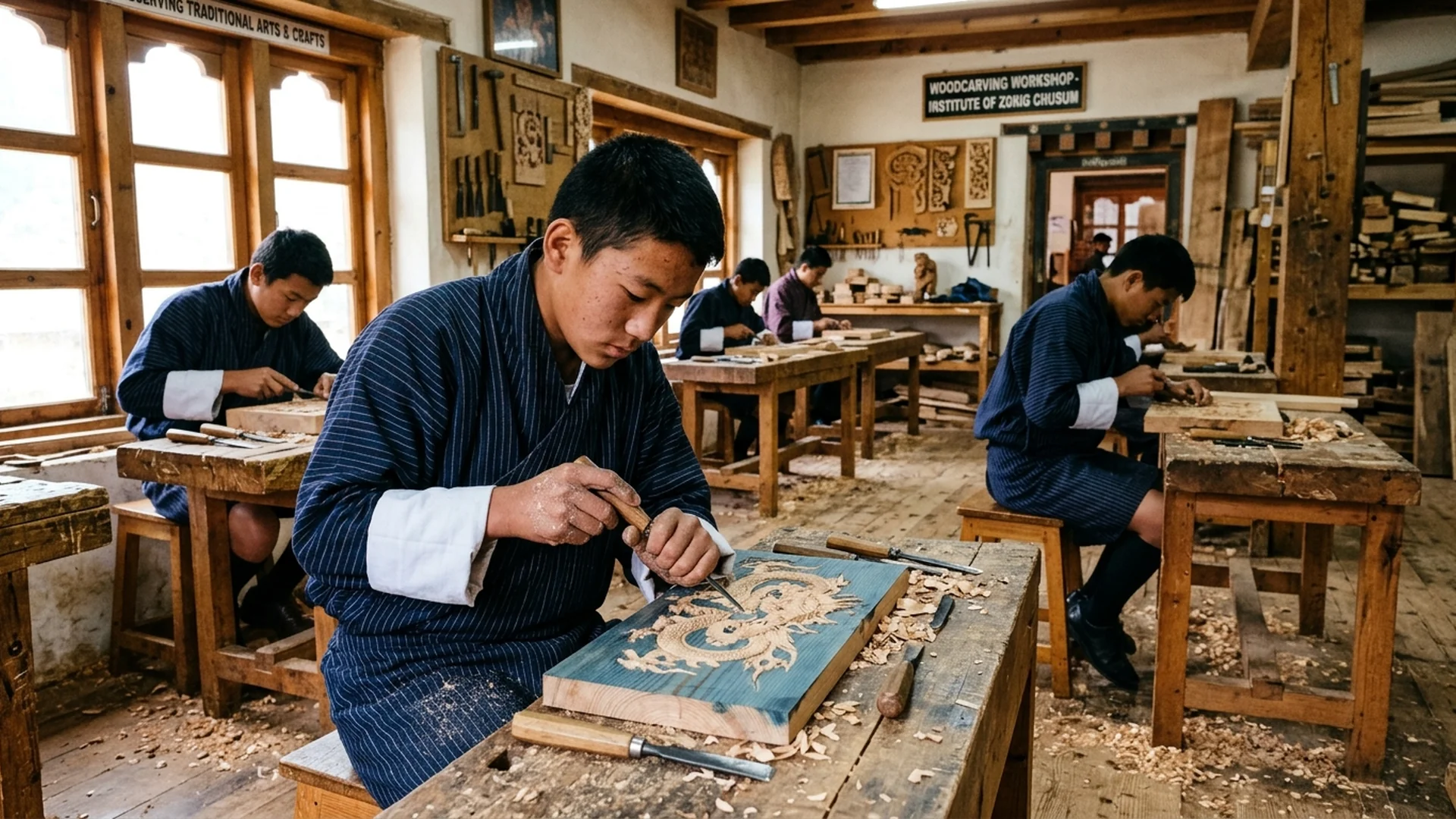
Emerging past dense canopies and the labyrinthine ridges of eastern Bhutan, the rhythmic percussion of chisels and the subtle aroma of natural timber drift through the morning mist. This is Trashiyangtse, a Himalayan enclave where time moves with deliberate grace, allowing ancient wisdom to breathe undisturbed. Beyond its pristine wilderness lies the Trashiyangtse Institute of Zorig Chusum—a living college of traditional arts that serves as the beating heart for the nation’s priceless cultural legacy.
Visiting this esteemed sanctuary offers an experience vastly removed from the passive observation of a conventional museum. Every footstep here is an invitation to witness the living pulse of ancestral craftsmanship, nurtured under the guiding philosophy of Gross National Happiness (GNH), which holds spiritual preservation in equal esteem with communal well-being. Here, devoted youth dedicate years to mastering patience and meditative concentration, ensuring that the thirteen foundational arts of Bhutanese civilization remain vibrantly eternal.
Zorig Chusum: The Root of Bhutanese Identity and Sacred Aesthetics
The term ‘Zorig Chusum’ encapsulates the thirteen traditional crafts classified and handed down across centuries in the mountain kingdom. Encompassing painting, woodcarving, clay sculpting, metal casting, textile weaving, and other elevated disciplines, these arts are never viewed merely as utilitarian vocations. Instead, they constitute a profound spiritual language designed to transmit sacred Buddhist philosophy, cosmological beliefs, and the sublime harmony of nature. Practicing these disciplines is treated as a form of contemplative meditation, demanding absolute stillness of mind, unerring visual precision, and deep humility toward both master instructors and the natural world.
Shagzo and Dappa: The Pinnacle of Trashiyangtse Woodturning
To speak of Trashiyangtse’s distinct artistic identity is to invoke ‘Shagzo,’ the revered art of woodturning for which this valley is universally celebrated. The crowning masterpiece of this tradition is the ‘Dappa’—an exquisite lidded wooden bowl carved from naturally occurring burlwood. Artisans meticulously select timber, air-dry the material, and shape it by hand on traditional lathes before boiling and treating the vessel with natural resins to reveal mesmerizing, organic grain patterns. Historically utilized by Bhutanese nobility, the Dappa remains a triumph of sustainable craftsmanship, demonstrating an ancient, sophisticated understanding of how to honor nature without depletion.
Inside the Living Studios: Silence, Form, and Diligent Devotion
The atmosphere within the institute’s studios is one of profound stillness and resolute focus. Students, attired in traditional gho and kira, gather in quiet circles around workbenches and easels. Natural light streams through large windows, illuminating suspended motes of wood dust and organic mineral pigments. In one hall, apprentices spend years mastering the rigorous geometric proportions of Thangka sacred scrolls. Adjacent studios echo with the steady, measured tap of mallets on timber. Every gaze is fixed entirely upon the work at hand, embodying an unwavering commitment to carrying ancestral wisdom across the threshold of the future.