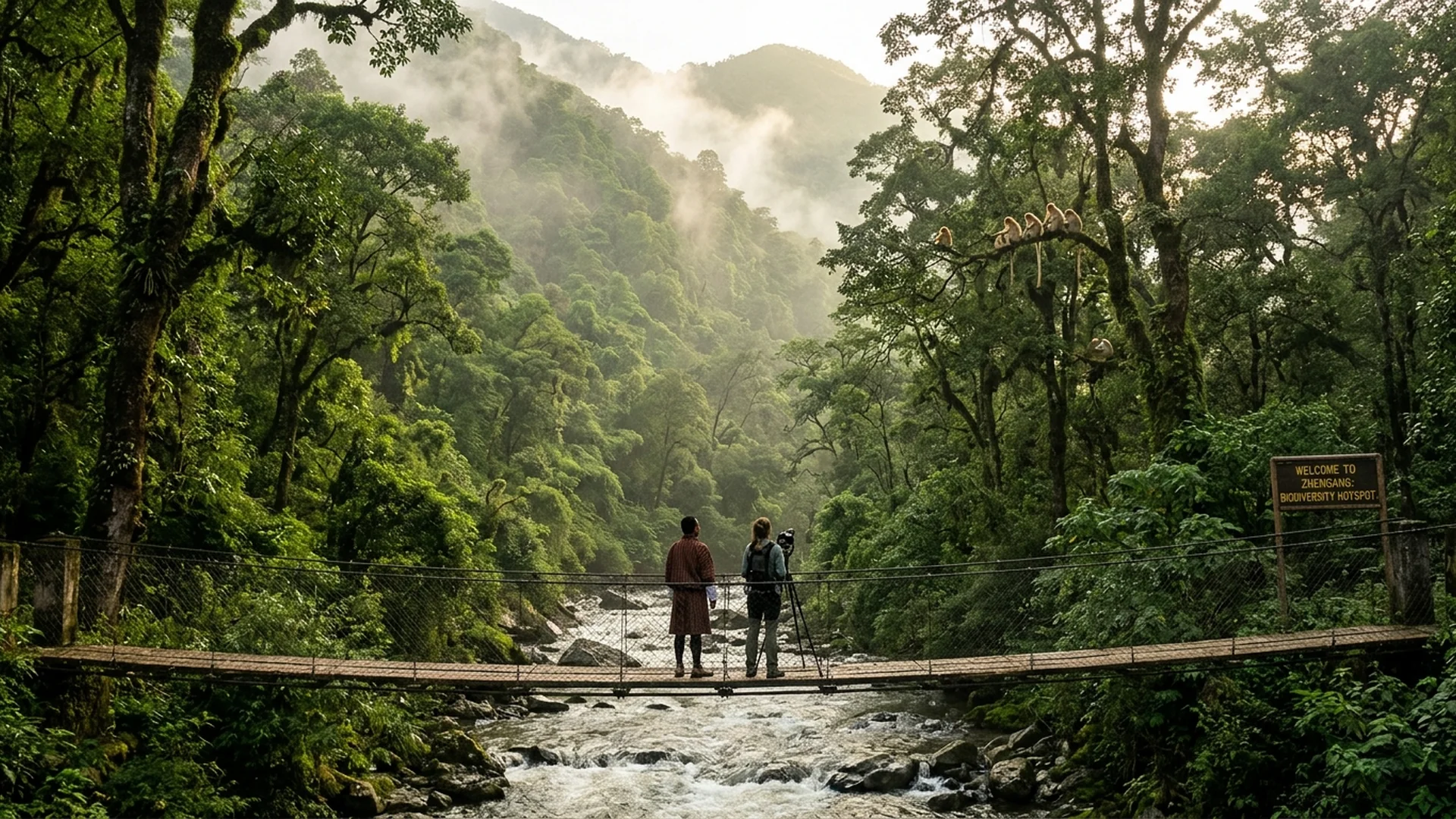
When conjuring visions of Bhutan, the mind often drifts toward the stark white fortress walls rising against azure skies in Thimphu or the serene, cypress-lined valley of Paro. Yet, journey deep into the southern folds of the kingdom, where the veils of time gently part to reveal Zhemgang. Here, ninety-five percent of the terrain is blanketed in dense, primeval forests—an undisturbed sanctuary where nature beats with its original, untamed pulse and rare wildlife roams free.
This is not a destination designed for fleeting itineraries or hurried sightseeing. Zhemgang is an expansive living classroom and the ancestral heartland of the Khengpa people, guardians of a deeply rooted cultural heritage. To arrive here is to cross the threshold of familiarity and embrace true luxury: profound silence, absolute privacy, and the restorative breath of an ancient wilderness that reconnects the modern traveler to the Earth.
The Emerald Heart: When Ninety-Five Percent of the Forest is Home
Zhemgang’s topography is a dramatic cascade of steep ridges and mist-shrouded valleys, sustained by some of the most luxuriant subtropical and moist broadleaf forests in the eastern Himalayas. This vast biological wealth allows Zhemgang to function as a vital ecological corridor, seamlessly connecting multiple national parks and permitting the unfettered migration of apex mammals, including Bengal tigers, Asian elephants, and Himalayan black bears.
Amidst this verdant architecture hides Zhemgang’s most precious jewel: the Golden Langur. Distinguished by shimmering golden-cream pelage contrasted against an inky black face, these striking primates were first discovered to science in southern Bhutan. Witnessing them leap effortlessly through the high forest canopy in the early morning, as golden sunbeams pierce the valley mists, is an arresting spectacle of wild grace—and the ultimate pilgrimage for discerning naturalists.
Wilderness Legacy: Royal Manas National Park and the Avian Haven
A significant portion of Zhemgang’s southern territory stretches gracefully into Royal Manas National Park, Bhutan’s oldest and most biologically diverse protected area. This pristine realm operates as an ecological treasure trove for ornithologists, hosting upward of 360 avian species, from the majestic Rhinoceros Hornbill to vibrant bulbuls and shimmering sunbirds.
Navigating these ancient riverbanks and forest trails under the intuitive guidance of seasoned local trackers reveals a symphony of natural wonders. The resonant calls of forest birds, the rich scent of damp earth following a mountain shower, and the fleeting footprints of elusive wildlife bear quiet testimony to an ecosystem fiercely protected under the guiding philosophy of Gross National Happiness.
The Khengpa Spirit: Heritage, Artistry, and Sacred Architecture
Beyond its grand natural expanses, Zhemgang is the living domain of the indigenous Khengpa community, whose distinctive dialects, customs, and agrarian rhythms remain wonderfully intact. The Khengpa are celebrated artisans, particularly famed for their mastery of intricate cane and bamboo weaving, creating exquisite vessels such as the traditional bangchung food bowls, whose geometric patterns embody generations of accumulated wisdom.
Perched dramatically upon a forested ridge overlooking the river valley stands Zhemgang Dzong, a storied fortress-monastery originally established in the 17th century by Lam Ngawang Namgyel. Further afield, rural settlements like Trong Heritage Village and the sacred Buli Lhakhang temple preserve esoteric oral histories and ancient animistic traditions seamlessly interwoven with Vajrayana Buddhism.