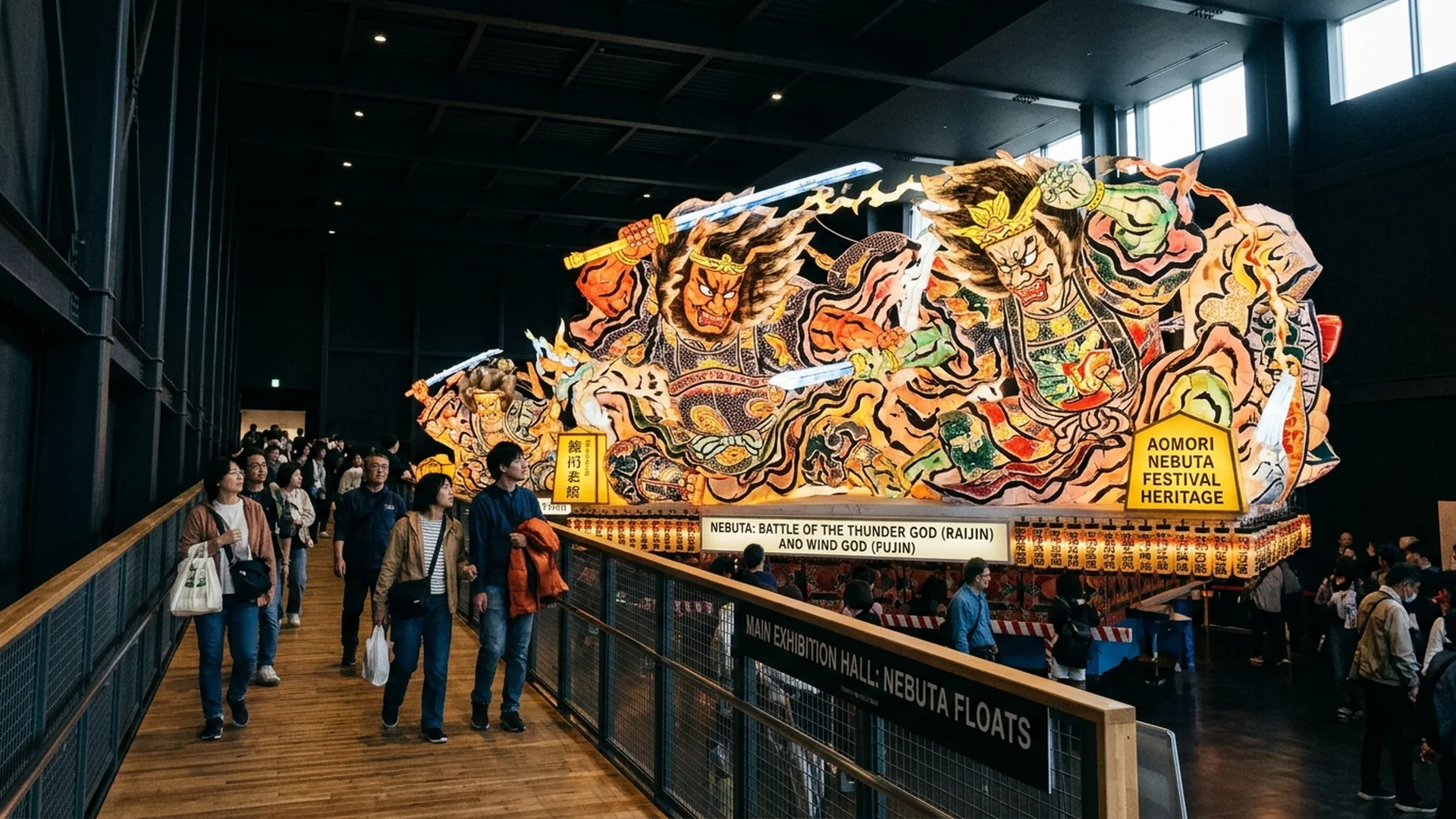
When summer’s fleeting warmth surrenders to the crisp, bracing winds of the Tohoku region, the pulsating drums, glowing spectacle, and infectious revelry of Aomori do not simply fade into memory. Instead, they are meticulously preserved and lovingly nurtured inside a striking vermilion ribbon-steel sanctuary resting quietly along the Aomori waterfront: the Nebuta Museum Wa Rasse.
For the discerning cultural traveler, a pilgrimage to this northernmost edge of Honshu transcends standard sightseeing. It is an unhurried crossing through time, granting intimate access to the heartbeat of the Nebuta Matsuri—a world-renowned living heritage that weaves ancient mythology, fierce samurai lore, and profound community devotion into a breathtaking visual symphony, long after the August festival crowds have dispersed.
Vermilion Ribbons and the Architectural Threshold of Myth
Upon stepping into the waterfront district adjacent to Aomori Station, the silhouette of Nebuta Museum Wa Rasse emerges like a bold contemporary sculpture. The exterior is wrapped in more than 730 twisting, deep red metallic louvers, ingeniously angled to filter natural sunlight in a soft gradient reminiscent of light filtering through an untouched canopy of northern beech trees. This semi-open transitional envelope serves as a poetic threshold—a deliberate bridge connecting the serene, quiet reality of the modern port city with the fiery, mythological realm of passion and spiritual devotion that defines the festival within.
The Artisan’s Soul: Behind the Hundred-Ton Paper Colossi
Deep within the dramatic, amber-lit expanse of the Nebuta Hall, colossal multi-story lanterns command the space with silent majesty. These towering masterpieces are not mere replicas; they are authentic creations sculpted by master artisans known as ‘Nebuta-shi’, who dedicate months of unbroken devotion to their craft. Intricate frameworks of timber and wire are cloaked in delicate Washi paper, meticulously hand-painted to portray legendary deities, formidable samurai, and heroic figures from classical folklore with arresting vitality. Standing mere inches from these monumental sculptures reveals the subtle brushstrokes, the tensile grace of the paper, and an exacting precision that is impossible to fully appreciate amidst the chaotic splendor of a live street parade.
Celestial Rhythms: The Thrum of Taiko and the Haneto Step
The true essence of Nebuta extends far beyond static visual splendor, awakening through the thunderous chant of ‘Rasse-ra, Rasse-ra!’ and the haunting, hypnotic melodies of Hayashi flutes and Taiko drums. Within the museum, visitors transcend the role of passive observers. Here, one is invited to touch the textured resilience of the Washi paper, examine the hidden interior skeletons of the floats, and—most importantly—step into the infectious rhythm of the ‘Haneto’ dancers through seasonal live demonstrations that dissolve the boundary between spectator and participant.