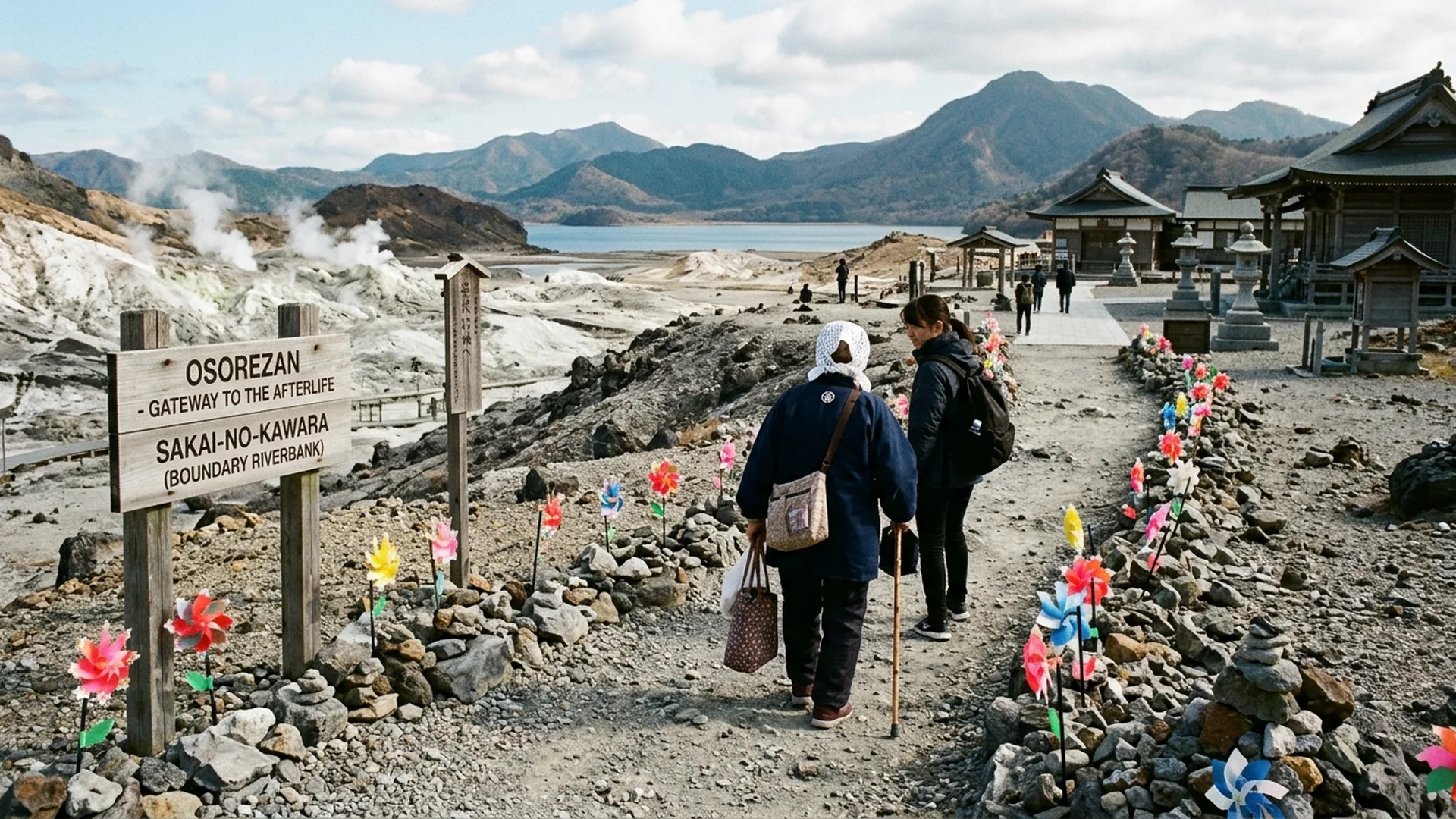
As a delicate mist drifts lazily through the solitary pine forests of the Shimokita Peninsula, a faint, sharp trace of sulfur touches the air, accompanied by the gentle rustle of brightly colored paper pinwheels spinning in the crisp wind. This is Mount Osorezan—known as the ‘Mountain of Dread’—a revered sanctuary designated as one of Japan’s three most sacred mountains, standing alongside Mount Koya and Mount Hiei. Yet amid the silent, desolate expanse of this volcanic landscape lies a profound current of faith, miraculously bridging the human world with the realm beyond.
To visit Osorezan is not merely a geographical excursion; it is a crossing of a spiritual threshold. Here, the untamed nature of dark grey volcanic rock contrasts sharply with the luminous brilliance of an emerald lake ahead. This exquisite duality echoes the profound truths of Mahayana Buddhism, inviting the contemplative traveler to pause, reflect, and meditate upon the wheel of existence and the preciousness of life.
A Millennial Legacy at Bodai-ji and the Ascent to the Sacred Peaks
Back in 862 AD, the renowned monk Jikaku Daishi of the Tendai sect received a divine vision during a pilgrimage in China, instructing him to seek a sacred land in the northernmost reaches of Honshu to enshrine Jizo Bosatsu, the bodhisattva who protects the souls of children and the departed. He subsequently pioneered and established Bodai-ji Temple within the crater of this dormant volcano, encircled by eight peaks like the petals of a celestial lotus.
As visitors cross the vermilion Sanzu-no-Kawa Bridge—symbolizing the crossing of the river of the dead according to traditional belief—the atmosphere shifts into an expansive wilderness. Wisps of subterranean steam rise through rock fissures, alongside neat piles of stones stacked by grieving loved ones to dedicate merit to children lost too soon. These sights leave an indelible, moving impression upon all who witness them.
The Dual Truths: From Hell Valley to the Paradise Shores of Lake Usori
The true wonder of Osorezan lies in its utterly contrasting landscapes. Within the area known as Jigoku Meguri, or the exploration of the netherworld, the terrain is dominated by muted grey sands, rugged volcanic rock, and boiling pools thick with the pungent aroma of sulfur. The palette here is strictly confined to the dull yellows of sulfur and the crimson stains of iron rust, reminiscent of ancient sutra depictions of purgatory.
Yet just a short walk beyond this barren inferno, the panorama transforms into Gokurakuhama, or Paradise Beach. Pristine white sands contrast brilliantly with the vivid emerald waters of Lake Usoriko, gleaming like a precious jewel. Although the lake is highly acidic and mineral-rich, preventing most fish from surviving save for a specialized species known as the Usoriko-uba-uo, the sparkling surface beneath soft sunlight radiates an extraordinary sense of peace, coolness, and emotional healing.
Arcane Rituals and the Mystique of the Itako
Osorezan preserves ancient spiritual traditions that are exceedingly rare in contemporary Japan. Foremost among these are the Itako—visually impaired women who undergo rigorous spiritual training to serve as conduits, summoning the departed to converse with grieving relatives. During major festivals such as the Osorezan Reitaisai in July and the autumn celebration, countless individuals stand in quiet queues to hear the voices and guidance of those who have passed through the distinct cadence of the Itako.
No matter how far modern civilization advances, the gentle chanting and the spinning red pinwheels stirred by mountain breezes among shrines and Jizo statues continue to serve as a bridge binding human sorrow to eternity, reflecting a profound spiritual wisdom that encourages acceptance of impermanence.
Natural Thermal Restoration: The Sacred Onsen at Bodai-ji
Another invaluable experience awaiting travelers at Osorezan is the restorative warmth of its historic natural hot springs. Within the precinct of Bodai-ji, modest wooden bathhouses welcome pilgrims and travelers to soak free of charge. The mineral water here is uniquely dense with milky-white sulfur, traditionally believed to soothe travel fatigue while purifying physical and spiritual impurities. Soaking in warm mineral waters amidst the pristine mists of this sacred mountain provides a deeply meaningful and harmonious conclusion to the journey.