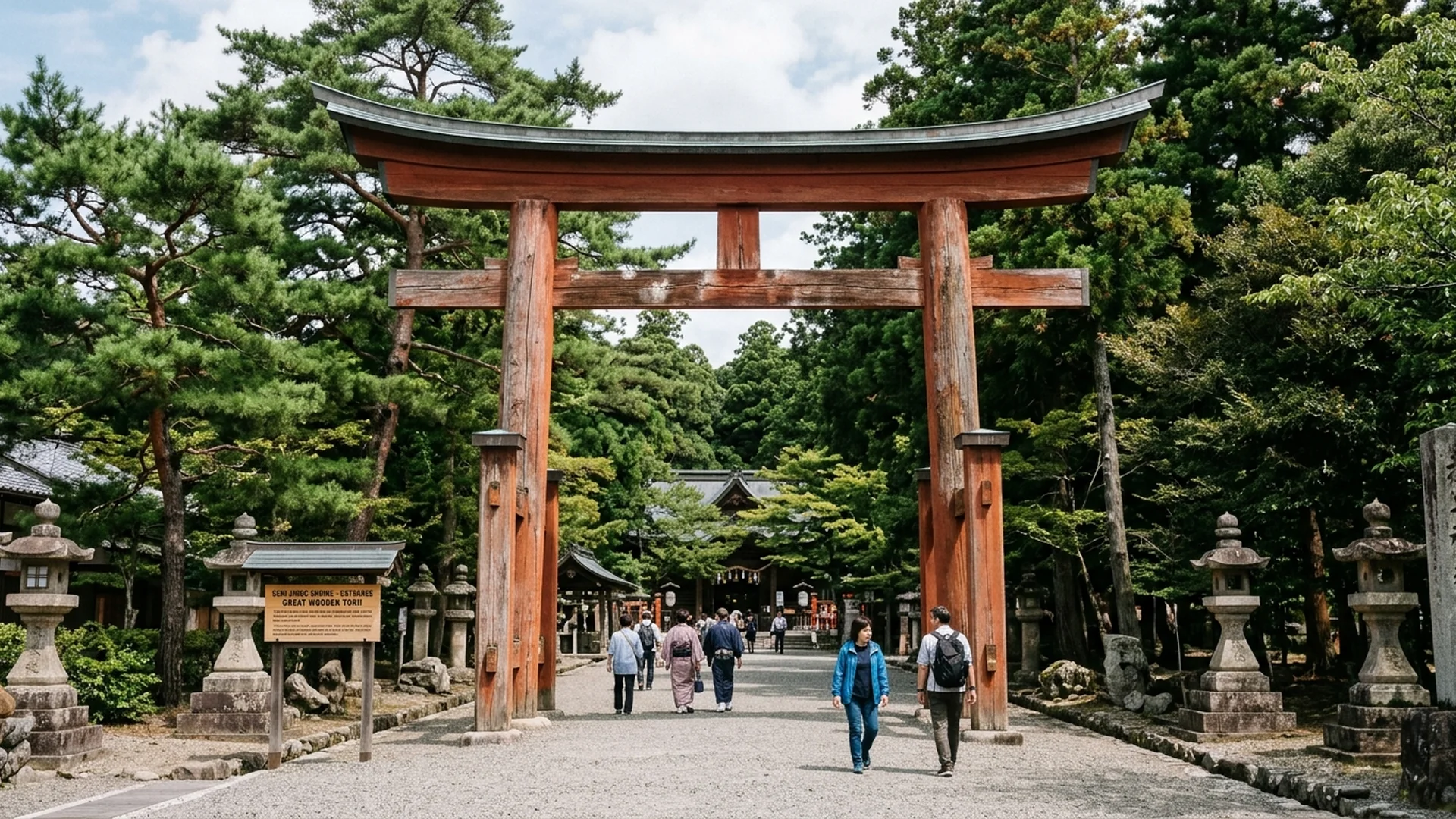
As winter winds sweep across the rugged capes of the Hokuriku region, whispered echoes from over thirteen centuries past drift through the coastal air of Tsuruga, Fukui. A monumental gateway to Japan’s most deeply guarded spiritual realms unfurls here as the Hokuriku Shinkansen effortlessly bridges distant mountains and sweeping seas, carrying travelers to a sanctuary where time itself slows its relentless pace. This is Kehi Jingu Shrine, a venerable powerhouse of faith that has long reigned as the Echizen Ichinomiya—the premier shrine and spiritual anchor of the ancient Echizen province.
Stepping past the vermilion grandeur of its colossal entrance into the sacred precinct is not merely an exercise in silent contemplation; it is a transcendent voyage back to the primal roots of devotion where humanity, divinity, and untamed nature intertwine in seamless harmony. Here, towering timber architecture converges effortlessly with mythic poetry and imperial lore, offering discerning travelers an immaculate immersion into Japan’s profound cultural continuum.
The Great Torii of Hokuriku: Timber Architecture and Enduring Sacredness
Upon approaching the threshold of Kehi Jingu Shrine, the gaze is immediately captured by the breathtaking scale of its monumental vermilion wooden torii. Soaring to an astonishing height of 11 meters, this architectural masterpiece proudly shares rank among the three greatest wooden torii gates in the Japanese archipelago, standing in esteemed company with Nara’s Kasuga Taisha and Hiroshima’s Itsukushima Shrine. Its robust timber framework, seasoned by centuries of unforgiving coastal gales, blinding winter snows, and relentless sun, bears silent witness to the intrepid ingenuity of ancient master carpenters while functioning as a threshold between the mortal realm and the divine empyrean.
Within the serene, moss-draped precincts shadowed by ancient pines and zelkovas rests the principal deity, Kehi no Okami, alongside Emperor Chuai and other revered ancestral spirits. The atmosphere is perpetually laced with the subtle fragrance of incense, the gentle rising of contemplative smoke, and an enveloping hush that effortlessly dissolves the clamor of the modern world.
Chomeisui and the Poet’s Footsteps: Seeking Life’s Meaning Through Springs and Verse
Beneath its stately exterior, Kehi Jingu guards quiet treasures of immense poetic and spiritual weight. Chief among them is Chomeisui, a legendary natural spring that has bubbled forth uninterrupted for over thirteen centuries. Local lore holds that these crystal-clear, mineral-rich waters possess restorative properties, granting vigor and longevity to those who partake. Stooping to cup the icy, pristine flow becomes an intimate meditative ritual—a tactile communion with the enduring vitality of the earth.
Not far from this sacred basin, the grounds once welcomed Matsuo Basho, the undisputed master of haiku poetry, during his iconic pilgrimage immortalized in the literary masterwork Oku no Hosomichi (The Narrow Road to the Deep North). Basho sojourned here, moved to compose verses that captured the wistful elegance of Tsuruga and its revered shrine. Today, stone monuments bearing his inscribed verses invite contemporary wanderers to pause, ponder the resonance of precise words, and reflect upon the art of deliberate travel.
Tsuruga: A Historic Port City and Gateway for Refined Exploration
A pilgrimage to Kehi Jingu finds its natural extension in the maritime heritage of Tsuruga itself, a historic port on the Sea of Japan that once thrived as a vital harbor for Kitamaebune merchant vessels and an international nexus of trade. Today, the extended reach of the Hokuriku Shinkansen line directly into Tsuruga Station has effortlessly compressed travel times from Tokyo and Kyoto, elegantly opening these storied shores to discerning travelers in search of unhurried authenticity.
Wandering just beyond the shrine precincts reveals Tsuruga’s atmospheric old town, defined by retro architecture, brick waterfront warehouses, and the enticing aromas of Hokuriku’s celebrated coastal cuisine—most notably succulent Echizen crab. Thus, a visit to Kehi Jingu transcends simple sightseeing, evolving into an exquisite sensory celebration of Japanese culture, history, and gastronomy.