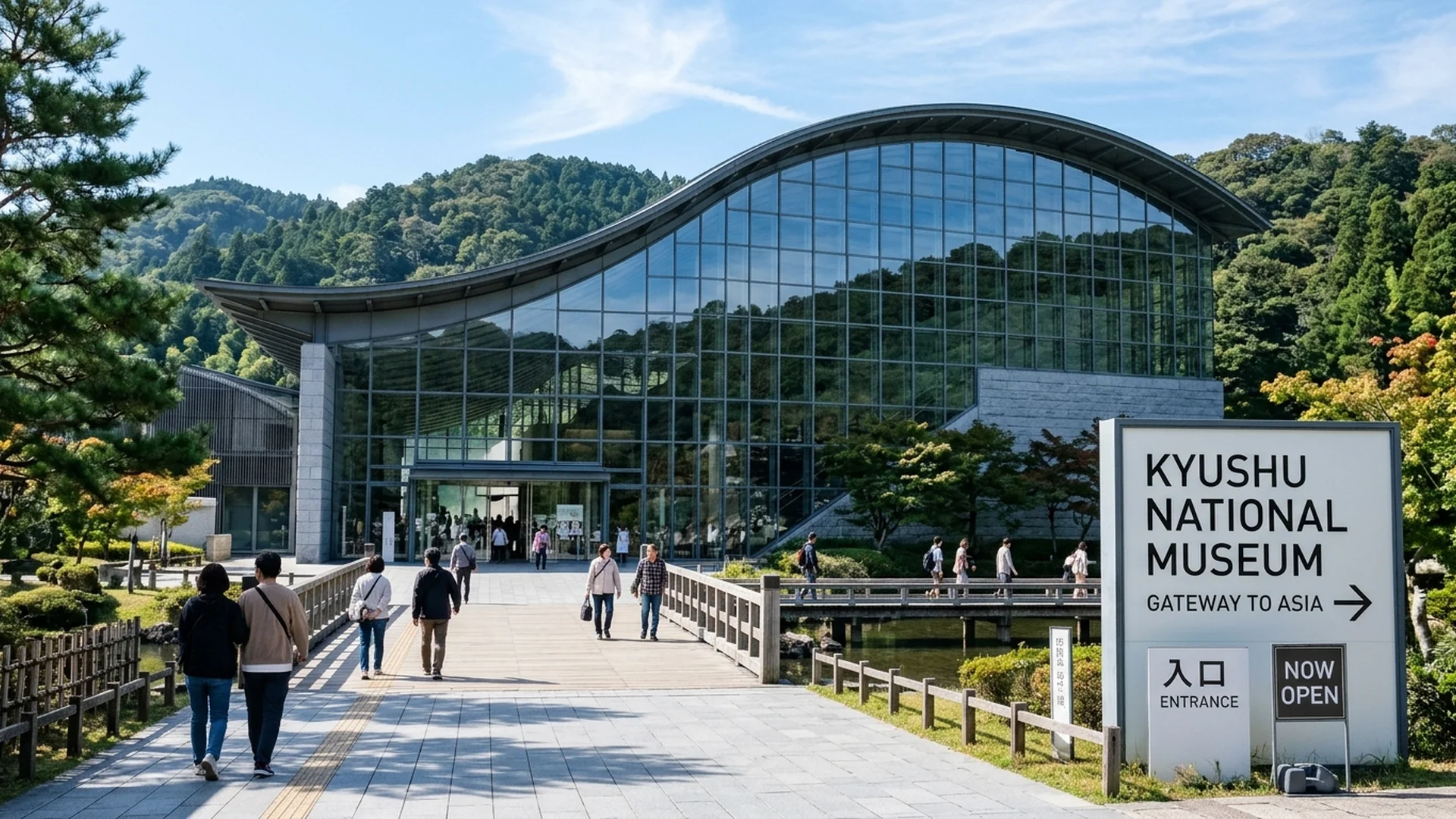
When the gentle winds of history sweep through the ancient forests of Dazaifu, the murmurs of cedar beams and the shifting reflections upon curved glass curtain walls whisper tales spanning millennia. This was once the sacred threshold where the island of Kyushu served as a magnificent bridge, connecting the vast mainland of Asia to the very heart of the Japanese archipelago. Here stands the Kyushu National Museum, the fourth national museum of the nation, operating not merely as a repository for ancient artifacts, but as a formidable intellectual sanctuary seamlessly uniting past, present, and untamed nature.
Crossing the threshold into this realm feels akin to turning the grand pages of history through the luminous Rainbow Tunnel, which bridges the spiritual sanctity of Dazaifu Tenmangu Shrine and propels travelers across time into breathtaking contemporary design. Characterized by sweeping organic curves that tenderly embrace verdant mountain peaks, the architectural marvel invites discerning global travelers captivated by art and culture to pause, reflect, and contemplate the ancient roots of Asian civilization in profoundly resonant dimensions.
The Gateway to Asian Civilization: Why Dazaifu Holds the Key
In bygone eras, the city of Dazaifu served as the seat of the Dazaifu-fu, the ancient governmental headquarters tasked with administering and safeguarding Japan’s western territories. Functioning as a vital frontier and a grand window opening toward the Korean Peninsula and mainland China, it embraced external philosophies, governance models, sciences, and religions. The establishment of the Kyushu National Museum upon this hallowed ground is no mere coincidence; rather, it stands as an architectural homage to Kyushu’s storied legacy as a pivotal nexus along the maritime Silk Road. Here, the complex and sublime tapestry of historical relations between Japan and its Asian neighbors is preserved through material echoes woven across time.
An Architecture of Wind, Waves, and Mountains by Kiyonori Kikutake
The edifice of the Kyushu National Museum represents a pinnacle of contemporary architectural achievement, conceived by Kiyonori Kikutake, a founding pioneer of the Metabolism movement. The exterior envelope is defined by a sweeping, wave-inspired curved roofline echoing the undulating topography of the surrounding hills. Massive glass facades serve as seamless canvases reflecting the shifting moods of the adjacent forests and seasonal skies. Inside, local cedar timber harmonizes with advanced structural steel frameworks engineered for uncompromising safety and ecological sustainability. The interior spatial choreography favors soaring openness, where shafts of natural daylight illuminate artifacts with striking dramatic intensity and vitality.
The Cultural Exchange Exhibition: The Curatorial Heart on the Fourth Floor
The permanent exhibition space, known as the Cultural Exchange Exhibition on the fourth floor, remains the quintessential destination for history connoisseurs. Conceived under the guiding philosophy of the history of Asian cultural interchange, this dynamic gallery continuously curates priceless antiquities, national treasures, and craft masterpieces drawn from across international borders. The narrative unfurls methodically from prehistoric times and the Kofun period through the Edo era, articulated via ceramics, metalwork, textiles, and rare manuscripts that illustrate the mutual transmission of human ingenuity and artistry.