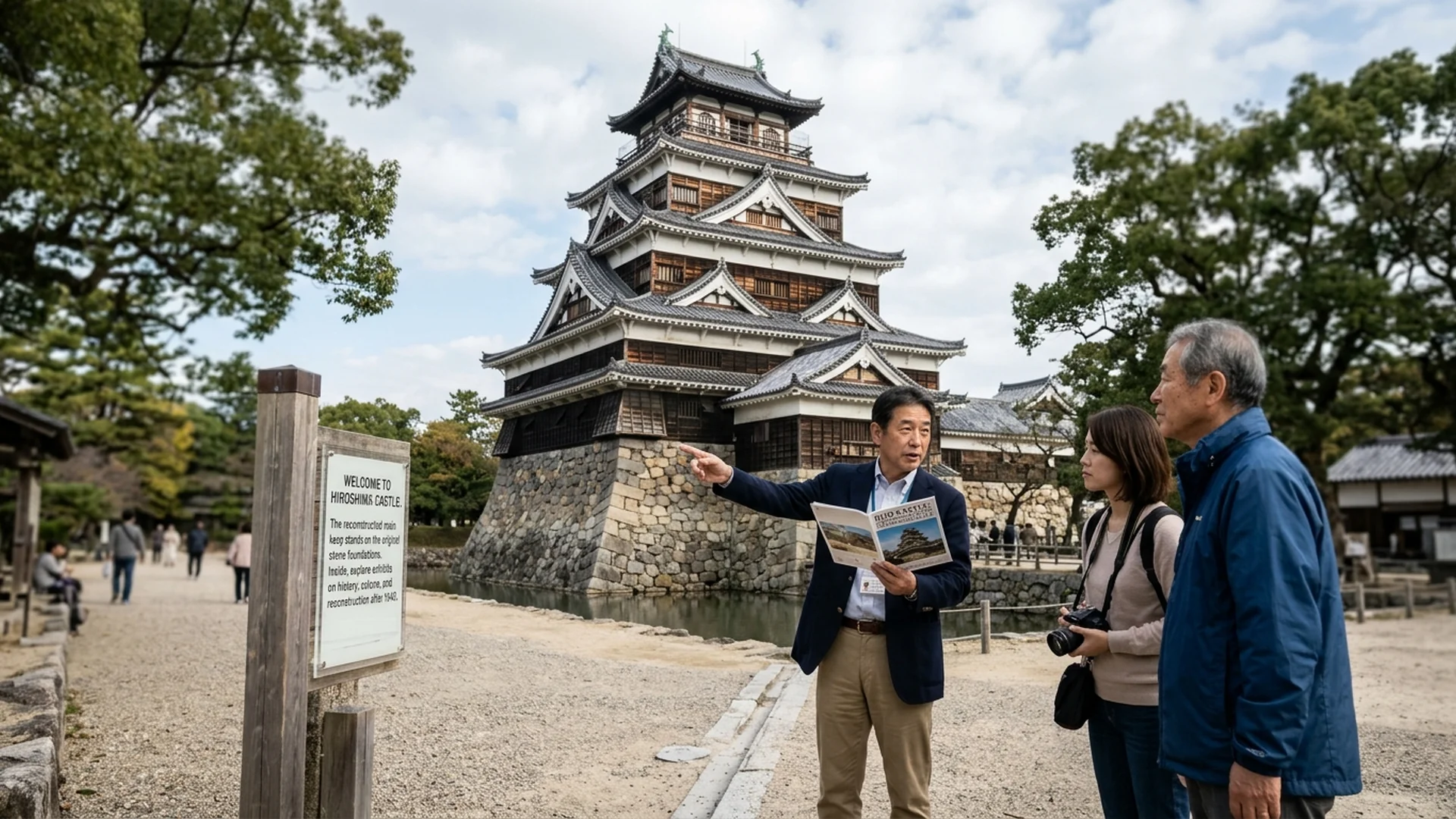
As the gentle spring breeze sweeps across the tranquil, reflective waters of Hiroshima’s ancient moat, the silhouette of deep ebony wood against a cerulean sky does more than merely whisper of bygone eras. It stands as an unyielding testament to rebirth from the ashes. Hiroshima Castle—revered historically as ‘Rijo Castle’ or the Carp Castle—is frequently overshadowed in modern consciousness by the profound tragedy of its twentieth-century history. Yet this lens of loss obscures a breathtaking truth: this fortress is one of Japan’s most exquisite and structurally significant examples of a Hirajiro, or flatland castle, brought to life through the visionary intellect of Sengoku-period daimyo Mori Terumoto.
A journey to these historic grounds transcends the superficial acquisition of landmark photographs. It is an unhurried, contemplative walk across ancient stone ramparts that still guard deeply layered historical narratives. While the primary keep was meticulously reconstructed using traditional techniques to honor cultural heritage, the palpable spirit of resilience saturating every square foot transforms the inner moat into a profound intellectual and sensory sanctuary.
From Sengoku Power Center to the Legendary ‘Carp Castle’
The chronicle of Hiroshima Castle commences in the twilight of the sixteenth century, when Mori Terumoto—a pivotal ally of Toyotomi Hideyoshi—recognized the immense strategic value of the Ota River delta. Blessed with fertile soil and exceptional waterways for trade and transit, he initiated the construction of this formidable fortification, christening it ‘Rijo’, signifying Carp Castle. This poetic moniker derived organically from the glistening scales of carp populating the surrounding moats and the vibrant aquatic ecosystem of the delta.
During the tumultuous Sengoku period, the fortress functioned as the supreme political, economic, and military epicenter of the Chugoku region before governance transitioned to the Fukushima clan and subsequently the Asano lords, who ruled until the dawn of the Meiji era. The monumental scale of the original complex is mirrored in its majestic five-story wooden structure, which steadfastly anchored the civic identity of Hiroshima through centuries of monumental sociopolitical transformation.
Hirajiro Architecture and the Stone Foundations That Defied Catastrophe
Architecturally, Hiroshima Castle commands attention as a defining archetype of the ‘Hirajiro’ style. Unlike the overwhelming majority of Japanese castles perched strategically atop precipitous mountain peaks, its flatland positioning necessitated an intricate defense grid. This relied upon a complex triple-moat system engineered to harness natural river currents for sophisticated tactical insulation.
Most poignant and astonishing is the legacy of August 6, 1945, when an atomic bomb detonated above the city, instantly reducing the original wooden keep to embers. Remarkably, the massive granite base walls, ancient foundation stones, and surviving flora—such as eucalyptus and willow trees that miraculously regenerated from calcified trunks—endured. The subtle scorching and fracturing of the stone faces constitute an open-air historical archive without peer. The present-day keep, reconstructed in 1958 utilizing reinforced concrete housing a traditional timber exterior, serves today as an enlightening municipal history museum.
Spiritual Dimensions and the Inner Enclosures: Gokoku Shrine and Ninomaru
A holistic immersion in the atmosphere of Hiroshima Castle demands unhurried exploration of its outer precincts, particularly the Hiroshima Gokoku Shrine nestled within the historic walls. Serving as a profound spiritual anchor for local residents honoring those lost to the ravages of war, the shrine grounds exude a serene, meditative dignity. During the New Year season, the pathways hum softly as worshippers gather for ‘Hatsumode’, seeking peace and spiritual well-being.
Adjacent lies the Ninomaru, or second fortification ring, where auxiliary defensive structures including the Tamamon-yagura and Ninomaru-taikomenshu have been flawlessly reconstructed using authentic Hinoki cypress. Traversing these heavy wooden gates evokes the quiet atmosphere of a period cinema. The gentle creak of polished timber underfoot and the subtle, organic aroma of natural wood combine to deliver a rich sensory experience for the discerning traveler attuned to architectural craftsmanship.