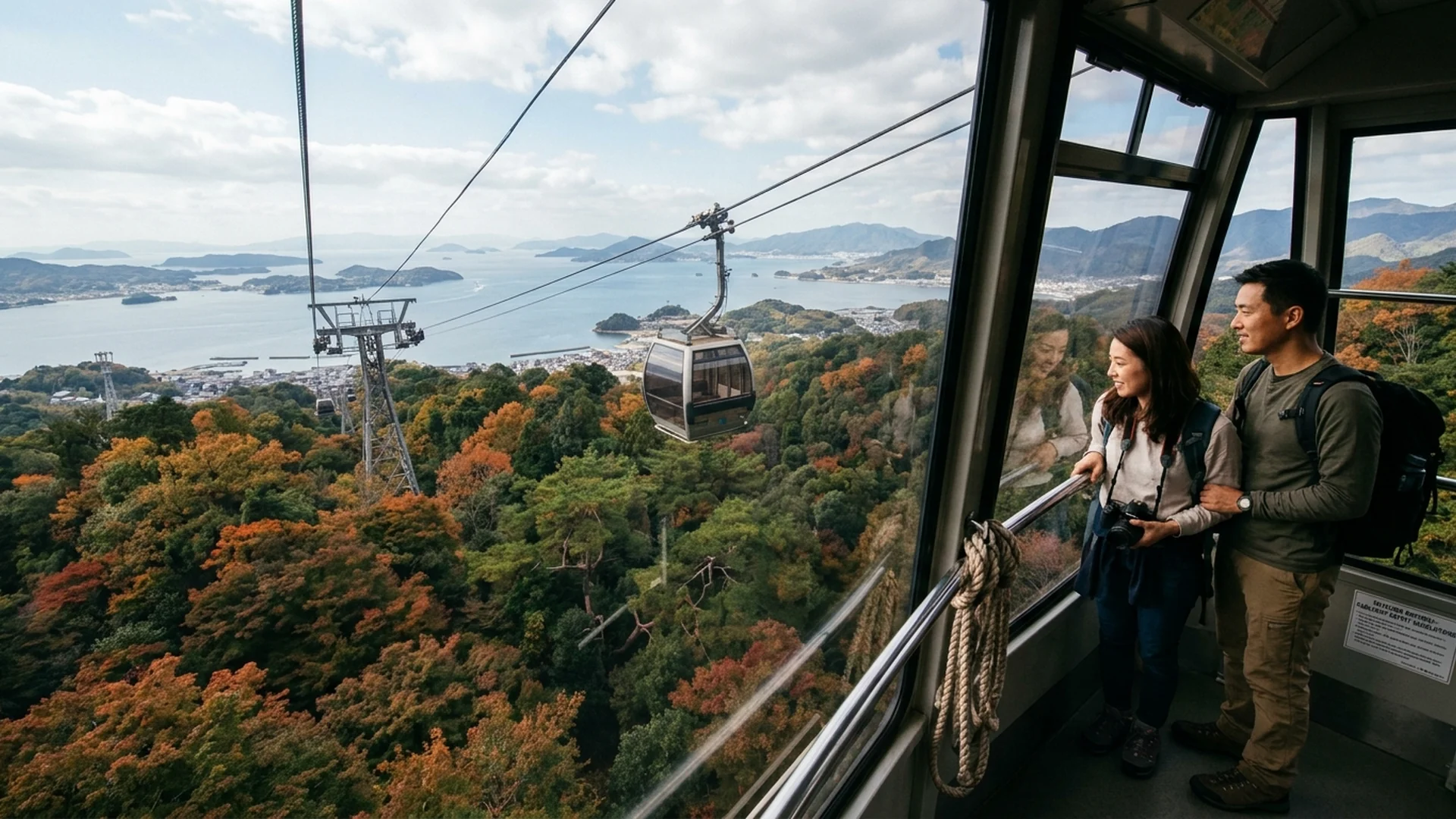
As the morning mist slowly lifts above the lapis lazuli waters of the Seto Inland Sea, the sacred island of Miyajima reveals far more than its iconic vermilion torii gate seemingly floating upon the tide. Beneath the dense, cathedral-like canopy of its protected primeval forest lies a hidden spiritual realm where geography and ancient devotion are inextricably intertwined. Rising toward the summit of Mount Misen via the Miyajima Ropeway is far more than a standard excursion; it is a deliberate passage across the boundaries of time, offering rare intimacy with a protected World Heritage ecosystem and sweeping vistas that lay bare the pure heart of Japan’s sacred landscapes.
For discerning travelers seeking profound cultural immersion, this aerial ascent provides a seamless transition from the bustling coastal paths to the ethereal stillness of the high peaks. As the cabin gently pulls away from the valley floor, the modern world recedes, replaced by the whispering pines, sun-dappled gorges, and centuries of quiet ascetic practice that echo through the rugged stone paths of Mount Misen.
Aerial Architecture: Traversing the Primeval Forest in Two Acts
The pilgrimage to the upper reaches of Miyajima begins at Momijidani Station, discreetly tucked away within a lush, river-carved ravine. Here, travelers board the Miyajima Ropeway, which is thoughtfully engineered in two distinct stages. The first leg, the Momijidani Line, carries passengers on a gentle ascent above a valley carpeted with thousands of Japanese maples. Autumn transforms this gorge into a vibrant tapestry of crimson and gold, reminiscent of a master’s watercolor. At the mid-point transfer, travelers board the larger, glass-walled cabins of the Shishiiwa Line. This second stage hovers silently above the dense, untouched canopy of a primeval forest where human intervention is virtually nonexistent. Below, dramatic granite outcroppings and steep, moss-laden ravines unfold in stark, beautiful relief. The exceptional quiet within the cabin encourages a meditative stillness, allowing travelers to hear the gentle sigh of mountain winds through the evergreens.
Shishiiwa Observatory and Mount Misen: Where Sea Meets Sky
Upon disembarking at Shishiiwa Station, visitors step out onto an observation platform situated some 500 meters above sea level. The horizon opens into a breathtaking panorama of the Seto Inland Sea, where emerald islets drift effortlessly across sparkling, sunlit waters. On exceptionally clear days, the view extends past Hiroshima’s coastline to the distant mountain ranges of the mainland. For those drawn to deeper exploration, a further twenty-to-thirty-minute walk along a stone-paved forest trail leads to the summit of Mount Misen itself. This highest point of the island is crowned by ancient shrines and colossal, wind-sculpted boulders shaped over millions of years. The atmosphere here is saturated with historical gravity and the subtle, profound influence of Shingon Buddhism, whose esoteric traditions have sanctified these slopes for more than a millennium.
The 1,200-Year Eternal Flame and the Spiritual Legacy of Misen Hondo
Mount Misen is far more than a geographical pinnacle; it is an irreplaceable spiritual sanctuary first consecrated in 806 AD by Kobo Daishi, the revered patriarch of Shingon Buddhism. Tucked near the summit within the unassuming Reikado Hall burns the Kiesou-zu-no-Hi, an eternal flame kindled by Kobo Daishi’s own hands over twelve centuries ago. Guarded closely against the elements, this sacred fire has never been extinguished. Beyond heating the holy water historically used to cure ailments of travelers and locals alike, this flame holds profound modern significance: a portion of its embers was transferred to ignite the Peace Flame at the Hiroshima Peace Memorial Park. Standing quietly before the altar, enveloped by the fragrant drift of incense and the low chant of monks, offers a rare moment of philosophical connection to an unbroken lineage of faith and resilience.