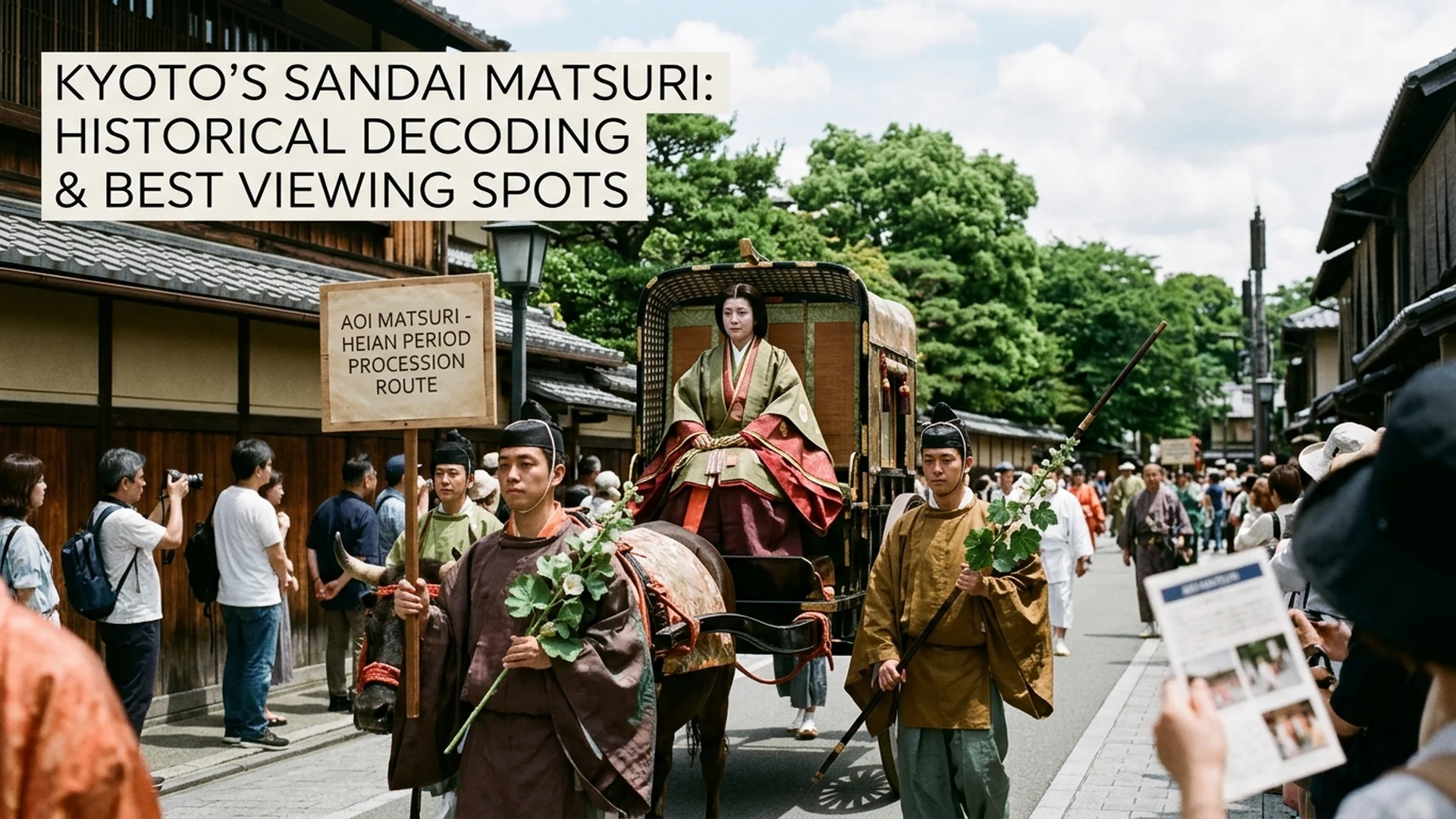
When the soft winds of time sweep through Japan’s ancient capital of Kyoto, the echoes of a glorious past are never confined merely to the pages of history books. Instead, they pulse with vibrant life during the Sandai Matsuri—the city’s three grand imperial celebrations comprising the vernal elegance of Aoi Matsuri, the spirited summer fervor of Gion Matsuri, and the autumnal splendor of Jidai Matsuri. These magnificent cultural pageants are far more than mere seasonal festivities; they function as living bridges across dimensions of time, transporting discerning travelers back to eras of immaculate spiritual devotion, aristocratic refinement, and master craftsmanship preserved across more than a millennium.
To fully comprehend these three sacred traditions is to read the living chronicle of Japanese history chapter by chapter—from ancient purification rites and towering wooden float engineering to sprawling historical processions unfurling like classical handscrolls. Here is your definitive invitation to step outside the frantic pace of modern tourism, decode the aesthetic brilliance of Kyoto’s heritage, and discover exclusive vantage points from which to absorb this ceremonial majesty in unhurried tranquility.
Aoi Matsuri: An Imperial Heian Tapestry and Veneration of the Kami
Observed annually on the fifteenth of May, the Aoi Matsuri—historically known as the Kamo Festival—stands as the most venerable of Kyoto’s grand triad, tracing its origins deep into the sixth century during the reign of Emperor Kimmei, who sought to appease natural deities and restore agricultural harmony. The emotional pinnacle of the observance is a stately procession of over five hundred participants meticulously garbed in the aristocratic court attire of the Heian period, spanning from 794 to 1185.
Along the solemn pilgrimage route from the Kyoto Imperial Palace toward the sacred groves of Kamigamo and Shimogamo shrines, every participant, alongside ceremonial horses and oxen, is adorned with leaves of aoi (hollyhock) and katsura branches, auspicious emblems believed to ward off malevolent forces. All eyes invariably gravitate toward the Saio-dai, a chosen unmarried woman of Kyoto who serves as the sacred imperial representative. Borne upon a palanquin beneath layers of exquisite silk kimonos weighing upward of thirty kilograms, she embodies the silent, timeless nobility of the ancient imperial court.
Gion Matsuri: The Architectural Marvel of Yamaboko and Summer’s Sacred Pulse
When July arrives, Kyoto awakens to the vibrant kinetic energy of the Gion Matsuri, an elaborate month-long festival originating in 869 AD as a spiritual supplication to quell devastating plagues. The beating heart of the festival resides in the procession of the Yamaboko floats, divided into two primary sequential marches known as Saki-matsuri and Ato-matsuri on the seventeenth and twenty-fourth of July respectively.
These monumental constructions are categorized into hoko—towering multi-story wooden structures supported by massive log wheels—and yama, more intimate floats housing revered deities and historical figures. What elevates these pageants to global cultural treasures is their status as mobile museums, draped in priceless imported Persian and Chinese tapestries alongside intricate woodwork. Hauntingly resonant melodies of flutes and gongs known as Gion-bayashi echo through the atmospheric alleyways of Gion and Shijo, evoking the immense merchant wealth and spiritual fervor of historical Kyoto.
Jidai Matsuri: A Living Scroll of History Amid Autumn’s Crimson Canopy
As crisp autumn breezes ignite the maple leaves in brilliant amber and crimson, Kyoto marks its founding anniversary on the twenty-second of October with the Jidai Matsuri, or Festival of Ages. Its defining structural brilliance lies in its reverse chronology: the magnificent two-kilometer parade moves backward through time, commencing with the modern Meiji era and receding gradually through successive epochs until culminating in the foundational Heian period, spanning over eleven centuries of Japanese civilization.
Featuring approximately two thousand participants alongside twelve thousand meticulously researched costumes, tools, and authentic weaponry crafted by master artisans of the Nishijin textile district, the procession is a triumph of historical scholarship. Witnessing full-suited Sengoku samurai, court nobles, priests, and influential literary heroines such as Murasaki Shikibu or Tomoe Gozen pass beneath the blazing crimson foliage of Heian Jingu, accompanied by stately gagaku court music, yields an aesthetic encounter found nowhere else on earth.