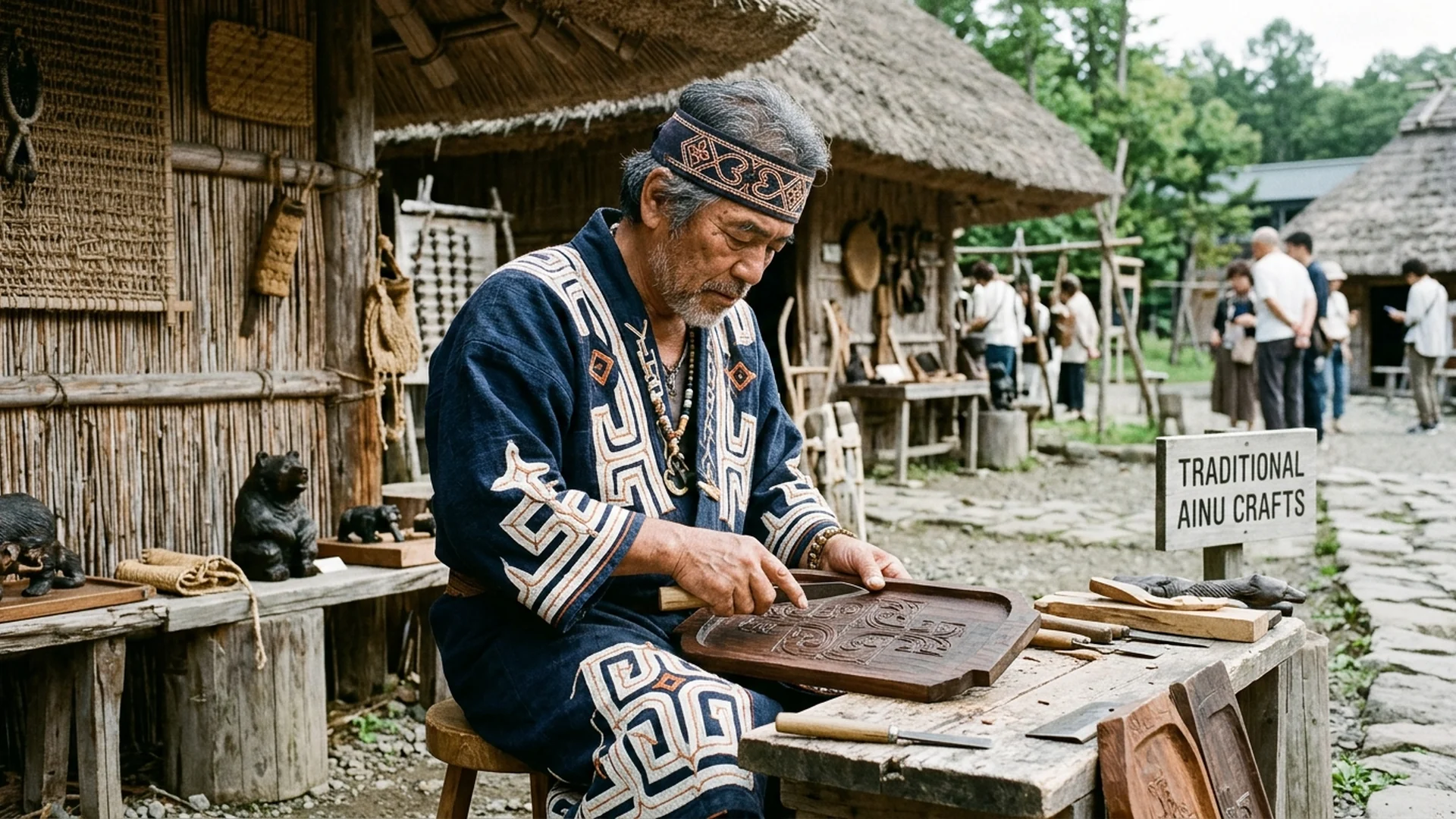
Beyond the venerable timber temples of Kyoto and the electric neon arteries of Tokyo lies another Japan—one obscured by the centuries-long narrative of the Yamato imperial court. To travel northward through the mist-shrouded valleys of the Tohoku region and across the Tsugaru Strait to Hokkaido is to walk through an unwritten ledger of the archipelago: the history of the ancestral communities who once roamed these wild mountains, rivers, and dense forests long before the consolidation of the modern state.
The history of the Emishi of Tohoku and the Ainu of Hokkaido is far more than a tale of peripheral minorities; it is an epic narrative of resistance, spiritual sovereignty, and adaptation in the face of relentless frontier expansion. From the legendary horse-mounted archers of the eighth century to the profound animistic devotion to ‘Kamuy’—the divine spirits inhabiting the natural world—these cultures form an indispensable pillar of Japanese heritage.
Following this historical trajectory invites discerning travelers to look past the conventional tourist itinerary and engage with the complex mosaic of Japan’s ethnic diversity, the lasting reverberations of Meiji-era assimilation policies, and the inspiring contemporary renaissance of indigenous pride found at sites like Hiraizumi and the Upopoy National Ainu Park.
The Tohoku Battlefield: Aterui and the Resistance of the Emishi Horse Warriors
During the Nara and early Heian periods in the eighth century, the northern reaches of Honshu were regarded by the imperial court in Kyoto as a lawless frontier. This territory was the domain of the Emishi, autonomous communities deeply attuned to the rhythms of the forests and mountains, renowned for horse breeding, archery, and highly mobile guerrilla tactics.
As the Yamato court pressed northward to claim territory and resources, friction erupted into the Thirty-Eight Years’ War. Amidst this existential crisis, an Emishi chieftain named Aterui unified disparate clans to mount a brilliant defense, decisively routing imperial forces in the Kitakami River basin. The severity of the defeat forced the court to appoint Sakanoue no Tamuramaro as the first ‘Seii Taishogun’—literally translated as the ‘Barbarian-subduing Generalissimo’—tasked with subduing the northern frontier.
Though Aterui ultimately surrendered in 802 to spare his people from total annihilation, only to be executed near Kyoto, the martial spirit and horseback mastery of the Emishi left an indelible mark on the development of mounted combat and sword craft that would eventually define the samurai class of eastern Japan.
The Legacy of Hiraizumi: Fujiwara Peace and the Synthesis of Cultures
Following the integration of Tohoku into the central administrative sphere, the bloodlines and cultural currents of the Emishi did not vanish; rather, they adapted and wove themselves into the evolving social fabric, most brilliantly during the supremacy of the Oshu Fujiwara clan in the twelfth century at Hiraizumi in Iwate Prefecture.
Fujiwara no Kiyohira, the clan’s founding patriarch, inherited lineage from both the ancestral Emishi and Kyoto nobility. He envisioned Hiraizumi as a magnificent Buddhist metropolis and intellectual haven, constructing the temple of Chuson-ji and its breathtaking Golden Hall, Konjiki-do. His grand ambition was to dedicate these sacred spaces to the pacification of all souls lost in war, honoring Yamato and Emishi fallen alike.
The architectural and spiritual legacy of Hiraizumi remains a testament to peace-building and artistic synthesis, harmonizing metropolitan refinement with the unyielding spirit of the northern frontier, and earning its rightful place as a UNESCO World Heritage site.
Ainu Cosmology: Reverence for Kamuy and the Meiji Assimilation
Crossing the Tsugaru Strait into Hokkaido—historically known as Ezochi—brings travelers into the ancestral homelands of the Ainu, an indigenous people possessing a distinct linguistic, physiological, and cultural identity entirely separate from both the Emishi and the Yamato.
Ainu cosmology revolves around the belief in ‘Kamuy’, sacred spiritual entities that animate every facet of the natural world, from the brown bear (Kim-un Kamuy) and Blakiston’s fish owl to rivers, trees, and domestic implements. Living in permanent settlements known as kotan situated along riverbanks and coastlines, the Ainu practiced sustainable hunting, river fishing, and gathering.
A profound historical trauma unfolded during the Meiji Restoration in the late nineteenth century, when the central government launched an aggressive colonization campaign to secure Hokkaido’s borders and resources. Enacted land-reform laws stripped the Ainu of their ancestral hunting and foraging grounds, while assimilation policies banned traditional ceremonies, outlawed women’s facial tattoos, and forced the adoption of Japanese names and language. This systematic cultural erasure disrupted generations of oral history and tradition.
Upopoy and the Restoration of Indigenous Breath
After decades of marginalization and institutional neglect, contemporary Japanese society has increasingly embraced historical reckoning and cultural healing. In 2019, the Japanese government formally enacted legislation recognizing the Ainu as the indigenous people of Japan.
A cornerstone of this cultural renaissance is Upopoy, the National Ainu Museum and Park, which opened in Shiraoi, Hokkaido, in 2020. The name ‘Upopoy’ translates in the Ainu language to ‘singing in a large group.’
Situated beside the tranquil waters of Lake Poroto, Upopoy serves as the nation’s premier institution dedicated to indigenous heritage. It houses the National Ainu Museum, displays of intricate Kaparamip textile embroidery, reconstructions of traditional kotan dwellings, and performance spaces for ancestral music and dance recognized by UNESCO as Intangible Cultural Heritage. The site transcends a traditional museum format, functioning instead as a vibrant center of cultural pride and living heritage.