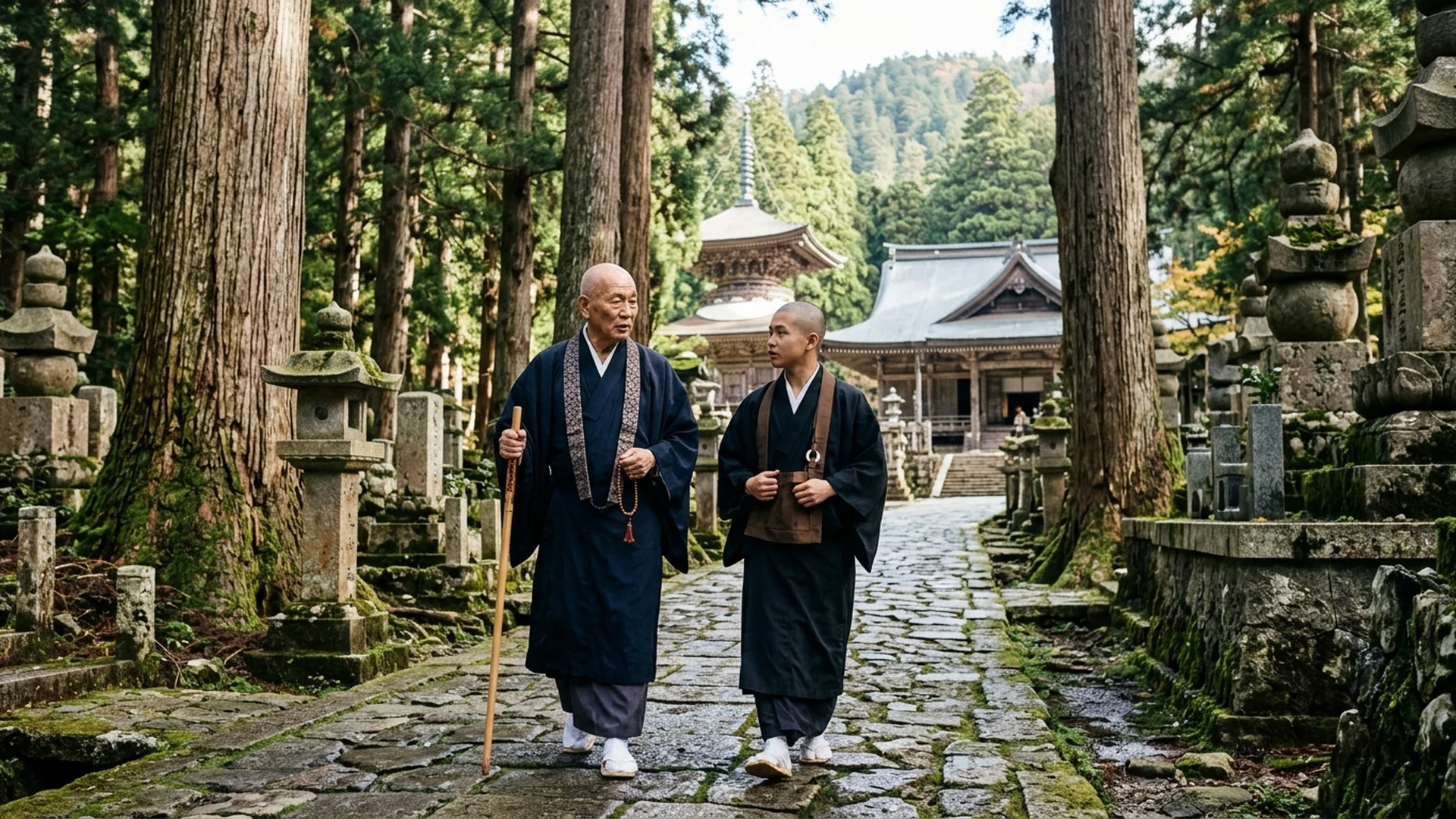
Amid the drifting morning mist that clings to the ancient cedar forests atop Mount Koya, the resonant toll of a bronze bell drifts softly through weathered wooden gates. This tranquil atmosphere marks the threshold of a pilgrimage across centuries, tracing the spiritual roots that have sustained Japanese civilization for over a millennium. Buddhism, having journeyed from India through China before reaching this island empire, transcended mere ritual observance. It wove itself intimately into the indigenous animist traditions, evolving into distinct schools that continue to profoundly shape Japanese philosophy, fine arts, architecture, and daily life.
To truly understand Japanese culture is to comprehend the intertwined histories of its four foundational Buddhist traditions: Shingon, Tendai, Zen, and Jodo (Pure Land). This evolution spans from the Heian period, when visionary master monks braved perilous seas in search of sacred texts, to the Kamakura period, when Buddhist wisdom expanded outward from the imperial court into the lives of samurai and commoners alike.
Embarking on a journey across these monastic sanctuaries and sacred peaks transcends historical tourism. It is a contemplative pilgrimage that invites the discerning traveler to explore the delicate equilibrium between humanity, nature, and the profound stillness at the core of Eastern philosophy.
Shingon and Tendai: The Twin Esoteric Sanctuaries of the Heian Era
In the early dawn of the Heian period during the ninth century, two brilliant young monks journeyed to Tang Dynasty China to study esoteric doctrine, returning to fundamentally transform the spiritual landscape of Japan. These master scholars were Saicho, founder of the Tendai school, and Kukai—posthumously revered as Kobo Daishi—founder of the Shingon tradition.
Tendai Buddhism planted its roots upon Mount Hiei, towering northeast of Kyoto, with Enryaku-ji serving as its grand administrative and spiritual hub. Saicho harmonized various teachings, placing the Lotus Sutra at the pinnacle of cosmic truth. Mount Hiei developed into medieval Japan’s largest monastic university, earning its reputation as the matrix from which nearly all subsequent reformers emerged.
Concurrently, Shingon Buddhism established its esoteric headquarters upon Mount Koyasan in Wakayama Prefecture. Kukai introduced Esoteric Buddhism, known as Mikkyo, which emphasizes spiritual realization through the ‘three mysteries’ of body, speech, and mind—manifested via sacred mudras, mantras, and complex mandalas. The core philosophy of Shingon proclaims that enlightenment is attainable within one’s current bodily existence (Sokushin Jobutsu). Deep within the Okunoin cemetery on Koyasan, devotees believe Kukai remains in perpetual deep meditation, offering eternal blessings to all sentient beings.
The Profound Silence of Zen: Meditation, Rock Gardens, and the Samurai Spirit
As political authority shifted from the aristocratic court in Kyoto to the military elite during the Kamakura period in the twelfth and thirteenth centuries, Zen Buddhism emerged as a powerful new spiritual anchor. Zen prioritized direct, experiential realization through seated meditation (Zazen), deliberately bypassing textual reliance in favor of unmediated awakening.
Japanese Zen bifurcated into two principal streams. The Rinzai lineage, introduced by Eisai, utilized paradoxical koan riddles to shatter conventional logic and provoke sudden awakening, earning the fervent patronage of the samurai class for its cultivation of ironclad discipline and fearlessness. Conversely, the Soto lineage, championed by Dogen, emphasized shikantaza—simply sitting in non-dualistic, open awareness.
The aesthetic footprint of Zen permeates Japanese design. Dry landscape gardens, or karesansui, such as the celebrated minimalist masterpiece at Ryoan-ji in Kyoto, distill vast cosmological expanses into quiet contemplation, while the tea ceremony elevates the appreciation of austere simplicity and impermanence (wabi-sabi).
The Pure Land Path: Devotion to Amitabha and Accessibility for All
While esoteric Shingon and austere Zen demanded rigorous ascetic discipline, the Pure Land traditions (Jodo-shu and Jodo Shinshu) opened a compassionate portal accessible to every stratum of society. Amidst the civil strife and natural calamities of the Kamakura era, the populace yearned for a spiritual refuge within reach of ordinary mortals.
Masters Honen, founder of the Jodo sect, and his disciple Shinran taught that in an era of spiritual decline, elaborate asceticism was unnecessary. Through sincere faith and the continuous invocation of Amitabha Buddha’s name—known as the nembutsu or ‘Namu Amida Butsu’—any practitioner could secure rebirth in the blissful Western Paradise.
This devotion inspired some of Japan’s most magnificent sacred art, exemplified by the towering bronze Great Buddha of Kamakura at Kotoku-in, resting in serene majesty under the open sky, and Byodoin Temple in Uji, whose Phoenix Hall was meticulously designed to mirror celestial palaces on earth.
Architectural Legacy and the Atmosphere of Sacred Grounds
The true allure of following the lineages of these four Buddhist traditions lies in experiencing the distinct physical and spiritual atmosphere of each sanctuary:
- Mount Koyasan: A high-plateau monastic town sheltered by ancient conifers, featuring the Danjo Garan temple complex with its vermilion Great Pagoda, alongside the mystical Okunoin cemetery.
- Mount Hiei: Overlooking the shimmering expanse of Lake Biwa, the Enryaku-ji precincts are thoughtfully divided across three distinct mountain zones, steeped in sublime isolation.
- Zen Temples in Kyoto and Kamakura: Sanctuaries such as Kencho-ji in Kamakura or Kennin-ji and Tofuku-ji in Kyoto showcase magnificent wooden architecture, raked gravel waves, and contemplative maple groves.
- Pure Land Sanctuaries: Defined by graceful symmetry and opulent halls dedicated to Amitabha, evoking boundless compassion and eternal peace.