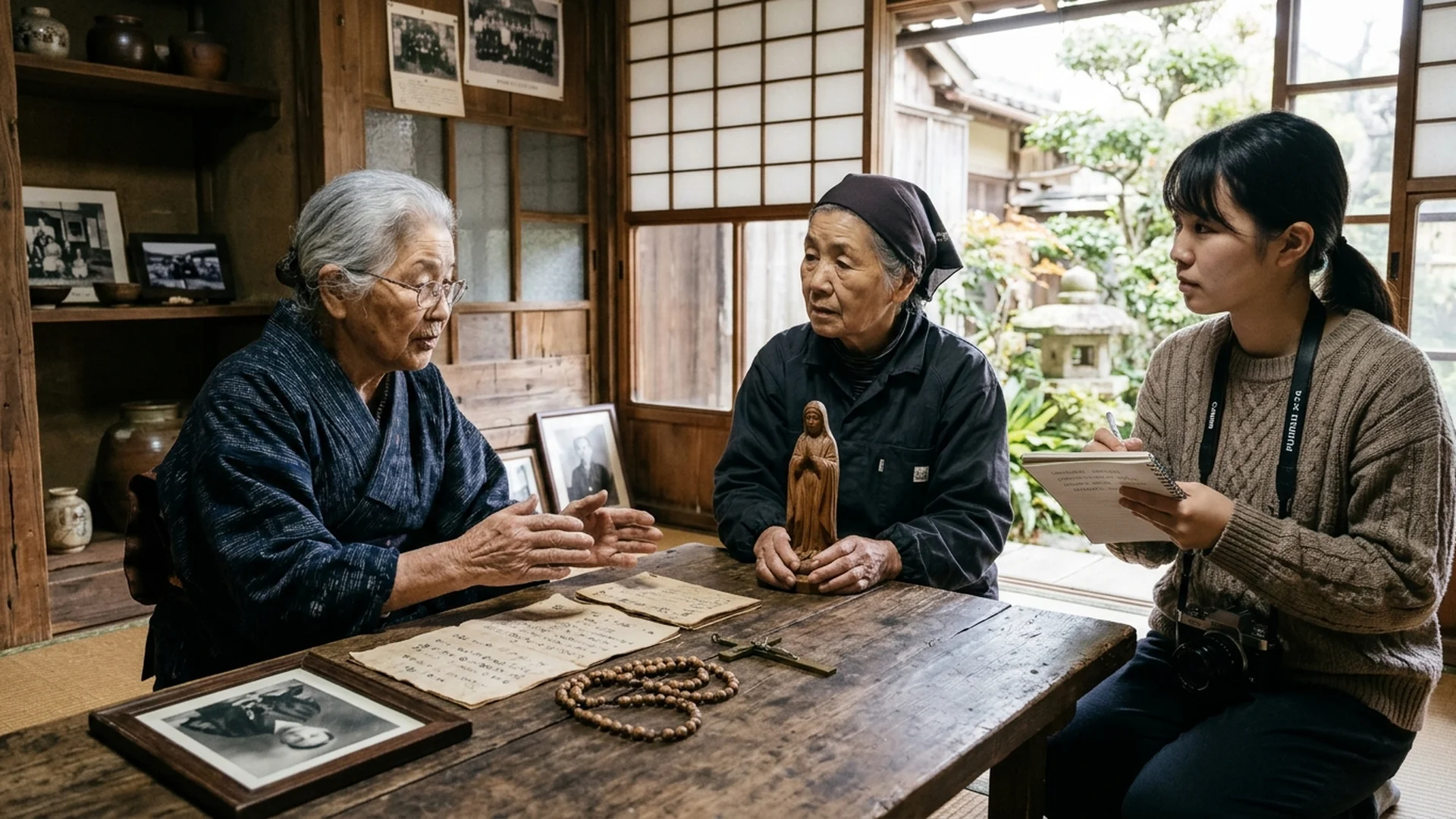
Beneath the tranquil contours of coastal hills and intricate rias in Nagasaki lies one of the most enduring testaments of human resilience and spiritual devotion in history. When the Edo shogunate decreed a total ban on Christianity under the Sakoku seclusion policy in 1614, believers faced an impossible ultimatum: recant under threat of brutal execution or embrace martyrdom. Yet, amidst the gathering darkness, a remarkable faction chose a third path. They descended into the shadows, outwardly adopting the guise of Buddhist and Shinto practitioners while quietly keeping the flame of their faith alive in secret for over two and a half centuries. These were the Kakure Kirishitan, or the Hidden Christians of Japan.
When clergy and churches were eradicated, the Kakure Kirishitan forged a profound underground liturgy and a covert cultural lexicon. Prayers in Latin and Portuguese were passed down orally, seamlessly blending with traditional Japanese cadences. Sacred iconography was ingeniously disguised within everyday objects, birthing the Maria Kannon—images of the Virgin Mary discreetly masked as the Buddhist deity of compassion, Guanyin. The most astonishing revelation came in 1865, when a group of villagers from Sotome stepped inside Oura Cathedral in Nagasaki to whisper a secret guarded for seven generations: ‘Our hearts are identical to yours.’
Tracing the heritage of the Hidden Christians across Nagasaki and Amakusa is not merely a tour of sacred architecture or UNESCO-listed sanctuaries. It is an unhurried pilgrimage into a landscape steeped in spiritual gravity, historical scars, and profound questions regarding the absolute limits of human conviction.
From Nanban Trade to Silence: Decoding Two Centuries of Underground Survival
Christianity first arrived in Japan in 1549 through St. Francis Xavier via the Nanban trade routes. Initially, southern daimyos in Kyushu welcomed the faith for both spiritual reasons and the acquisition of Western firearms and goods. As Christianity flourished in Nagasaki, hundreds of thousands converted. However, as Toyotomi Hideyoshi and later the Tokugawa shogunate consolidated power, the new faith was increasingly viewed as a geopolitical threat to feudal stability.
In 1614, the absolute prohibition of Christianity was decreed, resulting in the expulsion of missionaries, the demolition of churches, and the implementation of fumi-e—bronze plaques bearing images of Christ or the Virgin Mary that citizens were forced to trample to prove they were not Christian. Refusal meant torture and execution. The subsequent Shimabara Rebellion (1637–1638), led by Christian peasants and masterless samurai, prompted the shogunate to eradicate the faith entirely and enforce the Sakoku isolation policy for over two centuries.
To survive, the Kakure Kirishitan completely restructured their communal lives. Lacking ordained priests, they elected village leaders to oversee the liturgical calendar (Chokata) and administer baptism (Osuzukata). Latin and Portuguese prayers were compressed into short chants known as Orasho, whispered down through generations until they took on a cadence easily mistaken for Buddhist sutras.
The Art of Camouflage: Decoding Maria Kannon and Secret Symbolism
The most tangible evidence of the Kakure Kirishitan’s survival strategy is their creation of covert symbols woven into daily life. Most renowned is the Maria Kannon—porcelain or wood-carved statues of the Buddhist goddess holding a child, sourced from Dehua in China or local artisans. To government inspectors, these were standard Buddhist idols; to the faithful, the infant was the Christ child and the deity was the Virgin Mary. Some sculptures bore microscopic crosses carved ingeniously onto their bases.
Beyond sculptures, crosses were hidden within ancestral spirit tablets (Ihai), etched into the grain of wooden lintels behind Buddhist altars (Butsudan) and Shinto shelves (Kamidana), or represented simply by heart-cockle shells found by fishermen in Sakitsu, whose natural valve patterns mirrored the cruciform.
UNESCO Landmarks: From Oura Cathedral to the Fishing Heritage of Sakitsu
The UNESCO World Heritage property designated as ‘Hidden Christian Sites in the Nagasaki Region’ encompasses 12 components scattered across Nagasaki and Kumamoto prefectures, each reflecting different eras of concealment and eventual rediscovery.
The anchor of this narrative is Oura Cathedral in central Nagasaki, erected in 1864 by French missionaries to honor the Twenty-Six Martyrs of Japan. As the oldest standing Gothic-style church in the country, it was the backdrop for the 1865 discovery when Sotome villagers approached Father Bernard Petitjean to confess their generational secret—an event lauded by the Vatican as the ‘Miracle of the East.’
Further north lies Sotome, a rugged, isolated coastal expanse that once served as a sanctuary. Here, Shitsu and Ono churches rise from local stone, blending seamlessly into the mountainous terrain. Another vital pilgrimage point is Sakitsu Village in Amakusa, Kumamoto. Set within a traditional fishing community, Sakitsu Church stands on the very site of the former village headman’s house, its interior lined with tatami mats to honor both local customs and Western sacred architecture.