When conjuring the essence of the Japanese archipelago, the mind often drifts toward illuminated neon metropolises, minimalist architectural sanctuaries, or centuries-old temples. Yet beneath this veneer of hyper-modernity lies an ancient, untamed wildness. Across the length of the nation, five distinct UNESCO Natural World Heritage sites preserve ecosystems of staggering primordial beauty, stretching from the misty, southernmost rain-drenched shores to the freezing, drift-ice-choked waters of the far north.
From primordial primeval forests shrouded in eternal fog to floating ice floes off the coast of Hokkaido, these protected landscapes are far more than mere geographical curiosities. They function as living biological laboratories where evolution unfolds in timeless isolation. Delving into the intricate ecosystems of these five sanctuaries offers a deeply contemplative journey into the heart of the natural world’s purest cycles.
1. Yakushima and Shirakami-Sanchi: Two Contrasting Primeval Sanctuaries of Honshu and Kyushu
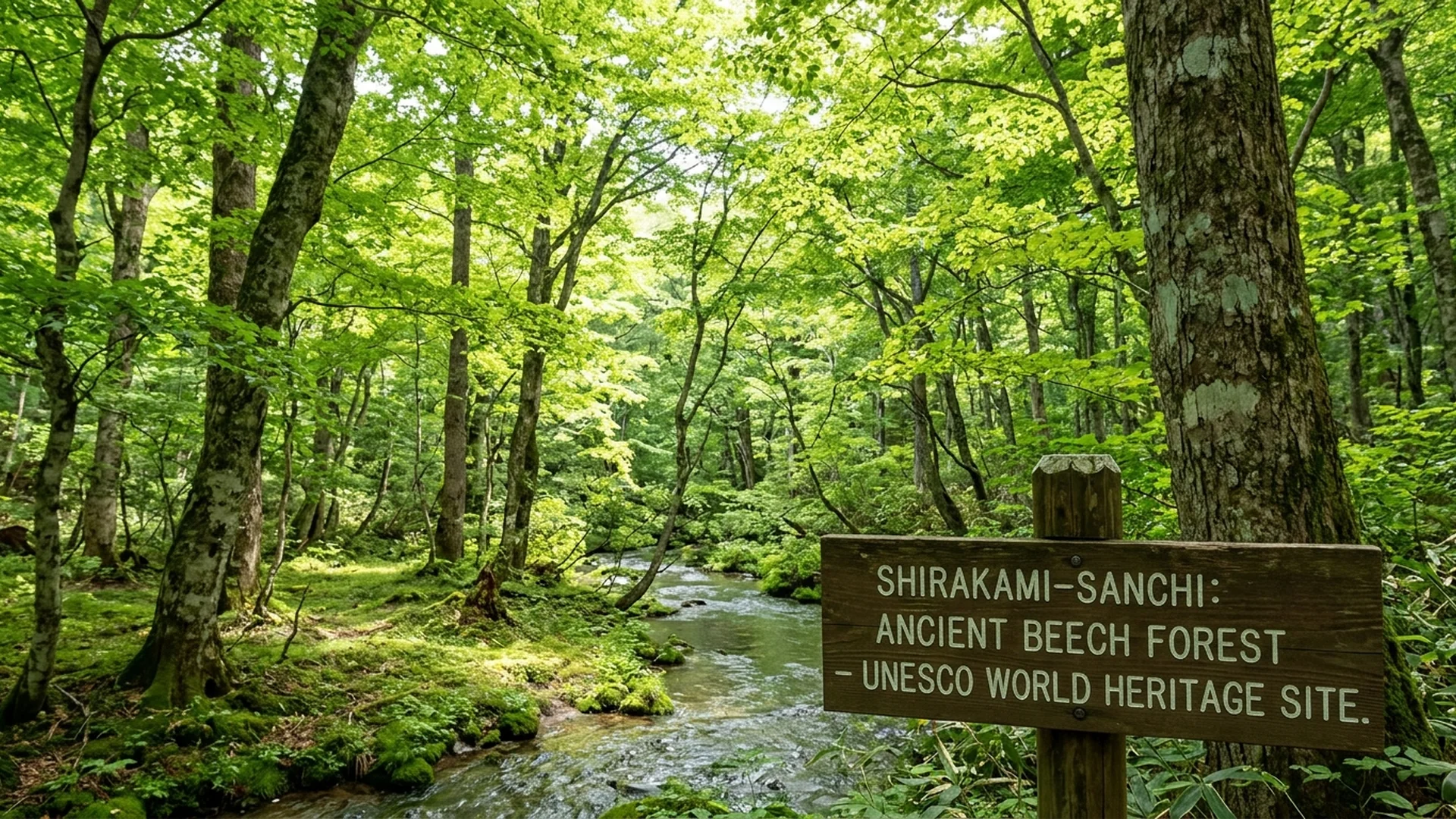
Japan’s legacy as a custodian of natural world heritage commenced in 1993 with the inscription of two profoundly contrasting landscapes. Yakushima, an island soaring from the southern seas of Kagoshima Prefecture, is an emerald cathedral where ancient ‘Yaku sugi’ cedars, aged over a millennium, sink their roots deep into a perpetually rain-kissed earth. The haunting, moss-draped silence of this rainforest famously inspired legendary cinematic depictions of enchanted woodland spirits. Conversely, Shirakami-Sanchi—straddling Aomori and Akita prefectures—protects the largest remaining virgin Siebold’s beech forest in East Asia, entirely untouched by human intrusion. Acting as a monumental natural sponge, this forest sustains the fertility of the valleys below, offering a powerful testament to the quiet majesty of unadorned wilderness.
2. Shiretoko: The Edge of the Earth and the Breath of the Sea Ice
Far to the northernmost frontier lies the Shiretoko Peninsula in Hokkaido, its name derived from the Ainu word meaning ‘the place where the earth protrudes.’ Here, warm and cold ocean currents collide, delivering nutrient-rich plankton to rugged shores. This convergence creates a rare ecological phenomenon: Shiretoko is the lowest latitude in the Northern Hemisphere where winter drift ice drifts directly onto the coast. The marine and terrestrial ecosystems are intimately bound together, from transient killer whales and migrating salmon to coastal brown bears foraging along the tideline, illustrating an unbroken, holistic food web.
3. Ogasawara and Amami-Okinawa: The Galápagos of East Asia
To comprehend absolute geographic isolation, one must look to the Ogasawara Islands—located roughly 1,000 kilometers south of Tokyo—and the Amami-Okinawa island chain. Having never been connected to the continental landmass throughout geological history, Ogasawara allowed flora and fauna to evolve along entirely independent trajectories, resulting in breathtakingly unique endemic species. Similarly, the southern island groups inscribed more recently in 2021 serve as the sole earthly sanctuaries for rare, endangered fauna such as the Iriomote cat and the Ishikawa’s frog, species found nowhere else on the planet.