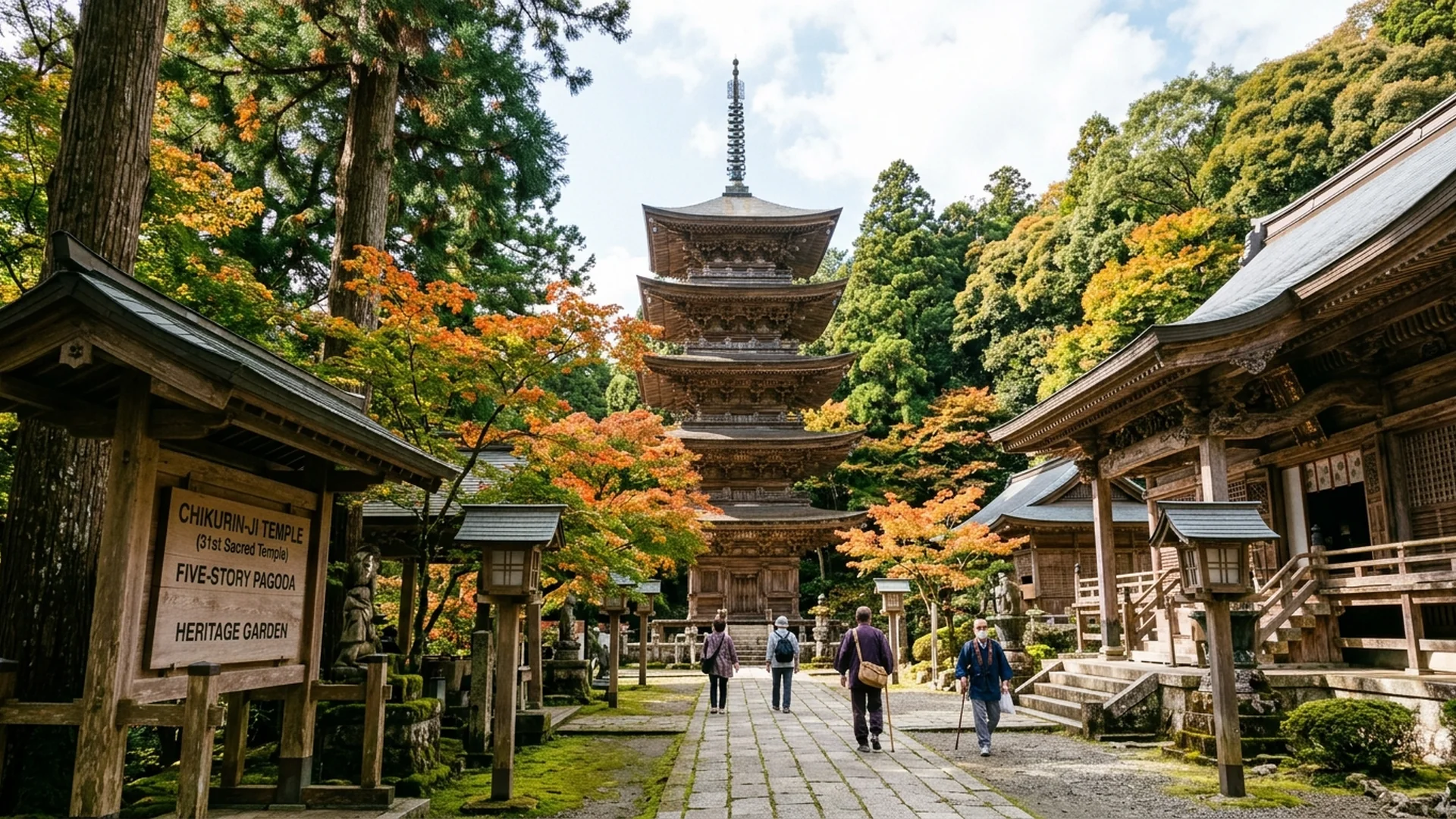
As the morning mist lifts and the golden twilight settles over the crest of Mount Godaisan in Kochi Prefecture, a gentle chant carried by the breeze through ancient bamboo groves and venerable timber halls invites travelers into another dimension of time. This is Chikurin-ji Temple, the thirty-first sacred sanctuary along the revered Shikoku 88 Temple Pilgrimage. More than a vital milestone of deep spiritual devotion, the temple functions as a living natural gallery, masterfully uniting ancient wooden architecture, exquisite Japanese garden design, and profound, unhurried stillness.
Approaching Chikurin-ji feels akin to stepping away from the clamor of the modern world and entering a sanctuary of intellectual and spiritual repose. Framed by the deep emerald embrace of towering pines and seasonal maples that blush with autumn crimson, the striking vermilion silhouette of its five-story Hinoki cypress pagoda stands in poetic contrast to the dense surrounding wilderness. It is an unforgettable tableau that speaks to the meticulous mastery of historic artisans and the enduring breath of Zen philosophy lingering in every corner of this lofty mountain realm.
A Junction in Time: History and Wisdom Atop Mount Godaisan
Chikurin-ji was established in the early eighth century by the esteemed wandering priest Gyoki, acting under the imperial decree of Emperor Shomu. The sovereign commanded the construction of this holy monastery upon Mount Godaisan, named in reverent homage to China’s sacred Mount Wutai due to their striking topographic similarities. What sets Chikurin-ji apart from the hundreds of other sacred sites across Shikoku is its primary dedication to Monju Bosatsu, the Bodhisattva of Wisdom and transcendent intellect. Consequently, alongside white-robed pilgrims seeking spiritual liberation, the temple has historically drawn scholars, poets, and seekers longing to refine their inner clarity and sharpen their philosophical insight.
Architectural Masterpieces: The Main Hall and Hinoki Five-Story Pagoda
Passing beneath the temple’s stately entrance gates, visitors encounter the breathtaking architectural legacy of pre-modern Japan. The Main Hall (Hondo) of Chikurin-ji is designated as an Important Cultural Property of Japan, showcasing time-honored timber joinery dating back to the Muromachi period, topped with curved tile and wood roofing crafted by master imperial builders. Nearby stands the luminous five-story pagoda, reaching a height of 31.2 meters. Built entirely from premier local Hinoki cypress without the use of a single metal nail, the structure reflects sophisticated earthquake-resistant engineering while cutting a striking, elegant profile against the deep forest canopy of the mountain.
The Aesthetics of Japanese Gardening: An Art Form of Stone, Water, and Moss
Another crowning jewel of Chikurin-ji is its traditional temple garden, celebrated formally as a Place of Scenic Beauty by the national government. Landscape design here strictly adheres to Zen principles, emphasizing natural rock arrangements that evoke wild mountain streams and precipitous crags, all cushioned by a velvety carpet of diverse moss species. Interspersed with ancient maples and towering evergreens, the garden transforms when morning sunlight pierces the canopy, casting a luminous, otherworldly glow across dew-kissed moss. It offers a deeply meditative sanctuary that gently coaxes visitors away from worldly haste and into restorative tranquility.