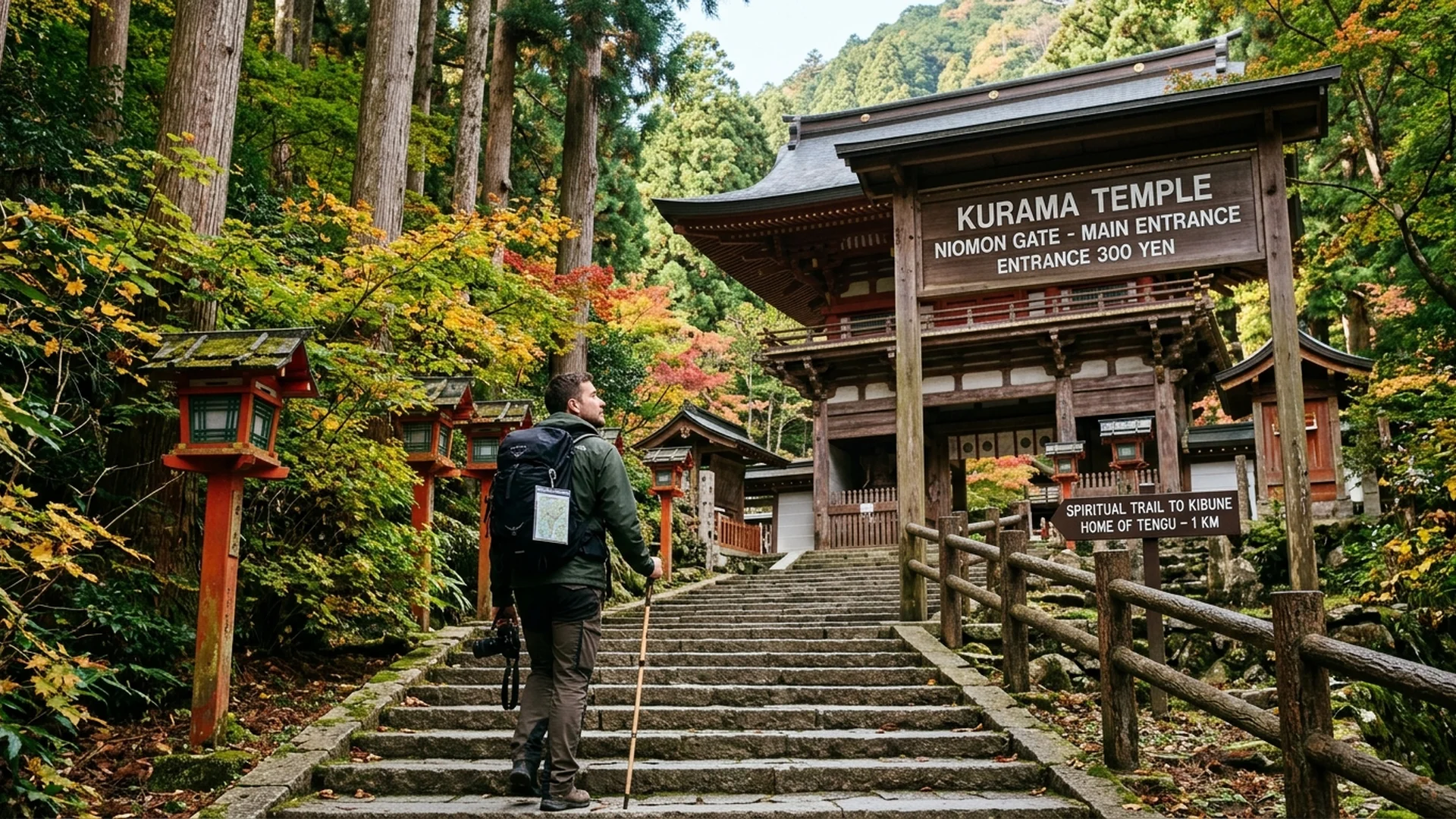
As the morning mist gently caresses the ancient pine trees of Mount Kurama in northern Kyoto, the soft chime of a temple bell cuts through the profound silence of the forest. This is far more than a conventional religious site; it is a sacred mountain sanctuary enveloped in lingering mystical energies and over a millennium of spiritual history.
Far removed from the bustling city streets of Kyoto, Kurama-dera stands proudly upon a steep forested slope where nature and spirituality deeply converge. From ancient folklore surrounding the legendary mountain-guardian Tengu to its status as the global birthplace of Reiki healing, this sacred peak serves as an ultimate destination for discerning travelers seeking inner stillness and a profound encounter with nature.
Sonten and the Star Mandala: The Cosmic Energy Center of the Summit
Deep within the sacred precincts of Kurama-dera, the principal deity enshrined defies conventional Buddhist iconography. Known as ‘Sonten’, which translates to the ‘Great Spirit of the Universe’, this deity is believed by the temple’s lineage to be the tripartite trinity of the cosmos: the sun (representing light and Bishamon-ten), the moon (representing love and Kan-jiten), and the earth (representing vital life force and Son-ten).
Upon ascending to the broad stone terrace before the main hall (Hondo), visitors encounter the striking six-pointed star pavement known as Kongo-teki, widely revered as the epicenter of cosmic energy on the mountain. The surrounding atmosphere is infused with crisp mountain air and the faint scent of incense, inviting the traveler to pause, quiet the mind, and align their inner self with the vast natural energies radiating from the surrounding peaks.
Tengu Footprints and Reiki Roots: Living Legends of the Forest
Mount Kurama is not merely a place of silent contemplation; it is a landscape woven with rich folklore. According to ancient Japanese tradition, this mountain is the domain of Sojobo, the legendary King of the Tengu—powerful, winged mythic beings said to have instructed the young samurai hero Minamoto no Yoshitsune in the lethal arts of swordsmanship. Echoes of these tales resonate throughout the geography and oral histories of the pilgrimage trail.
In a more contemporary dimension, Kurama holds deep significance for practitioners of global energy healing. In 1922, Master Mikao Usui ascended this mountain to fast and meditate for twenty-one days, culminating in a profound spiritual awakening and the reception of the Reiki principles. Consequently, Kurama remains a cherished spiritual homeland for energy practitioners from across the globe.
The Ancient Tree-Root Path and the Journey to Kibune Shrine
No exploration of Kurama is complete without traversing the ‘Ki-no-ne Michi’, or the Ancient Tree-Root Path. This mesmerizing trail winds from the upper temple grounds down the rear slopes of the mountain, where massive cedar roots have wrestled their way above the stony soil, forming gnarled, sculptural natural staircases. These exposed roots stand as a testament to the resilient life force required to thrive in the harsh mountain terrain.
Meandering downward through the serene forest canopy brings the traveler to Okunoin Mao-den hall before culminating in the picturesque village of Kibune. Here, visitors connect with Kibune Shrine, an ancient sanctuary nestled alongside a rushing stream dedicated to the deity of water and harmonious relationships. Crossing the mountain ridge from Kurama to Kibune is an exquisite synthesis of mindful exercise, forest bathing, and emotional renewal.