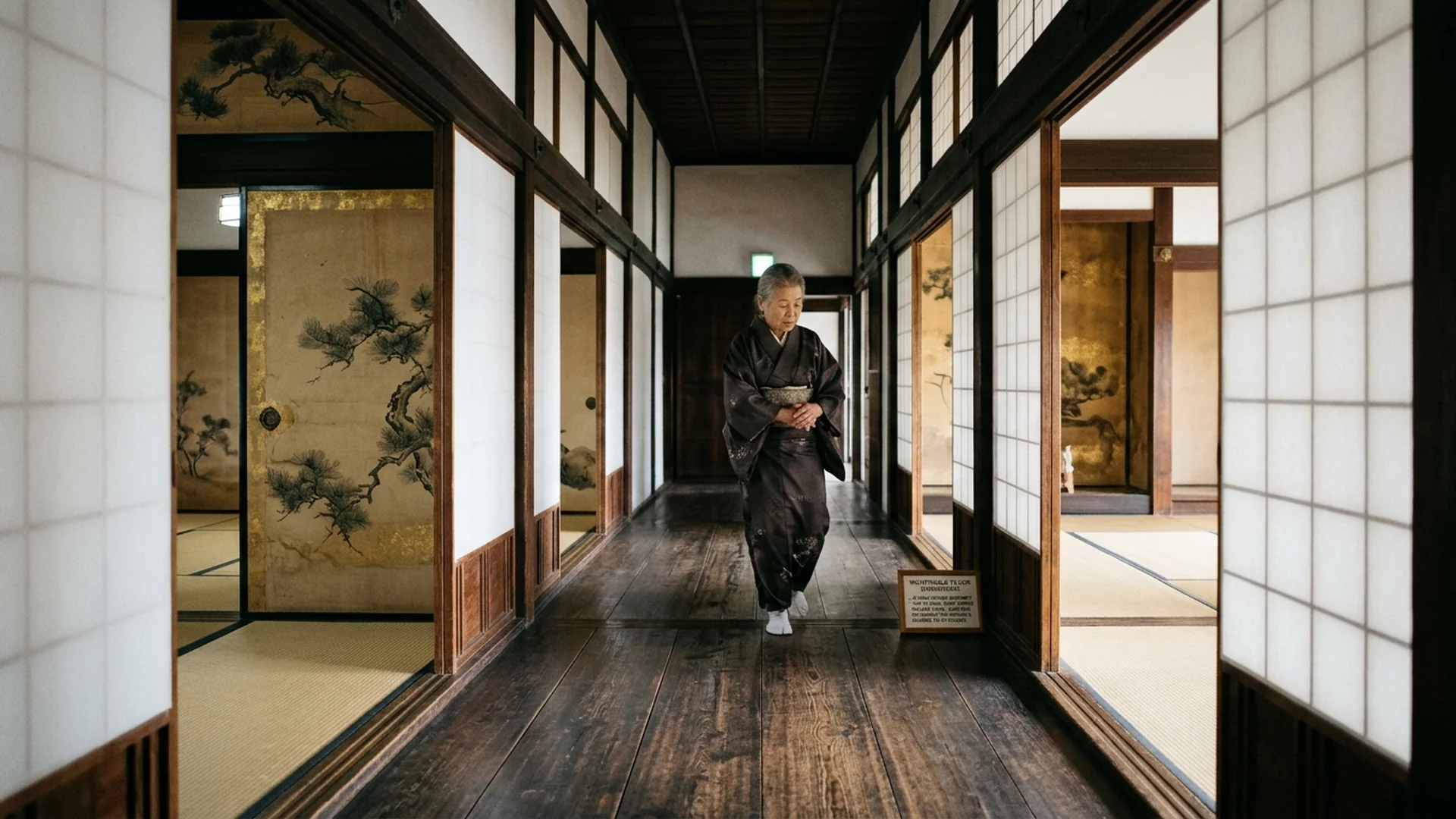
When stepping through the ornate Karamong Gate into the tranquil stone ramparts and protective moats of Nijo Castle, one does not merely enter an ancient historical site; one crosses a crucial threshold in the destiny of Japan. This fortress served as both an unyielding symbol of absolute military might established by Tokugawa Ieyasu—founder of the military regime that ruled Japan for over two centuries—and the dramatic final stage for the restoration of imperial power. Every footstep upon the wood planks that sing like nightingales and every nuance of the gold leaf wall paintings whisper tales of glory, political maneuvering, and master craftsmanship untouched by time.
The Rise and Fall of the Shogunate: A Kyoto World Heritage Monument
If Kyoto is the spiritual heart of Japan, Nijo Castle is its most formidable monument to political power. Tokugawa Ieyasu, the unifier who brought enduring peace to the realm and established the shogunate, commissioned Nijo Castle in 1603 as his secure stronghold during visits to Kyoto to pay homage to the Emperor. Its grand scale and imposing design were deliberate declarations to the imperial court that supreme governance now rested firmly within the hands of the Edo government. The castle’s historical arc is profoundly compelling, as this exact location witnessed both the dawn of the shogunate era and its twilight, when Tokugawa Yoshinobu, the final shogun, surrendered all governing authority back to Emperor Meiji in 1867, officially closing Japan’s feudal chapter. This UNESCO World Heritage site is therefore not merely a collection of ancient timber, but the profound intersection of two great historical epochs.
The Architecture of Ninomaru Palace and the Ingenious Nightingale Floors
The emotional and historical pinnacle of any visit to Nijo Castle is the Ninomaru Palace, an intricate complex of five interconnected structures distinguished by delicate wood carvings and bronze fittings. Yet, what endlessly fascinates international travelers and historians alike is the Uguisubari, or ‘nightingale floor.’ This sophisticated anti-intrusion mechanism is concealed entirely beneath the wooden walkways. Whenever an individual steps upon the corridor, specially calibrated floorboards and hidden metal brackets rub together to produce a resonant chirping sound remarkably akin to the song of a nightingale. Designed so that no intruder could walk in absolute silence, this acoustic security system guarded against assassins and unauthorized visitors during volatile eras. Furthermore, the interior spatial hierarchy vividly mirrors feudal society: the reception halls designed for visiting daimyo lords are positioned lower than the shogun’s elevated dais, ensuring guests gazed upward in subservience, while hidden chambers behind wall screens allowed personal bodyguards to maintain constant surveillance.
The Masterworks of the Kano School and Three Distinct Japanese Gardens
Upon crossing the threshold into the palace chambers, visitors are immediately enveloped in the luminous brilliance of wall paintings and sliding screens created by master painters of the Kano School. Tigers and majestic eagles rendered across shimmering gold leaf backgrounds served not merely an aesthetic purpose, but were deliberately crafted to project awe and intimidate visiting provincial lords. The tigers, in particular—rendered by artists who had never seen a live beast, relying instead on imaginative interpretations of large felines—exude a ferocious, stylized majesty. Beyond the interior galleries, the estate unfolds into magnificent Japanese gardens. These begin with the Ninomaru Garden, a classic shoin-style landscape featuring expertly arranged stones and reflecting ponds, followed by the Seiryu-en garden, constructed in modern times to entertain visiting international dignitaries, and tranquil groves of plum and cherry trees that change with the turning seasons.