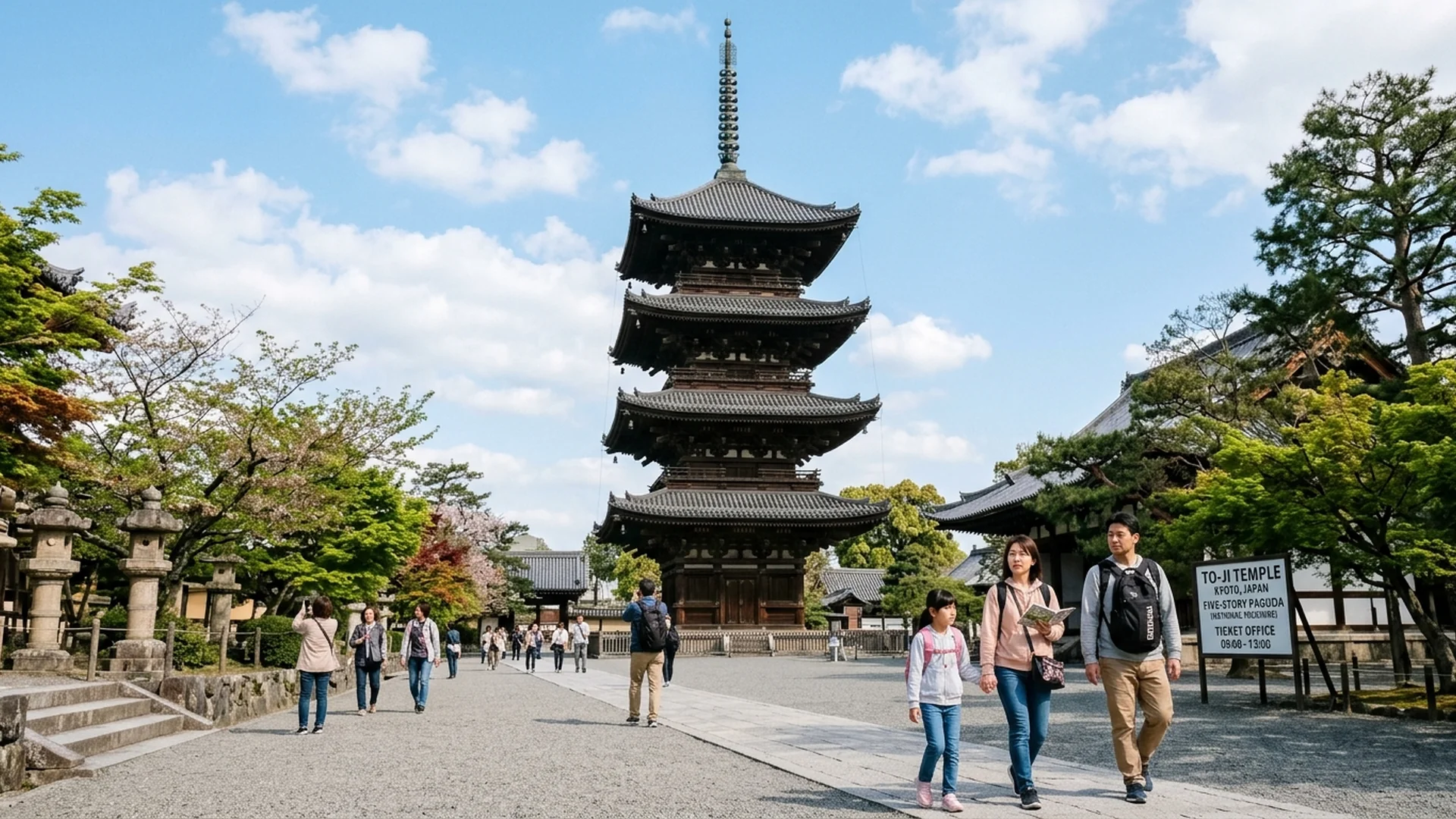
As the Shinkansen glides toward Kyoto Station, the skyline’s first historic greeting is not a modern skyscraper, but the brooding, crimson silhouette of an ancient wooden pagoda defying the centuries. This is To-ji—formally known as Kyōhō-goku-ji—a UNESCO World Heritage site that stands not merely as a geographical landmark, but as the enduring spiritual pulse of Japan’s ancient imperial capital.
Commissioned in 794 by Emperor Kanmu when the capital moved to Heian-kyō (modern-day Kyoto), To-ji was originally erected at the southern gateway alongside its counterpart, Sai-ji, to serve as a spiritual bulwark protecting the nation. Yet among the great imperial temples of antiquity, To-ji alone survives in its magnificent entirety, preserved through the visionary prayers and profound philosophy of Kobo Daishi—also known as Master Kukai—the revered patriarch of Japanese Shingon Buddhism.
Crossing the threshold into To-ji today is nothing less than stepping across the threshold of time into a sophisticated cosmological realm woven from timber, artistry, and quiet devotion. It invites discerning travelers to unravel a legacy of beauty quietly hidden within one of the world’s architectural masterpieces.
The Esoteric Cosmos of Kodo Hall: A Three-Dimensional Mandala
The beating heart that entrances every architecture enthusiast and student of sacred art at To-ji is the Kodo Lecture Hall. Rather than housing solitary altars for conventional worship, this sacred space arranges twenty-one statues in precise formation to manifest a mandala—a physical blueprint of the universe according to Mikkyo, or Esoteric Buddhism.
Kobo Daishi translated the unfathomable complexities of the cosmos into tangible, three-dimensional form. At the center reigns Dainichi Nyorai (the Cosmic Buddha), surrounded by clusters of Tathagatas and wrathful Myo-o deities—such as Fudo Myo-o—whose fierce compassion subdues inner spiritual defilements. Sculpted primarily during the early Heian period from Japanese cypress (hinoki), these statues retain their formidable presence and serene grace through gilded surfaces and flowing drapery, defying a millennium of passing time.
Gojutono Pagoda: Engineering Marvel and Japan’s Tallest Wooden Spire
Undeniably, the most iconic silhouette of To-ji is its Gojutono (Five-Story Pagoda), piercing the Kyoto sky at an elevation of fifty-five meters. The present structure was erected in 1643 under the decree of Shogun Tokugawa Iemitsu after earlier iterations succumbed to fires.
The brilliance of the pagoda lies less in its staggering height than in its mastery of ancient seismic engineering, constructed entirely without nails. Each tier diminishes gracefully upward to absorb seismic tremors. Furthermore, the massive central pillar (shinbashira) running from spire to foundation acts as an ingenious stabilizing axis. As late-afternoon light rakes across the deep vermilion wood against a crisp Kyoto sky, its reflection mirrored in the tranquil waters of Hiyoshi Pond creates an unforgettable tableau of quiet splendor.
The Library and Intellectual Legacy of Kobo Daishi
Beyond its towering pagodas and halls, To-ji functions as a profound repository of cultural intellect, preserving ancient scriptures, master calligraphy, and priceless artifacts within the Homotsuden (Temple Treasure House), which opens seasonally during spring and autumn.
These collections mirror the polymathic genius of Kobo Daishi, who was not merely an ascetic master, but a visionary poet, calligrapher, and civil engineer who shaped the spiritual architecture of Japan. Encountering these relics offers international travelers an authentic window into Japanese heritage far beyond superficial sightseeing.