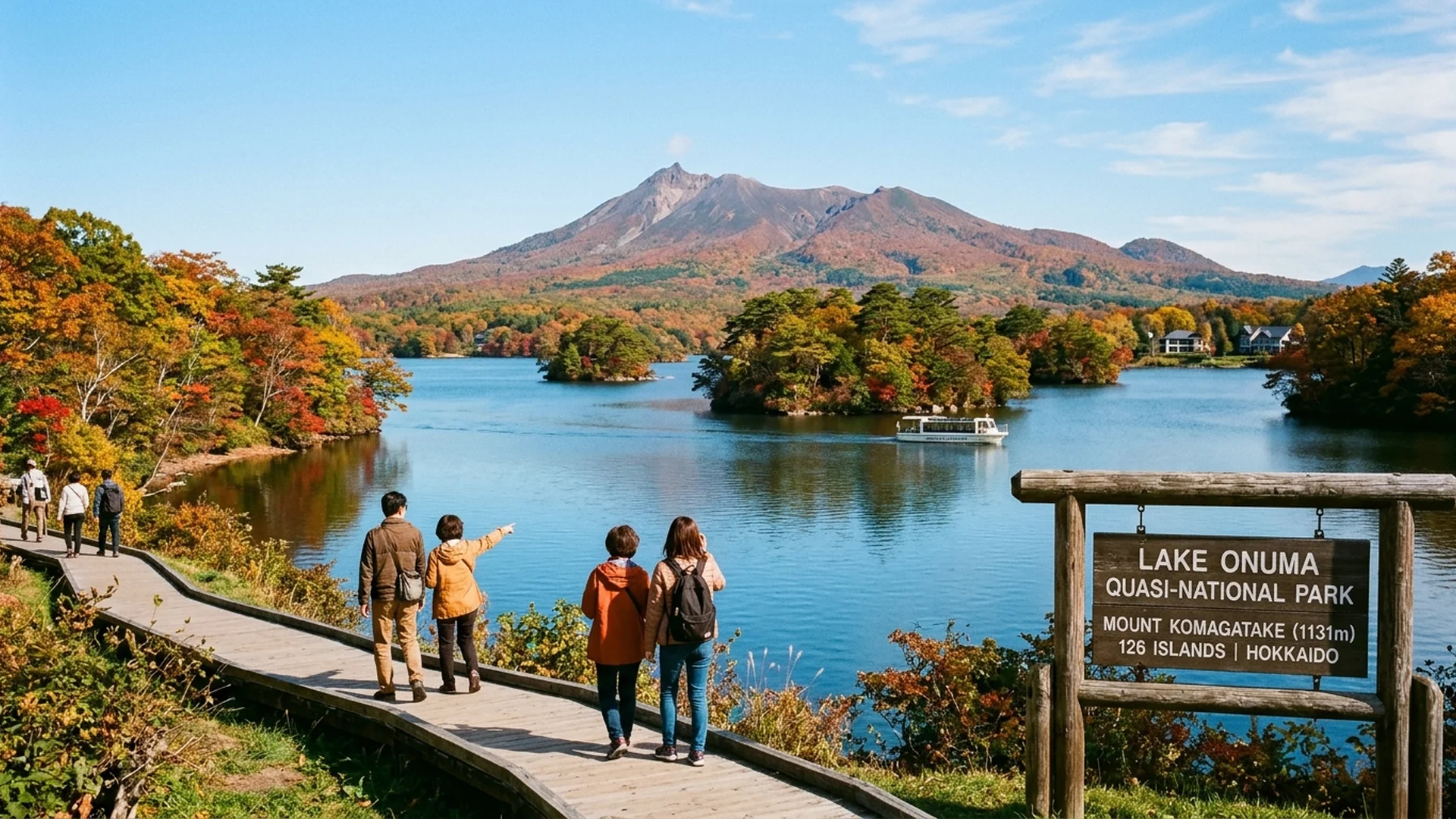
Travelers frequently overlook this serene lowland basin, treating it merely as a fleeting railway stop on the express line connecting Hakodate and Sapporo. Yet beyond the passing train window lies Lake Onuma, a precious jewel cradled within the Onuma Quasi-National Park—a landscape forged through centuries by the proud, towering volcanic energy of Mount Komagatake.
This is far more than a conventional body of water; it resembles a classical East Asian ink wash painting brought to life upon the northern expanse of Hokkaido. Its intricate geography features no fewer than 126 nascent islets floating in pristine, emerald-hued waters, bound together by an ethereal network of 18 pedestrian bridges. Here, discerning visitors find an effortless escape into slow and premium travel, where every measured footstep becomes a silent dialogue between the soul and untouched nature.
Genesis of the Northern Matsushima: The Legacy of Mount Komagatake
Beneath the delicate, picturesque exterior of Lake Onuma lies a dramatic, powerful geological history. Mount Komagatake, dominating the horizon with its distinctive saw-toothed summit, once unleashed monumental eruptions that sent torrents of volcanic rock and debris cascading down to obstruct ancient riverbeds. This cataclysmic shaping carved out three primary basins: Lake Onuma, Lake Konuma, and Lake Junsai-numa.
This natural wonder scattered 126 diverse islands across the waters, earning the region its illustrious moniker as the Matsushima of Hokkaido—drawing comparison to Miyagi Prefecture’s famed coastal scenic bay. The pristine reflection of Mount Komagatake cast upon the glass-like surface of the lake at dawn remains an iconic tableau that photographers and artists worldwide travel great distances to witness.
The Art of the Footbridge: Traversing 18 Spans to the Heart of the Isles
The truest appreciation of Lake Onuma unfolds at a pedestrian pace, following nature trails that weave across the waters via eighteen harmoniously designed wooden bridges. Each bridge introduces a unique perspective and architectural grace, guiding travelers through ancient pine forests, wild undergrowth, and indented shorelines kissed by cool mountain breezes.
For those seeking active, private exploration, cycling the fourteen-kilometer perimeter or chartering a private canoe to navigate narrow straits inaccessible to motorized watercraft offers a truly high-end immersion into silence. The gentle lap of paddles against the water, accompanied by the distant calls of migrating cranes and wild swans, provides nature’s finest acoustic therapy.
Symphony of Time: The Four Seasons of Onuma
Lake Onuma resists the notion of a singular defining visit; its character transforms completely with the turning of the seasonal wheel. In summer, the waters bloom with pristine white and yellow water lilies, framed by crisp, invigorating mountain air that offers a welcome respite from the bustling metropolis.
When autumn arrives—typically from mid to late October—the surrounding forests ignite in brilliant shades of crimson, burnished gold, and amber maple leaves, mirrored flawlessly upon the glassy water. As winter descends, an icy stillness coats the entire lake, turning it into an open-air sanctuary where travelers delight in traditional wakasagi (pond smelt) ice fishing, savoring the delicate catches freshly prepared against the crisp chill.