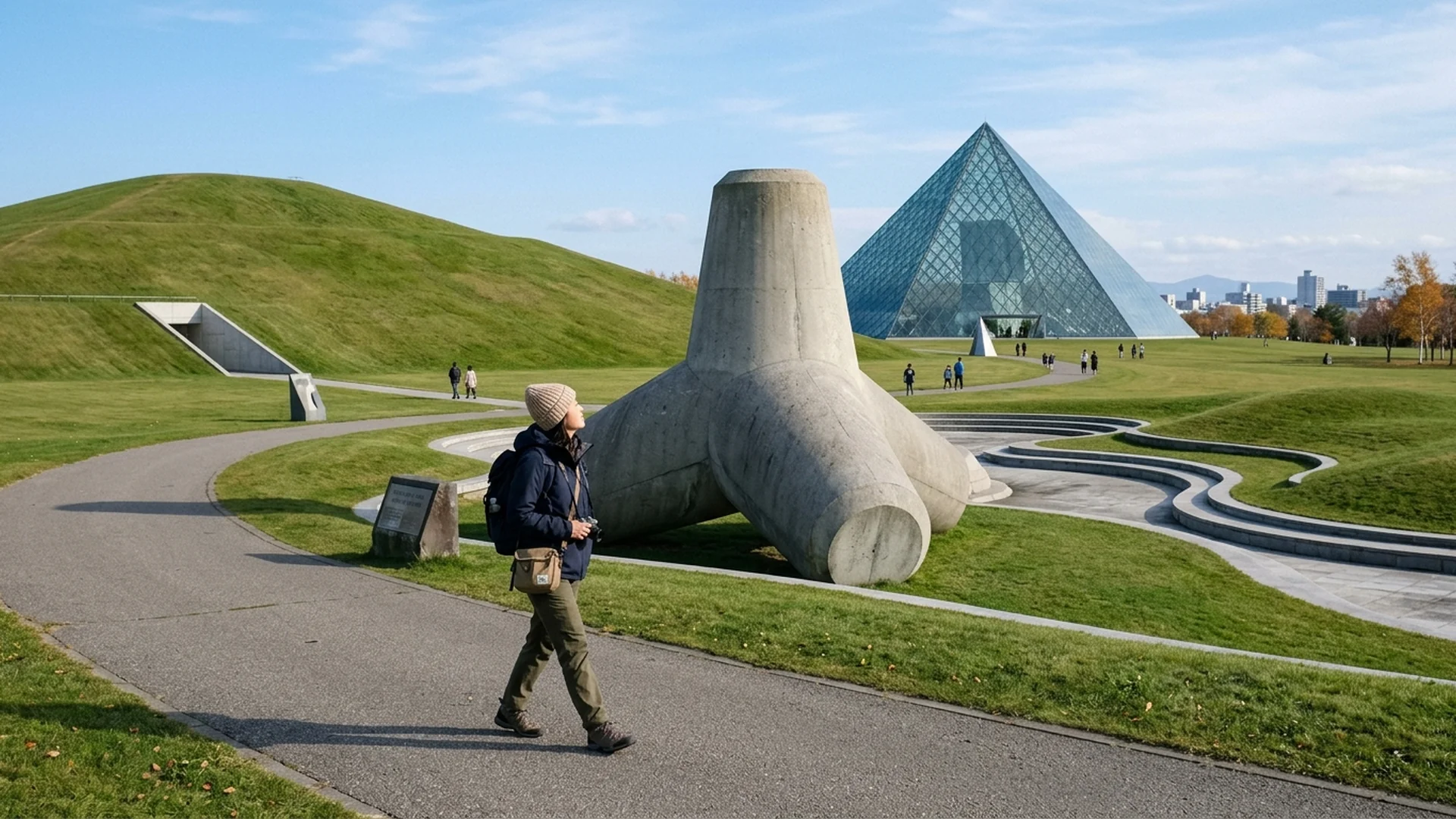
Amidst the vibrant lights and bustling density of Sapporo lies an expansive sanctuary defined by pure geometric lines and meticulously sculpted terrain. This is no ordinary public park; it is the world’s only massive earth sculpture designed as a single, cohesive work of art. Moerenuma Park stands as the powerful final testament of Isamu Noguchi, the visionary Japanese-American sculptor and landscape architect who dedicated his final breath to transforming a neglected municipal waste site into a vibrant, enduring outdoor museum.
Rooted in the philosophy of ‘The Whole Being a Single Sculpture,’ every acre of this 180-hectare landscape is steeped in intentionality. Noguchi did not simply design a recreational space; he sought to seamlessly fuse humanity, nature, and architecture into one living entity. Every footstep upon the immaculate lawns, every ascent up the contoured hills, and every gaze across the reflective waters offers discerning travelers an immersive journey into the brilliant mind of a 20th-century artistic master.
From Emptiness to the Aesthetics of Rebirth
The genesis of Moerenuma Park stems from Sapporo’s ambitious Circular Greenbelt Concept, yet its elevation into an international artistic pilgrimage site is entirely due to the involvement of Isamu Noguchi in 1988. Once a sprawling municipal waste disposal site and natural marshland, the terrain was reshaped through cutting-edge landscape engineering and refined earth-moving techniques. Noguchi devoted the final years of his life to meticulously mapping every square meter of the park. Although he passed away before its completion, his comprehensive master plan and blueprints were faithfully executed, culminating in its grand opening in 2005 as a monumental tribute to environmental stewardship and spatial harmony.
Architecture of Light and Shadow: HIDAMARI and Mount Moere
The intellectual and visual anchor of the park is HIDAMARI, a striking structural glass pyramid that serves as the central pavilion. Inside this luminous atrium, natural light dances effortlessly across minimalist surfaces throughout the day. The building also ingeniously harnesses subterranean winter snow storage to cool its interior during warmer months, presenting an exemplary model of environmentally conscious architecture.
Nearby stands Mount Moere, a 62-meter artificial peak constructed from recycled materials and excavated earth. Ascending its stone steps or winding pathways rewards the traveler with an uninterrupted 360-degree panorama of Sapporo and its framing mountain ranges. The tranquil atmosphere at the summit invites deep contemplation, offering a profound sense of seclusion from the rush of the modern world.
A Dialog Among Water, Art, and the Four Seasons
Water is treated as a dynamic sculptural medium within the park. Chief among these installations is the Sea Fountain, positioned at the heart of the grounds, which launches dramatic geysers skyward in choreographed sequences that interact brilliantly with sunlight and mountain breezes. As the seasons turn, Moerenuma Park sheds and dons entirely new identities. Spring paints the landscape with the delicate pinks of over a thousand cherry blossoms; summer invites leisurely afternoons by the water; autumn sets the woodlands ablaze with warm amber and russet tones; and winter blankets the entire expanse in pristine white, turning the grounds into a serene cross-country skiing and snowshoeing haven.