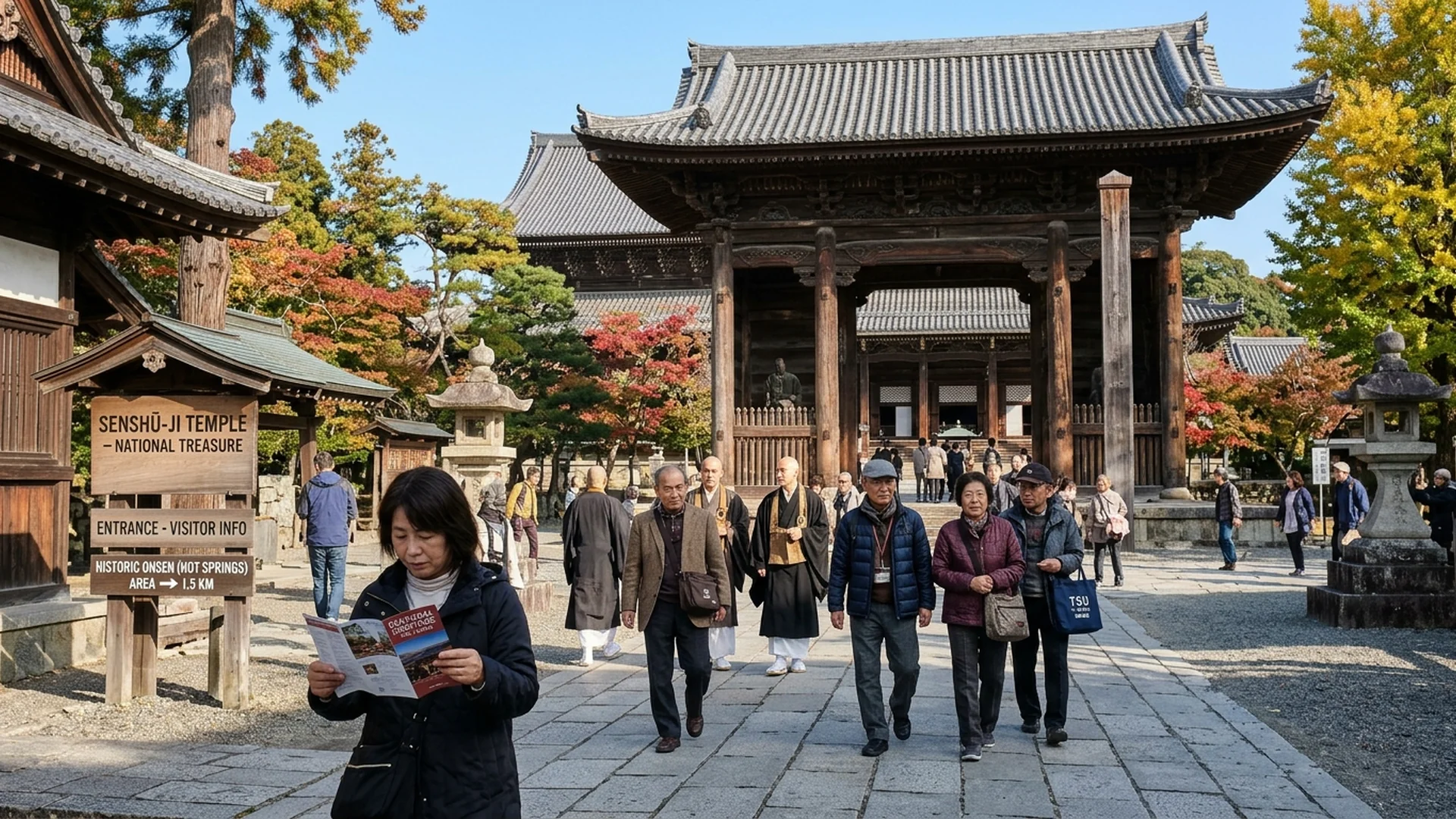
Amidst the rushing currents of mass tourism toward predictable destinations, a quiet coordinate in Mie Prefecture lingers in profound stillness, brimming with the living spirit of history. Tsu—a concise name that guards the grand secrets of Japan’s ancient past—is far more than a mere prefectural capital overlooked by travelers rushing onward to the Grand Shrine of Ise. Instead, it is a sanctum where discerning seekers of calm and profound aesthetics discover the true meaning of slow travel.
As morning mist drifts gently over primordial forests and the ancient warmth of natural mineral springs whispers tales of a thousand years past, Tsu welcomes the visitor with a graceful harmony of monumental national treasure timber architecture, exquisite seasonal foliage, and refined traditions of rest designed to gently wash away the quiet weariness of the modern world.
Tracing the Legend of Sakakibara Onsen: Waters of Purification and Velvet Skin
To speak of the ultimate indulgence in Mie Prefecture is to invoke Sakakibara Onsen, a sanctuary immortalized in classical Japanese literature such as the Tale of Genji as one of the realm’s sacred thermal springs endowed with miraculous skin-softening properties. In ancient times, this lush valley served as an essential resting place for nobles and pilgrims who bathed in its crystal waters to cleanse themselves of worldly impurities prior to paying homage at Ise Jingu. The first touch of these colorless, scentless waters brings an immediate sense of weightless ease, while the balanced natural minerals gently soothe tired muscles and nourish the body from within, all framed by traditional ryokans enveloped in ancient trees and the music of running streams.
The Monumental Timber Mastery of Senshu-ji Temple: A Sanctuary of Faith
At the heart of Tsu stands Takada Honzan Senshu-ji, the head temple of the Jodo Shinshu Takada school and a proud Japanese National Treasure. A sense of awe takes hold the moment one passes through the colossal Sanmon Gate into the expansive stone courtyards. The monumental wooden structures of the Mie-do and Hondo halls were raised by master artisans without the use of a single metal nail, their intricate joinery and soaring pillars standing as testament to unwavering spiritual devotion. When slanting afternoon sunlight filters through delicate wooden lattices onto polished tatami mats, accompanied by the faint, comforting fragrance of incense, the mind is naturally drawn into a state of profound stillness and contemplation.
Seasonal Aesthetics and the Pinnacle of Local Gastronomy
The natural landscape of Tsu transforms with subtle grace through the turning of the seasons. At Kazahaya no Sato, sprawling woodlands and gardens awaken in spring with the delicate fragrance of thousands of blossoming plum trees, while the monsoon season reimagines the landscape into a dreamscape of hundreds of thousands of hydrangeas blooming in shifting shades of azure and violet against lush emerald backdrops.
Culinarily, Tsu is a haven for epicureans devoted to authentic flavors. The local unadon features freshwater eel painstakingly grilled over binchotan charcoal until the skin achieves a delicate crispness while the flesh melts upon the palate, glazed in a closely guarded proprietary tare sauce. Complemented by the beloved local specialty of oversized, golden-fried Tsu Gyoza, every meal captures the rich bounty of Mie’s fertile earth and pristine coastal waters.