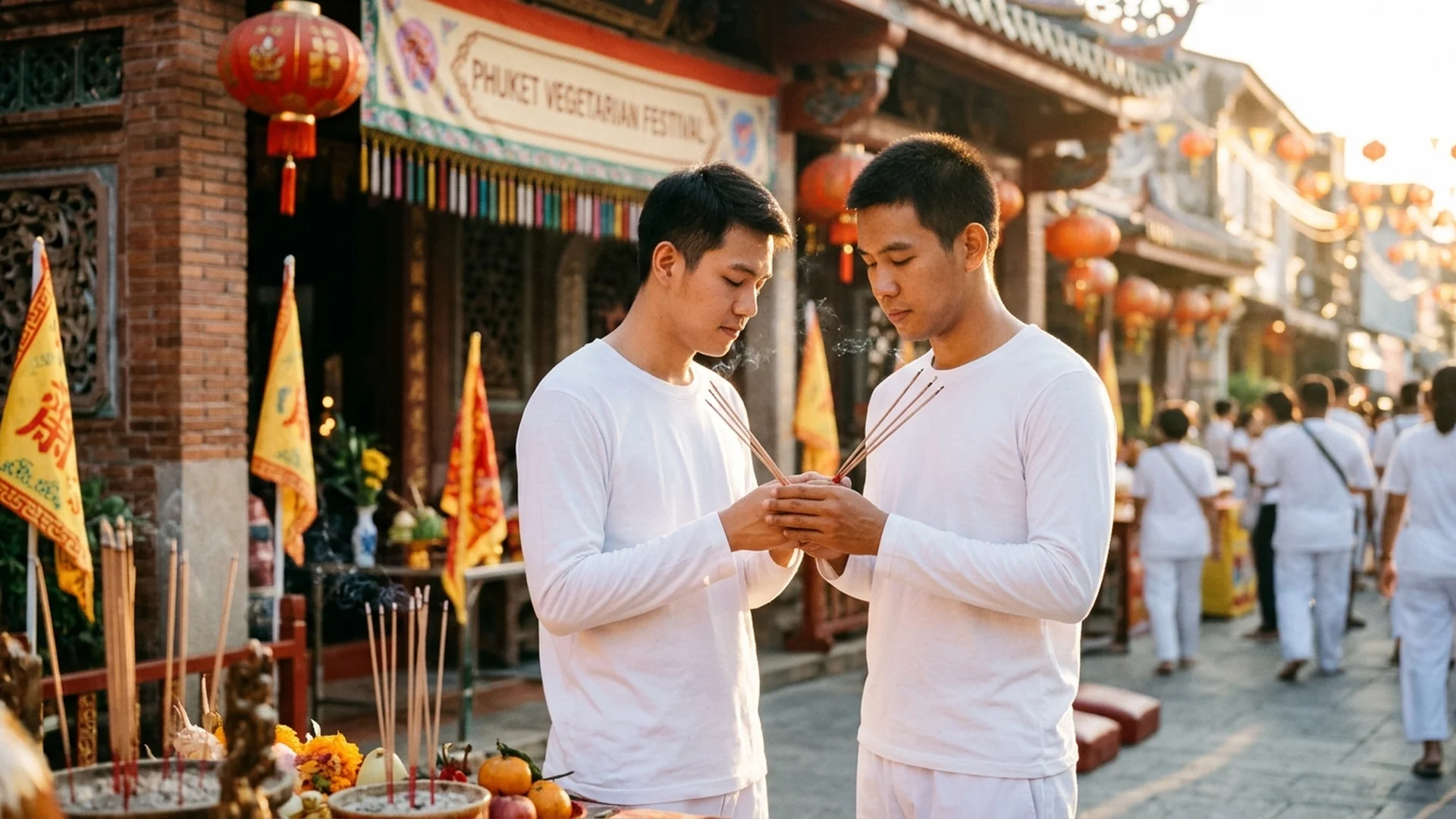
When the southwest monsoon softens beneath the ninth lunar moon, Phuket Old Town is gently enveloped in a sacred stillness. Vibrant yellow prayer flags snap against the Sino-European façades, while the heavy, comforting scent of sandalwood incense and burning joss paper drifts through the warm air. In the distance, the resonant pulse of bronze gongs and temple drums announces the commencement of the annual Vegetarian Festival, known locally among the Hokkien Chinese community as ‘Jiek Chai.’
Rooted in more than two centuries of history, this enduring tradition transcends mere dietary abstinence; it is a profound spiritual phenomenon inextricably linked to the island’s tin-mining era and Hokkien migration. The observance traces back to 1825, when a traveling opera troupe from southern China fell gravely ill with a mysterious plague while performing in Kathu. Turning to their ancient faith, the performers abstained from meat and prayed devoutly to the Nine Emperor Gods. Miraculously, the affliction vanished.
This pure devotion has been meticulously preserved, evolving into a cherished national intangible cultural heritage that fuses animist folk beliefs, magnificent shrine architecture, and distinctive Peranakan gastronomy. For the discerning cultural traveler, entering the world of Phuket’s Vegetarian Festival is an invitation to witness living spirituality and appreciate the enduring geometry of purity and faith.
Roots of Devotion: From Kathu Opera Troupe to Historic Shrines
The spiritual legacy of the Phuket Vegetarian Festival is deeply embedded in the island’s rich tin-mining history of the early 19th century. When Hokkien migrants crossed the treacherous seas to settle here, the Kathu district emerged as a bustling mining center. As legend records, an opera troupe visiting to entertain the miners was struck by a severe epidemic in 1825. The troupe leader urged members to abstain from meat, maintain pure thoughts, and invoke the ‘Kiu Ong Tai Te’ (Nine Emperor Gods) following ancestral customs from Fujian.
When the illness miraculously receded, local villagers embraced the faith with profound reverence. They invited the sacred flame to be permanently enshrined, giving birth to Kathu Shrine—the primordial cradle of Jiek Chai on Phuket. From Kathu, devotion radiated toward the island’s historic center, establishing vital sanctuaries such as Jui Tui Shrine, the largest and most frequented spiritual hub, alongside Bang Neow and Lhor Rong shrines. Each sacred structure stands as a testament to classic Chinese architecture, featuring intricately carved timber dragons, polished stone courtyards, and aged teak screens that whisper tales of prosperous overseas merchant families. Visiting these shrines during the festival is less about sightseeing and more about reading social history through living symbols.
Sacred Rites: The Mystical Geometry of Processions and Purifications
The festival unfolds according to precise Daoist astrological choreography. It commences on the first evening of the ninth lunar month with the Go Teng Pole Ritual, where a towering bamboo mast is erected in the shrine courtyard. Nine celestial lanterns are hoisted to the summit, signaling the descent of the deities and officially opening the sanctuary of purification.
The emotional peak of the public observations is the Iu Peng, or grand street procession. Over successive days, different shrines take turns carrying their revered deities through the historic streets in ornate sedan chairs, accompanied by temple musicians and celestial guards. The most striking and emotionally charged figures are the Ma Song—spirit mediums who pierce their cheeks and bodies with sacred implements. According to ancient cosmology, the physical suffering endured by the mediums absorbs and deflects misfortune away from the community. Residents kneel in pristine white garments along the roadside, setting up flower-adorned offering tables to receive blessings as the processions glide by.
Other profound rites include Goi Hoi (fire-walking) across glowing beds of coals to purge negative energies, and crossing the symbolic bridge of fate known as Goi Han. The festival culminates on the ninth night with the Song Phra send-off ceremony. Tens of thousands of devotees clad in white converge on Saphan Hin beach, setting off deafening strings of firecrackers to illuminate the return of the Nine Emperor Gods to the heavens, marking an intensely moving transition back to daily life.
Flavors of Purity: The Distinctive Gastronomy of Peranakan Plant-Based Cuisine
Beyond its metaphysical dimensions, the festival serves as a vibrant celebration of Phuket’s culinary heritage, manifesting as both bustling street food and refined heritage recipes. True to Hokkien traditions, festival fare centers on wholesome ingredients: handmade soybean tofu, wild mushrooms, and indigenous greens seasoned with artisanal soy sauces, strictly omitting pungent roots and alliums as mandated by spiritual dietary laws.
Essential dishes to discover include Mee Hoon Phad Je, delicate rice vermicelli wok-fried over high heat with soy and fragrant shallots, and Loh Ba Je, a plant-based adaptation of a classic pork offal dish utilizing crispy bean curd skin served with a tart tamarind dipping sauce. Diners will also encounter plant-based versions of southern Thai noodle curries alongside heirloom sweets like Apong Je and Tao Sor Je pastry.
While vibrant street stalls proliferate around Jui Tui and Ranong Road, contemporary dining establishments in Phuket Old Town have also begun reinterpreting these traditions. Modern culinary artists offer sophisticated Peranakan vegetarian tasting menus that honor ancient rules while presenting the refined flavors of the region through a contemporary lens.